Turkey

Selime Cathedral –The inspiration for the setting in Star Wars Episode 1

After hiking through a portion of the Ihlara Valley we hopped back in our car and stopped at a small store. A friendly Turkish gentleman spoke with us at the store, and when he found out we hadn’t gone to Selime Cathedral, he strongly urged us to do so—we’re so glad we did, I can’t believe we almost missed it! An added bonus was that the entry fee for Selime Cathedral is covered by the Ihlara Valley ticket (8 TL per person). (For a map of the general area click here.)
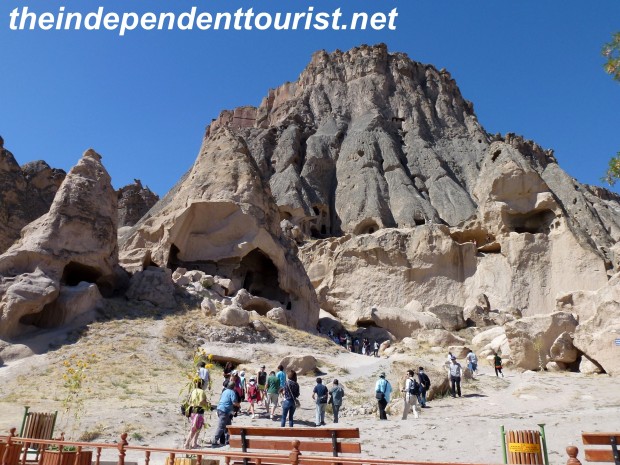
Hiking up the hill to Selime Cathedral (note the carved cave entrances everywhere).

Selime Cathedral along with numerous other rock-carved buildings sits at the northern end of the Ihlara Valley just across a highway. This area is “other worldly” and was the inspiration for part of the location set in Star Wars Episode 1, the location where Anakin Skywalker’s “pod race”  took place, if you saw that movie.

The landscape of Selime Cathedral area–hiking up.
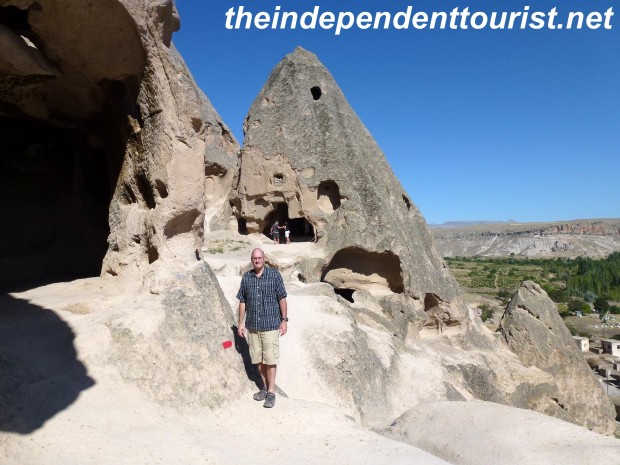
The exterior area on the hillside around Selime Cathedral.

Entrance to one of the churches at the Selime Cathedral site.
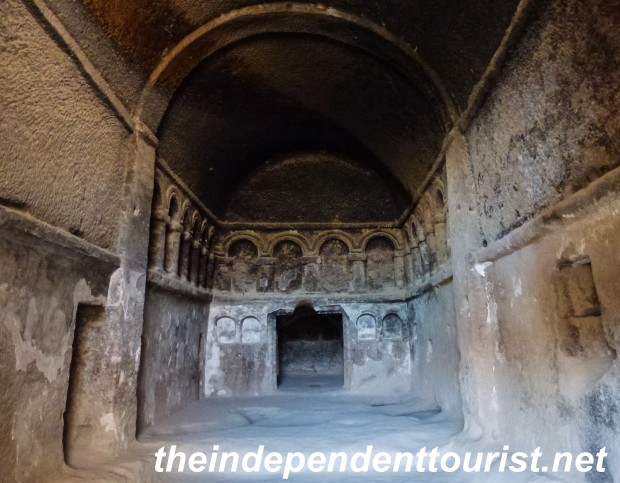
Interior of another church at the Selime Cathedral site.

This room has two levels, and walkways around the 2nd level.

Selime Cathedral does not look like a cathedral in the traditional sense. The main church is the largest of its kind (carved out of rock) in Cappadocia, and the site contains numerous other caves and rooms for the monks (living quarters, kitchens, chapels, etc.) in the side of a mountain. Most of the structures here are from the 13thcentury.
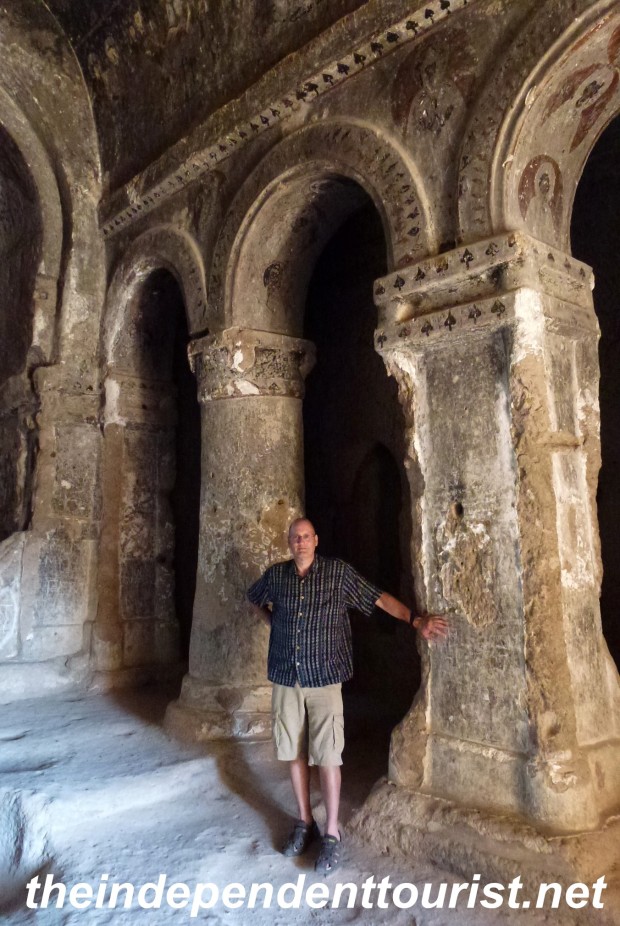
Interior of Selime Cathedral.
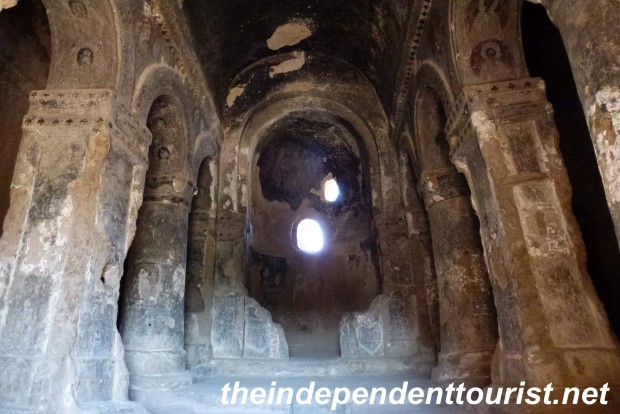
Another interior view of Selime Cathedral.
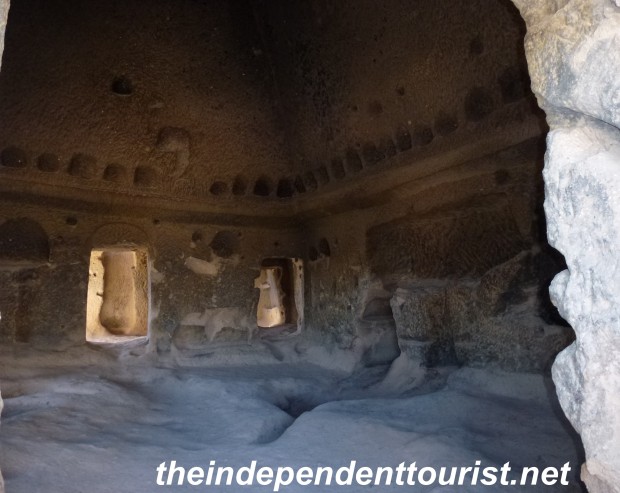
Possibly the Chapter House of Selime Cathedral.

Allow at least an hour to visit this site.  Hiking up to the caves does involve some scrambling along the narrow and steep rock trails.
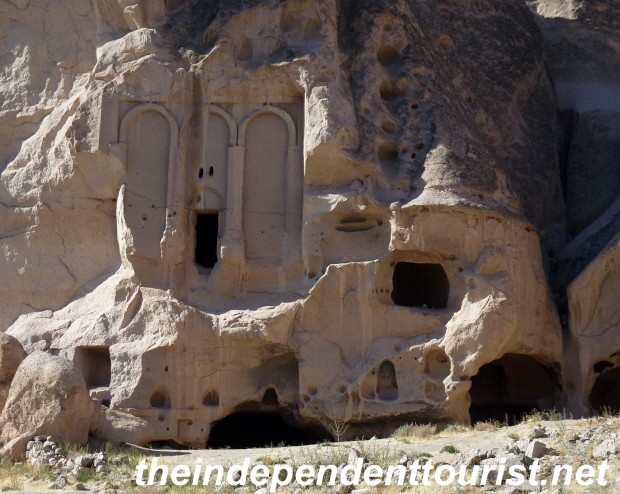
Another exterior view of the carved churches and other rooms.

Due to its easy access from the road, Selime Cathedral was far busier that the Ihlara Valley itself.

Derinkuyu Underground City—Living Below in Times of Peril

Our group at the entrance to Derinkuyu underground city.

About 35 km south of Göreme, Turkey is Derinkuyu, a small city with a fascinating history. At the southern end of town is the entrance to the 6th century underground city, which is the largest in this area. There are at least 130 more underground cities in Cappadocia, about 30 of which are open to the public. For a general map of the area, click here.

The low, narrow passageways in Derinkuyu–they must have had one-way traffic rules! Some of the passageways are quite long and steep.

These underground cities were built to provide protection for the Byzantine Christian villagers during raids by the Persians and Arabs in the 6th and 7thcenturies. Derinkuyu housed 10,000-20,000 people, plus all kinds of animals during periods of raids (up to 3-4 months at a time).  It has 8 levels, most of which can be visited. Features include air shafts, kitchens, a well, baptistery, church, confessional and rolling stone doors to seal off lower sections in case of invasion.

A rolling stone door to seal off portions of the underground city in case of a breach at the upper levels.

Although a little hard to tell, this is looking up through an air shaft over one hundred feet up – the little light spot in the lower center of the picture is the opening at ground level.

An intersection between levels of the underground city.

The confessional booth–the priest would go in the passageway on one side and the sinner on the other side to share his/her confession (the hall is connected but totally dark).

Baptismal font–the font is deep enough to stand in (notice the spout in the middle of the picture), meaning the Byzantines must have practiced baptism by immersion.

A meeting room – for the town council?

When you have 10,000 people living together for a few months in crowded conditions, some will not live to see daylight again. This photo is in the necropolis, reached down a long passageway separated from the living areas.

Going down into this carved-out city was fascinating; however I cannot imagine living down there for months as the Byzantines did with thousands of people on top of each other with animals, a graveyard, and all the associated issues of waste, water, fires, air, food, and just about everything we take for granted. Coming back up to the surface must have been a very joyous occasion!

The entry fee is 15 TL per person and parking was 2 TL per car (1.80 TL per 1 USD).  Allow about 2 hours for a visit to this fascinating site.

Ten Things That Make Turkey a Great Vacation Destination

We just returned from two weeks in Turkey and had a fabulous time. Our vacation was really three separate trips: Cappadocia, Southwest Mediterranean Coast, and Istanbul. Here are some things to know before you go.

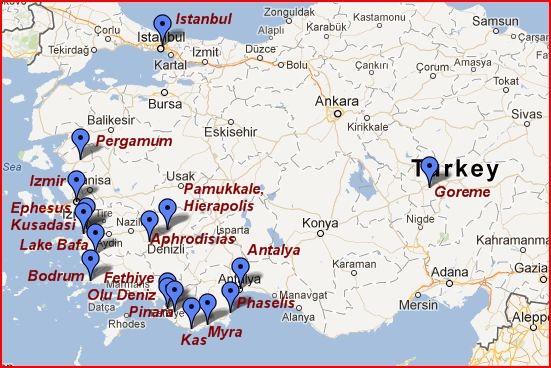
Our primary destinations in Turkey (two week trip). We flew to Kayseri (near Goreme), then to Antalya on the south coast and drove west around the coast up to Izmir. Then, flew from Izmir to Istanbul.

  1. So Much To Do. We could have stayed a week in each location we visited rather than a day or two. Between the natural scenery and historical sights, it would be easy to spend a week in one spot. In some cases we spent a couple nights, and in others just one night. Especially along the coast, with the multitude of beaches, possible boat trips and islands, there is a lot to see and do. I don’t’ regret our itinerary, I just wish I’d had a month instead of two weeks for this trip. It’s just a trade off as to how much ground you want to cover in one trip.

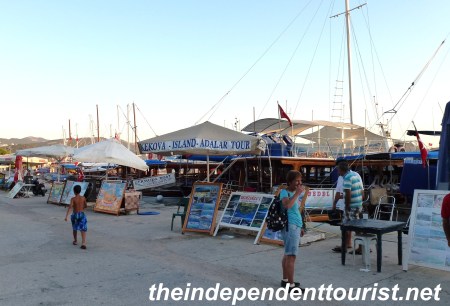
    The tour boat docks in Kas. The boats go to islands, coves, sunken ancient cities for half or full day trips.

  2. Amazingly Friendly People. The Turkish people were some of the most helpful and friendly people we have met anywhere. In Göreme (Cappadocia), we arrived very late at night via a car rental from Kayseri, and Google Maps failed us in finding our hotel. We met a couple gentlemen and they had us follow them to our hotel to make sure we knew where it was. In another location, people gave us fresh vegetables from their garden, as we stopped for gas and visited with them for a few minutes.

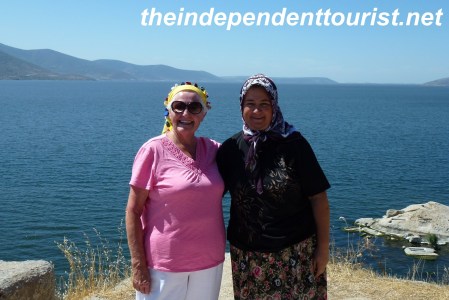
    Our friend in Herakleia with my mother-in-law showing us around the ruins (and selling nice scarves).

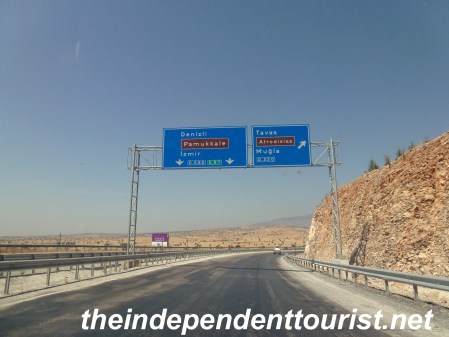
  3. Taking the Road Less Traveled. It’s easy to get around Turkey by rental car. Historical/tourist sights are well marked with brown signs (like many in the US). Roads and directions in general are well-marked. Many roads are being upgraded, so be prepared for some construction. I had heard stories about crazy Turkish driving habits, but didn’t find it much different than Italy, for example. Having your own transportation will allow you to visit many sights before or after the crowds. We had the Library of Celsus (Ephesus) pretty much to ourselves in the late afternoon. Gasoline and diesel are expensive, however, around $10 US/gallon. While there aren’t many toll roads, don’t get on them without first getting a toll card available from gas stations. I learned the hard way, paying a $25 US fine for a $1 toll.

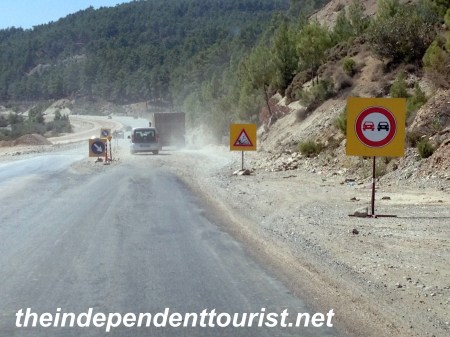
    Typical road construction in Turkey

    Road signs in Turkey – easy to follow, and sights were well-marked.

  4. Blow Your Socks Off Scenery. How about mountains, pine trees, picnic areas and Roman ruins all nestled around three perfect bays with turquoise clear water and perfect for swimming? Phaselis Beach and ruins (about 60 km west of Antalya) was one example of the incredibly scenic Turkish coast.

    One of the scenic bays at Phaselis.

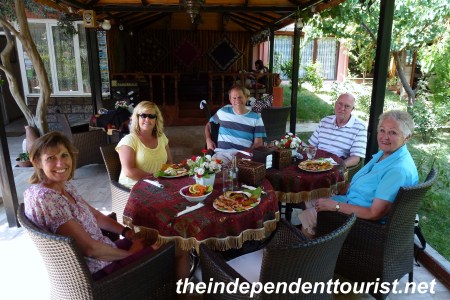
  5. Excellent Food and Restaurants. The Turks love grilled meats and fish dishes. In addition to good Turkish cuisine, we ate some excellent Indian dishes and pastas. We found restaurants open from about 11 am throughout the day, making eating whenever you want very easy. Salads were fresh and most dishes were served as an art form.

    Another gourmet meal in Pamukkale.

  6. Accommodation Options.  Our accommodations averaged about $75 US per night for two people for decent rooms. Breakfast was included everywhere, no additional charge. Most locations had beautiful terraces where one could enjoy breakfast or dinner taking in the beautiful  scenery.

    The view from our hotel in Kas on the south coast of Turkey (the island in the left side of the picture is part of Greece).

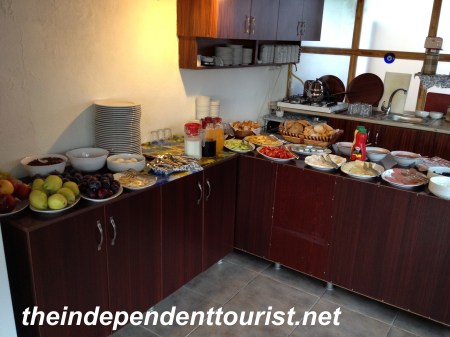
    Typical breakfast spread–fruits, tomatoes, olives, cucumbers, cheese, breads, some sliced meats, hard boiled eggs, and chocolate cold cereal – not sure why chocolate is so popular!

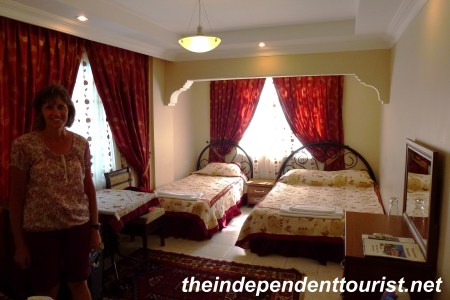
    Our comfortable room at the Venus hotel in Pamukkale.

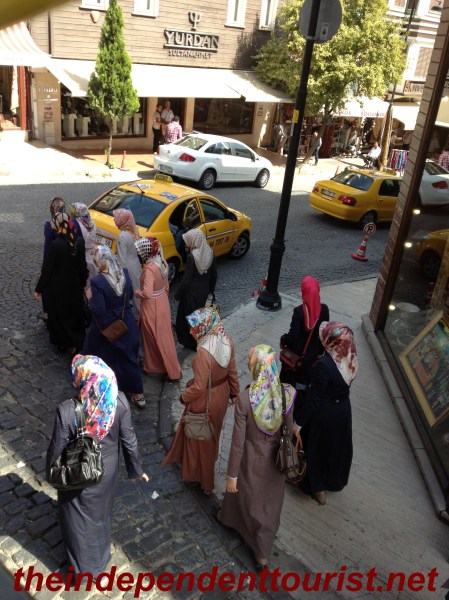
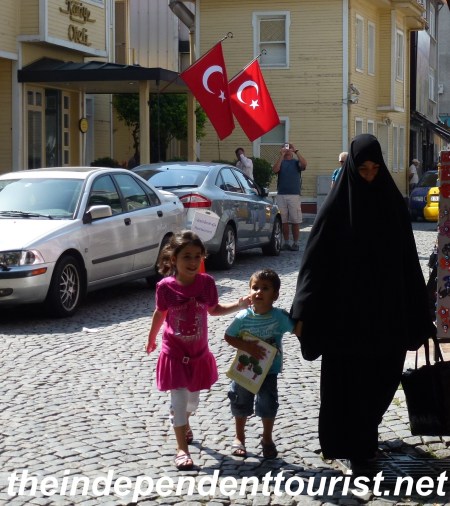
  7. Religious Tolerance & Moderation.  We often get asked “is it safe?” Short answer:  Yes! While Islam is the predominant religion (be prepared to get woken up every morning a 5 am for the call to prayer), the people are very tolerant of other religions. One sees a variety of dress on the streets—from very conservative Muslim dress to very Western styles.

    A popular style in Turkey–head scarves and long trench coats–even in 80 degree F weather!

    A woman in more traditional Islamic dress.

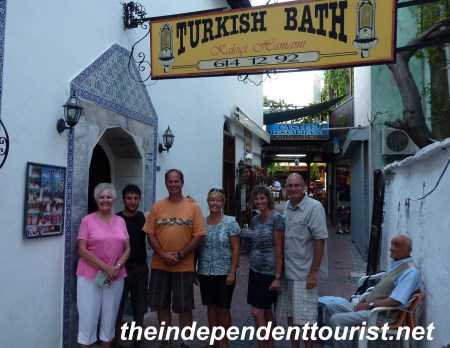
  8. A Turkish Bath.  We got our first (and only) Turkish Bath experience in Kuşadasi. It was a mixed bath (men and women), and pretty modest. It is a multi-part process—sauna, exfoliation, soaping and rinse. Some baths have separate facilities for men and women. The person doing the scrubbing works you over pretty hard—be prepared for some bruises as they work the muscles! It was a fun experience.

    A Turkish Bath house in Kusadasi.

  9. A Balloon Ride in Cappadocia. I’m thinking that most other balloon rides would be boring now. Our balloon ride over the unique Cappadocian landscape was a never-to-be forgotten experience. I will say more about this adventure in a separate post. Save your pennies, the ride is not cheap, about $130-150 US/per person.

    The stunning landscape of Goreme, Cappadocia seen from our balloon.

  10. Awesome Weather. We visited in September. Every day was perfect—sunny and clear. While the Mediterranean coast was warm (mid-upper 80’s F) the humidity was low, and the water was perfect for swimming. We read in our travel books about mosquitoes and were prepared with repellant but didn’t notice any mosquitoes (and few bugs of any kind).

Also, Turkey is not a cheap country, many prices are stated in Euros, especially in Istanbul. There are entry fees at almost every historical and tourist site and those add up over time. It would be great if the Turkish government created some sort of membership pass for the historical locations for tourists, since they have a pass for nationals. Please note that there is a pass available (“Museum Pass”, good for 72 hours once activated) in Istanbul that covers the Hagia Sophia, Topkapi Palace and Harem, Chora Church, and two museums. In addition to saving a little money, it allows you to bypass the ticket and entry lines and go right into the site. There is a booth to purchase the pass right next to the Hagia Sophia, it costs 72 TL (1.8 TL = 1 USD).