Sights near Antalya

Phaselis – Where Antiquity and the Blue Mediterranean Meet

One of my favorite stops in Turkey was the quiet beach park and historic site of Phaselis, which is 58 kilometers west of Antalya. Can you imagine anything better than relaxing on the beach of your choice in one of three small bays, each overlooking the calm, clear, blue water–surrounded by pine trees, with Roman ruins right behind you? I can’t! It is a picture-perfect setting. For a map of this location, click here.

A perfect setting - one of the three bays at Phaselis.

A perfect setting – one of the three bays at Phaselis.

Some of the ruins are right next to the water!

Some of the ruins are right next to the water!

History of Phaselis

Phaselis has a long history, having been founded in the 7th century BC and belonging to many kingdoms over the years. It was a strategic location, with a great harbor. Phaselis was a major trading partner with Syria, Greece, Egypt and other Mediterranean countries. Its main exports were timber, lilium (lily) oil and roses. It was a prosperous community that didn’t worry too much about its overseers.  Alexander the Great came through in 333 BC and the city decided that rather than fight him, they would welcome him outside the city gates with a golden crown–a smart move. Alexander spent time here peacefully before moving on.

The Roman Theater at Phaselis.
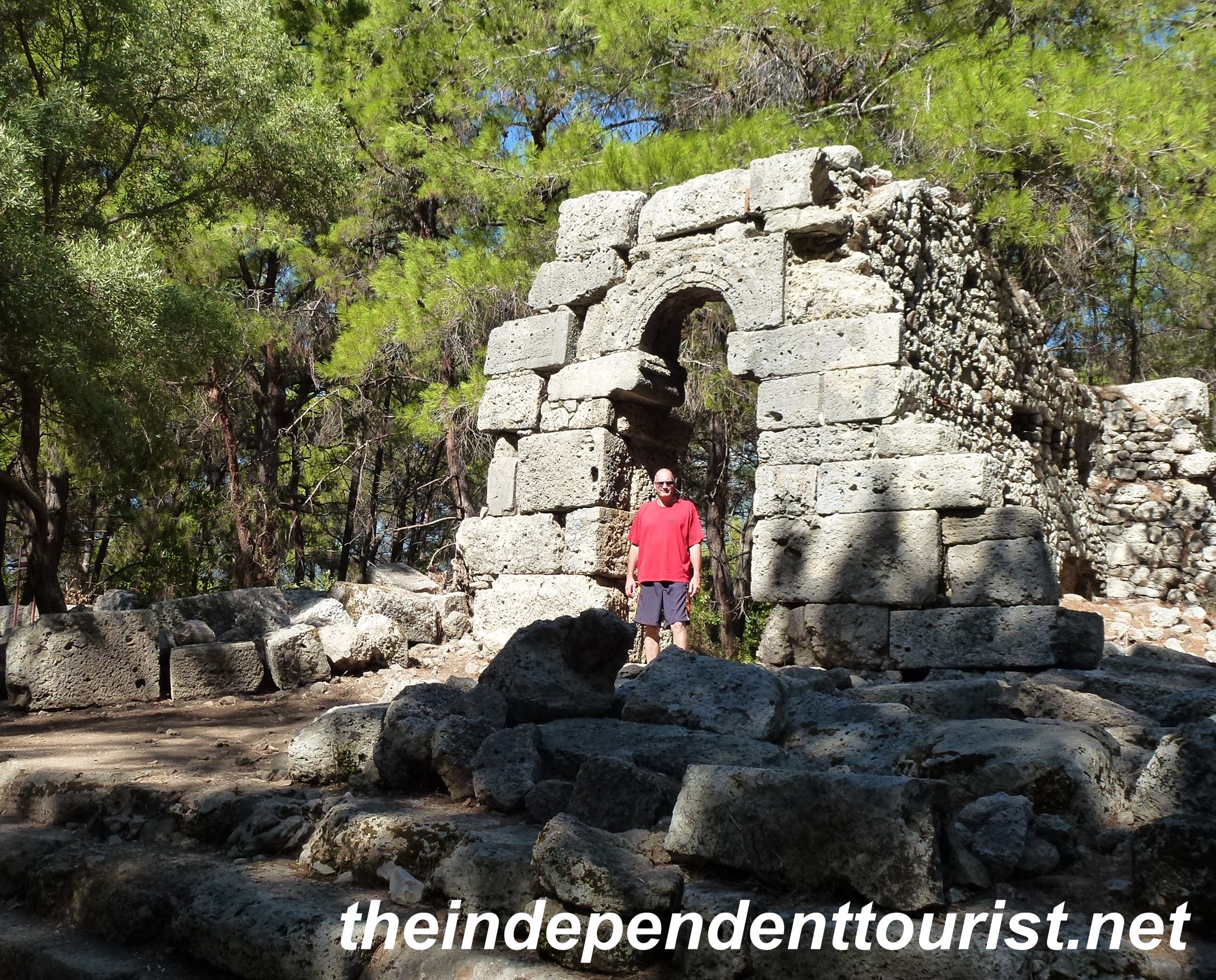
The Roman Theater at Phaselis.

In the agora at Phaselis.

In the agora at Phaselis.

The main street in Phaselis, heading down to the largest bay and harbor.

The main street in Phaselis, heading down to the largest bay and harbor.

Phaselis became part of the Roman Empire in 43 BC and enjoyed 300 years of peace and prosperity. After a brief decline, the city experienced a renaissance of sorts in the 8th century and continued on until it was abandoned during the collapse of the Byzantine Empire  in the 13th century. Much of what we see today are the Roman and Byzantine-era ruins.

Practical Information

Phaselis is a park, with picnic tables, nice restrooms (with showers) and a few small snack stands. The entrance fee was 8 TL per person (1.8 Turkish Lira to the USD). The best way to reach Phaselis is by car from Antalya, either as a day trip or, (as we did) as a stop on the way to Kaş. Day-trip boats from Antalya also bring tourists to spend the day snorkeling and swimming.  The area is big enough that even with a few tourist boats it does not feel crowded—in fact we had the middle bay pretty much to ourselves.

The largest bay at Phaselis with a few boats.

The largest bay at Phaselis with a few boats.

Reference: Information sign-posted in park.
Termessos – A City That Defied Alexander the Great

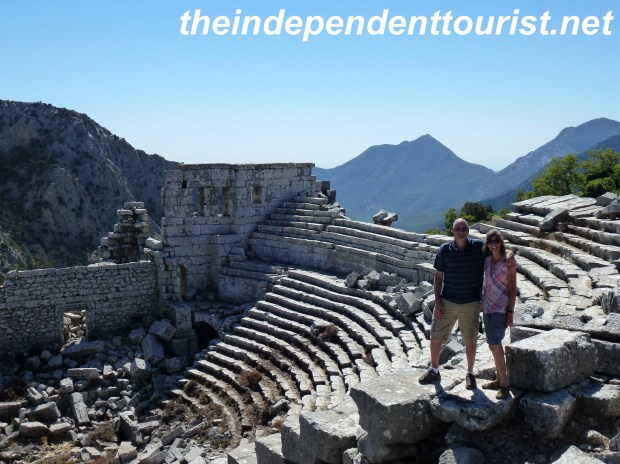
A view of the theater at Termessos.

A view of the theater at Termessos.

A visit to the ancient city of Termessos is a great half-day trip from Antalya, Turkey.  We visited Termessos in the morning and then took a refreshing dip in the Mediterranean Sea at the Konyaalti Beach Park near Antalya in the afternoon. The ruins are about 35 km inland and sits in a narrow and high mountain valley—the road up to the site is good, although winding and somewhat steep. Anciently, this region was known as Pisidia, and due to the fierceness of the people and its strategic defensive location, Alexander could not conquer Termessos (in 333 BC). The Romans who came later chose an alliance with Termessos rather than risk war in 70 BC.

Part of the gymnasium ruins at Termessos.

Part of the gymnasium ruins at Termessos.

The ruins include a large theater in a dramatic setting, an agora, temples, tombs, a gymnasium, necropolis and remnants of houses.

The Tomb of Alcetas - note the figure on the horse above my shoulder.

The Tomb of Alcetas – note the carved figure on the horse above my shoulder.

A dramatic backdrop for the theater at Termessos, which held 4,000 people.

A dramatic backdrop for the Termessos theater, which held 4,000 people.

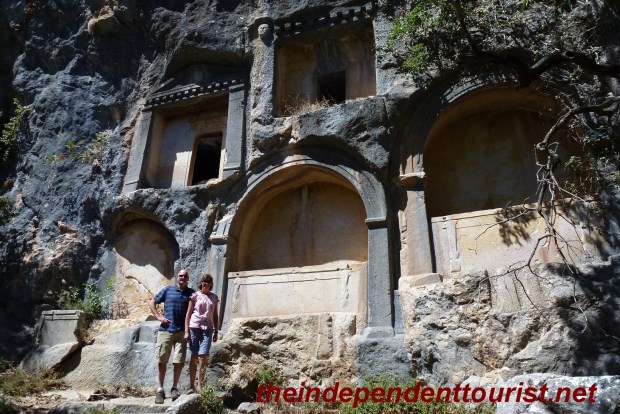
Some of the rock-carved tombs at Termessos.

Some of the rock-carved tombs at Termessos.

Practical Information

There are some interpretive signs at the site and also a small map available at the entrance. The ruins are inside the large Termessos National Park, which is known for its abundance of wildlife. At the entrance to the park is a restaurant and small botanical museum.  From the entrance, a 9 km paved road takes you up to the parking area at the base of the ruins. You will see ruins of some buildings and the massive walls on the road up to the site, giving a feel as to how large this city was.

There are toilets at the ruins but no water or snacks, so bring these items with you. It is a bit of a hike from the parking lot up to the main site, which is large, and mostly hidden from view from the base. The trails are fairly steep, so be prepared with good hiking shoes.  I suggest a loop route, going from the parking lot up to the left of the Artemis-Hadrian Temple (as recognized by the large doorway arch) and returning on the trail to the right (or behind the Artemis-Hadrian Temple). This return trail passes a number of interesting tombs in the rock hillside (see picture above).

The Temple of Artemis-Hadrian near the parking area. The trail behind this temple goes up to some tombs.

The Temple of Artemis-Hadrian near the parking area. The trail behind this temple goes up to some tombs.

Due to the climb from sea level, Termessos is definitely cooler than Antalya and was very comfortable in September. The entry fee was 5 TL per person (1.8 Turkish Lira (TL) to 1 USD in 2012).

Konyaalti Beach Park. On your way back to Antalya, stop at this great beach. There was a 4 TL parking fee, but the beach is free. The water and beach were very clean.

Konyaalti Beach - a great way to spend the afternoon after hiking around Termessos.

Konyaalti Beach – a great way to spend the afternoon after hiking around Termessos.