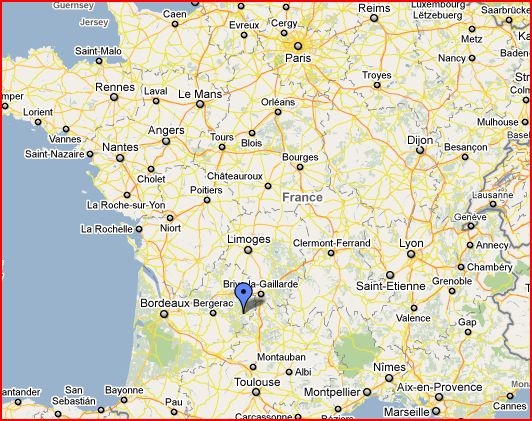
France

Dordogne, France Part 3: Commarque Castle (Chateâu de Commarque)

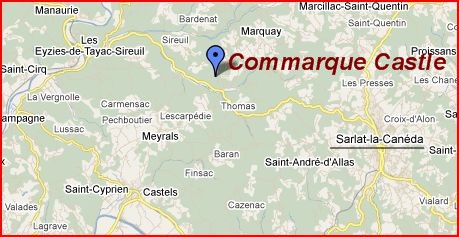
Commarque Castle Map

Commarque Castle is 15 km NW of Sarlat.

Commarque Castle is slightly off the beaten path , near Les Eyzies-de-Tayac-Sireuil.  I wouldn’t have even known about it had I not received a large picture book of France as a gift, which had a picture of the castle at sunset. It is not listed in the guidebooks I have on France, probably because it isn’t accessible without a car.  We drove to the Castle from Sarlat, which is only 15 kilometers away.  From the parking lot it’s another 600 meter walk to the castle on a trail through the forest.

Commarque Castle France (2)

Commarque Castle and Beune Valley.

Commarque Castle France

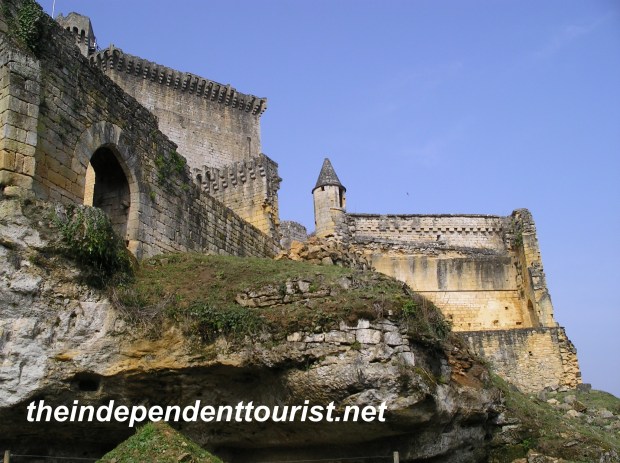
Village ruins, Commarque Castle.

As the view of the Valley of the Beune opens up, it’s a beautiful sight.  On the left hillside sits the castle and the village ruins, on the right side of the valley are niches carved in the rock wall, probably used as storage or possibly dwellings 700 years ago?  In the distance, nearly straight ahead, is another small castle, privately owned by an English person.  The Dordogne is a favorite spot of the English, and many have bought residences in the area.

Commarque Castle France (7)

Commarque church ruins and private castle in background.

The castle’s early history is a bit uncertain.  It’s believed to have been founded in the 12th century, and to have been rebuilt in stone in the 14th century, with later additions continuing until the 18th century, when the castle and village appear to have been totally abandoned.  The English captured it during the Hundred Years’ War (1350’s – 1450’s) for several years.  This location was strategic—near the crossing of two main roads in medieval France and the site of a spring—essential for the village and castle life. Check out the castle’s website, http://www.commarque.com/htmfr/infos.php for more information.

Commarque Castle France (4)

Cave dwellings underneath Commarque Castle.

Commarque Castle is interesting for a several reasons.  First, it’s a quiet and peaceful setting in a secluded valley—we were there early in the morning, and had the castle to ourselves.  The sun was out, and the dew was just drying off the grass, with birds chirping and the sounds of a babbling brook nearby.  Second, there are several other buildings which made up the 13thcentury village that have been excavated fairly recently (1980’s), and add to the wonder of the site. Third, in the cliff directly underneath the castle there are living quarters carved out of the rock which can be visited.  Some of these dwellings are prehistoric, part of many which dot the Dordogne region. Fourth, it is possible to climb to the top of the castle keep (or donjon in French) for a great view of the village, and the private castle across the valley.

Commarque Castle France (9)

View of Commarque Castle donjon (tower keep).

If you love castles and sites that are less visited, take the drive out to Commarque, you won’t be disappointed.

Visiting France – An Overview

France

France-the largest country in Western Europe.

France is the birthplace of medieval Gothic architecture. Soaring cathedrals with priceless intricate stained glass windows (such as Chartres Cathedral) dot the country and take you back in time. The island fortress of Mont-St-Michel, exudes an incredible medieval feeling as one winds up the narrow alley through the village to the entrance to the monastery and moss-covered stone walls from centuries of damp sea air. In the beautiful Loire Valley, one finds the grand chateaux of the fifteenth and sixteenth centuries, which became a symbol of the excesses of the royal families, and led to the French Revolution in the late 1700’s. The Dordogne Valley offers the melding of the natural landscape and ancient architecture, such as the holy pilgrimage site of Rocamadour and other villages built right into the rock cliffs. Some of the best-preserved Roman ruins in Western Europe are not in Italy, but rather France (such as the Pont Du Gard aqueduct). It has some of the best prehistoric paintings (Lascaux Caves), and, if these sights weren’t enough, there’s also beauty in the natural landscapes— widely varied from green, fertile lowlands of Brittany in the northwest to the rocky “Massif Central” in the south center and soaring peaks of the French Alps in the southeast.

Le Man Cathedral 2_France

The Gothic flying buttresses of Cathédrale St.Julien, Le Mans.

Shown here are a few pictures of some less-visited sites (and one very overcrowded site!)

Blois Chateau France

Blois Chateau, in the heart of the city of Blois.

Puy-L'Eveque (2)

A view of the town from the Lot River.

When asked, many people might say, “oh yes, I’ve visited France” but in reality they’ve seen a few of the sights in Paris and that is about it. It’s like someone visiting New York City, and saying they’ve seen the U.S. France is a special part of Europe to me. I can’t say enough about the incredible array of sights that France has to offer tourists.

Eiffel Tower 1

Eiffel Tower near Seine River, Paris.

 Traveling by Car in France

We love to rent a car when we are in France, which allows us to meander on quiet country roads and visit pristine medieval villages where very few tourists venture.

Keep in mind that many of the main highways in France are “peage” or toll roads. Make sure you have a couple different credit cards that work in Europe, since I have found that some tolls booths accept one card (like a Visa) and another booth may accept another card (like American Express). Cash is also accepted at staffed toll booths. Even with the tolls, renting a car when traveling with 2-4 people is very economical. Get a diesel fuel car if you can, since the mileage tends to be much better. Cars with automatic transmissions are less common, more expensive to rent, and are less fuel efficient. Via Michelin is a great website for calculating distance (in kilometers), as well as cost for fuel and tolls between different cities in Europe.

Take some time to familiarize yourself with the European road signs prior to driving, and when on major highways, do not linger in the left lane, it is for passing only. When coming into a town, usually the key sights are in the center of town, so follow the signs to “Centre” and then look for the big blue “P” signs which indicate parking garages or lots.

Accommodations in France

For the traveler who wants an economical European trip, France can be a great place to go, especially if visiting off-season, and if you are ok with modular, generic and basic hotel rooms. France is the home of many inexpensive roadside hotel chains such as Formule 1 (typically shared bathroom), Etap (private bath), and Ibis (all part of the Accor Group). B&B Hotels are similar to Etap, and offer very basic rooms (a double bed usually with a 3rd single bed).  Another option is Hôtel Première Classe, which is even more basic (no carpet), with a tiny bathroom (smaller than most cruise ships!) and double bed with a 3rd single bed. All of these hotels are popular with Europeans on road trips. Many of these rooms are 30-40 Euros per night for 1-3 persons, and they are ubiquitous, usually just outside the towns on an intersection (roundabout) located near roadside restaurants or light industrial buildings. These are not quaint accommodations, but they are functional, cheap and plentiful. They have 24 hour automated check-in, and usually a very limited breakfast service for an additional fee. Most have wireless internet service too. Some of these hotels (such as Ibis and Etap) are also near train stations.

Restaurants in France

In the off season, trying to find restaurants open at convenient times is sometimes a challenge. We found that restaurants often close early (before 5 pm) during the winter or do not open until later (after 8 pm), if at all. Europeans generally eat later than we do in the U.S., but choices seem to be more limited in October-March. A good idea is to eat your main meal before 2 pm, or whenever you find a place open.

Language Considerations

As with any country, but especially in France, learning a few words is very helpful.  The French are not particularly fond of speaking English. Knowing a few words helps tremendously in navigating by car, asking a price, ordering off a menu, and seeking directions. I find French pronunciation somewhat challenging, but the effort will be appreciated. My family and I played a game as we traveled in France, thinking of all the English words that are French in origin—it was fun to see how many words we kept thinking of! The history of France and England are so closely interwoven it’s not surprising that so much of our vocabulary comes from France.

In future posts on France, we will explore various regions of this magnificent country.
Dordogne, France Part 1: Rocamadour

Rocamadour

Rocamadour is in south-central France

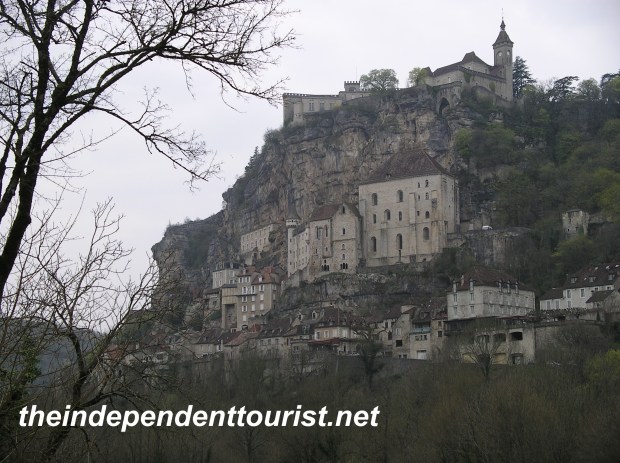
The Dordogne region and in particular the village of Rocamadour should be on everyone’s must-visit list in France. We have been to Rocamadour twice, and both times I was impressed how stunning the setting is—an almost vertical village nestled into a rock face on the side of the gorge of Alzou. The Dordogne region is full of many river gorges and rock cliffs with homes and villages built into the rock. In many cases, the cliffs provide a natural rear wall for the buildings.

Rocamadour France

Rocamadour (the Château is at top of cliff, the Basilica is the large building below the Château)

The village gets its name from St. Amadour, his body was said to have been found in an ancient niche (located in the Church square described below) in an undecayed state, and many miracles, mainly healings (at least 126) followed. Rocamadour became a very popular pilgrimage site in the 1100’s based on these miracles. During the Middle Ages, pilgrimage sites existed throughout Europe. These sites were typically associated with Christian relics and miracles. The rich and the poor would travel long distances to these sites to worship, be healed and forgiven. Kings and Lords of both England and France have travelled to Rocamadour. The village was occupied by the English in 1369 during the Hundred Years war.

The only convenient way to visit the Rocamadour is with a car.  There is a tourist information office at the top of the cliff, on the main road just across from the Château and also in the town itself.

Rocamadour France (3)

Main Street of Rocamadour

Rocamadour is a one (pedestrian) street town, with gates at either end, and parking is found either outside the Port du Figuier (east gate-very small parking lot), or below the village at the bottom of the gorge. Be prepared for lots of steps up to the town, and then up many more to visit the many chapels and Basilica of St. Sauveur (11th-13th centuries).

Rocamadour France (4)

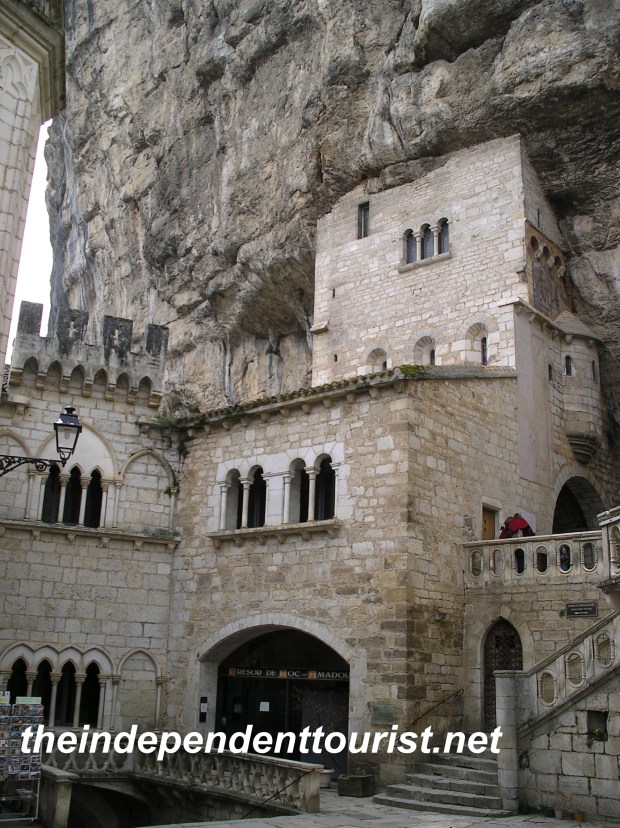
Church Square nestled against the rock cliff face.

The seven chapels are built around the church square (which used to be a burial site), nestled underneath the rock cliff, at the top of the Grand Stairway. The Grand Stairway (Grand Escalier-216 steps), leads from the pedestrian street up to the center of the various chapels, including the Basilica.  Pilgrims for hundreds of years, and even today, climb the Grand Stairway on their knees in penance, sometimes carrying chains symbolizing their sins. Several of the chapels have been rebuilt.  It is worth spending a little time just enjoying the church square at the top of the Stairway. The medieval chapels on different levels in this compact area and the rock overhang give this place a very unique feeling, one is transported back in time, thinking about this area being filled with pilgrims.

Rocamadour France (6)

St. Michel’s Chapel and Church Square

The three chapels which are mostly original and the most interesting to visit are:  The Basilica (including the crypt), The Notre Dame chapel, and St. Michel’s chapel. All three of these buildings are built right into the cliff, with the sides of the chapels being cemented into the cliff, and the rock face forming the back wall and part of the ceiling in each chapel.  The niche where St. Amadour’s body was found is between the Notre Dame and St. Michel’s chapels.  Also, look carefully for the faded fresco near the door of the Notre Dame chapel.

Rocamadour France (5)

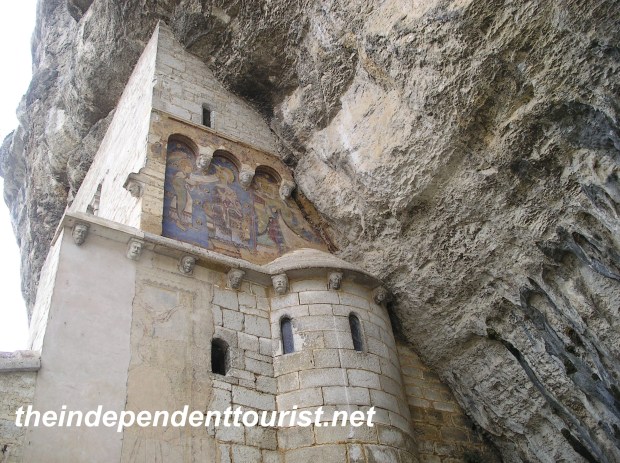
Frescoes high on St. Michel’s Chapel.

St. Michel’s Chapel, has remained almost completely intact since the 12th century.  It contains some excellent 12th century frescoes on the outside above the door (near the rock cliff) and inside the chapel as well. When we visited in November of 2003, this chapel was closed. When we visited in March of 2009, the chapel was open.   Rather than walking back down the Grand Stairway, take the narrow passage way through the Basilica and walk down the trail past the carved out rooms with the Stations of the Cross, which is interesting also.

Above the village at the top of the cliff, is Château de Rocamadour.  The interior is off limits to tourists, but we did buy tickets that allowed us to walk on its ramparts right above the village overlooking the gorge.

On our first visit to Rocamadour, we stayed in the village of Gramat, just a few kilometers from away, since in November there were no accommodations open in the town.

Dordogne, France Part 2: Beynac Castle (Château de Beynac)

I recall the tingling sensation I got when I saw Beynac Castle, as I looked up from the Dordogne River Valley high on the cliff above the river. To be in the Dordogne region, center of the Hundred Year’s war between France and England was for me surreal.

Location of Beynac, France

Beynac is in south-central France

A short drive from the river takes one up to Beynac Village, which seems frozen in time. There is a small parking lot 50 yards from the village. Beynac Castle (13th century) is well preserved and commands a far-ranging view east and west along the Dordogne River.

Beynac Castle France (2)

View of Beynac Castle from Dordogne River Valley

In the distance to the south, the former English stronghold of Castlenaud (Château de Castlenaud) can be seen.  We had the fortune of excellent weather in March 2009, giving us great views of the valley and also straight down to the Dordogne River from the Castle ramparts (don’t fall over!). The castle has been restored beautifully–the Great Hall contains some very large tapestries, and near the entrance is a restored workers kitchen, with many tools and cutlery of the day displayed.

Beynac Castle France (5)

Beynac Castle-East Side

The setting, size and beauty of Beynac Castle makes it one of my favorite in Europe. I’m surprised that most tour and guide books barely mention it, if at all.

The drive from Périgueux via Sarlat to Beynac is enchanting. As one drives south, small villages nestled against the cliffs, right off the sides of the road appear in greater frequency.

Cazelle Grottos Dordogne France (2)

Cazelle Grottos

On our way to Sarlat, we stopped at a bit of a tourist trap, Les Grottes du Roc de Cazelle, where we took a walk through the woods and cliffs to take a trip through time, learning about the prehistoric people who lived in this region (who gave us the great artwork of Lascaux caves), farm life in medieval times in this region and more recently in the 1800’s. We learned how people used the caves and cliff overhangs as shelter.  While some of the displays are tacky, the explanation of how villages were supported hanging off the cliffs (by holes being drilled into the cliffs for beams) was quite interesting.

Cazelle Grottos Dordogne France (3)

Settler’s Residence in cliffs