Sicily

A Few Historic Sites in Cagliari You Must Visit

Located at the south end of Sardinia the city of Cagliari is the island’s capital, main city and port. Its population is roughly 150,000. Some cruise lines do make a port call at Cagliari. My recommendation would be to give the city itself 1-2 days and spend the rest of your time in Sardinia elsewhere because there is so much to see on this lovely island, one of Italy’s many treasures.

Unfortunately we didn’t get to do a lot of sightseeing in Cagliari; I had eight hours of business webinars to facilitate from my hotel room which took a chunk of the two days we had planned for our visit here. In spite of my work commitments, we still were able to get out and see a few things in Cagliari.

Cripta Santa Restituta

This church doesn’t look like much until you enter the crypt, and then you realize what a historical gem it is. The crypt is a natural limestone cavern that has a history dating back about 3,500 years to an era of pagan worship. The crypt is named for Restituta, a martyr who made cavern her home in the 5th century. You can see a few faded frescoes from the 13th century and World War II – era graffiti when local residents used the crypt as an air-raid shelter. This crypt was definitely a highlight of our time in Cagliari.

View of the Church above the Cripta Santa Restituta.

Thirteenth century fresco of John the Baptist in Cripta Santa Restituta.

Tuvixeddu Necropolis

If you’d like to see something a bit off the tourist radar, check out Tuvixeddu Necropolis. It is on the edge of the older part of Cagliari and does not seem to get many visitors. There is no fee to visit, and the walking paths are used by locals taking their dogs for a walk. For some reason, the informational placards have been allowed to fade and are hard to read. I understand you can get a tour guide to assist you with your visit and that could be very helpful. There are about 1,000 tombs here, originally developed in the 6th to 3rd centuries BC by the Carthaginians and then reused in Roman times. These tombs were also used as air-raid shelters in WWII. The necropolis is definitely worth a visit! A few images below.

This image shows how deep some of the rock tombs are – I’m guessing this one is about 15 feet deep, over twice my height. Other are deeper. I would love to explore these, but it’s clear the local authorities don’t want you doing that from the signs and access barriers.

Bastione San Remy

This 19th-century structure is one of Cagliari’s iconic locations. From the terrace, you are rewarded with a sweeping view of Cagliari and the shoreline. There are a number of restaurants below Bastione San Remy, this is a good area to wander in the evening as the sun sets.

View of Cagliari from the Bastione San Remy.
View of Bastione San Remi from the street level.
The terrace archway at Bastione San Remi.

Il Castello

This is Cagliari’s hilltop citadel, surrounded by huge walls with several towers and gates. The interior of the citadel seemed pretty quiet – there is a university here and cathedral and some small squares, but not many tourists!

The massive walls of the Il Castello, Cagliari.

Other Views of Cagliari

This is about the only view I could get of the Roman amphitheater in Cagliari, which dates from the 2nd century AD. Unfortunately, it was closed during the time of our visit for restoration work. The amphitheater is just outside the Il Castello.

I would have also liked to visit Poetto Beach – just to the south of Cagliari’s old town. It looks lovely. However, we had visited many other beaches in Sardinia so we decided to prioritize our time to see the city’s other sights.

Hotel

We stayed at the Palazzo Tirso hotel in Cagliari, a beautiful hotel right on the waterfront and close to everything we visited above. The service was excellent and the room was very comfortable. I wanted to ensure I had good internet capability and I needed an early check-in, so we chose this hotel. Definitely recommended!

The pool and lounge area on the rooftop of the Palazzo Tirso Hotel.

Outside Cagliari

There are several other interesting sights not too far from Cagliari that could make nice day-trips, including the ancient Su Nuraxi di Barumini (which you can read more about here). Also, the Roman settlement of Nora (west of Cagliari) is definitely worth visiting and the fantastic resort area of Villasimius, southeast of Cagliari – with so many beautiful beaches it’s hard to know where to begin! I will be posting about Nora and Villasimius soon.
Caltabellotta Sicily Italy

Tour of Sicily: Overview

Sicily Italy Map

Sites visited in Sicily.

We visited Sicily in late April. This is a great time of year to visit, due to the pleasant temperature (low 80’s F), spring flowers and the green landscape. The only downside we could find with this time of year is all the elementary age school children visiting many of the tourist sites—it must be the time of year for school field trips. Sicily has a little different feel than other parts of Italy. The architectural style of many buildings is Baroque, built following a devastating earthquake in the late 1600’s. Sicily is an autonomous region of Italy, and appears to be a little poorer economically than northern Italy. The island has been conquered by many different nationalities over the centuries. For a good short overview of the history of this strategic island, I recommend the book:  Sicily: Three Thousands Years of Human History, by Sandra Benjamin.

Given the range of history, the sights are quite varied—from beautiful natural scenery, Greek Temples and Roman ruins, to medieval towns, churches and grand Baroque architecture.

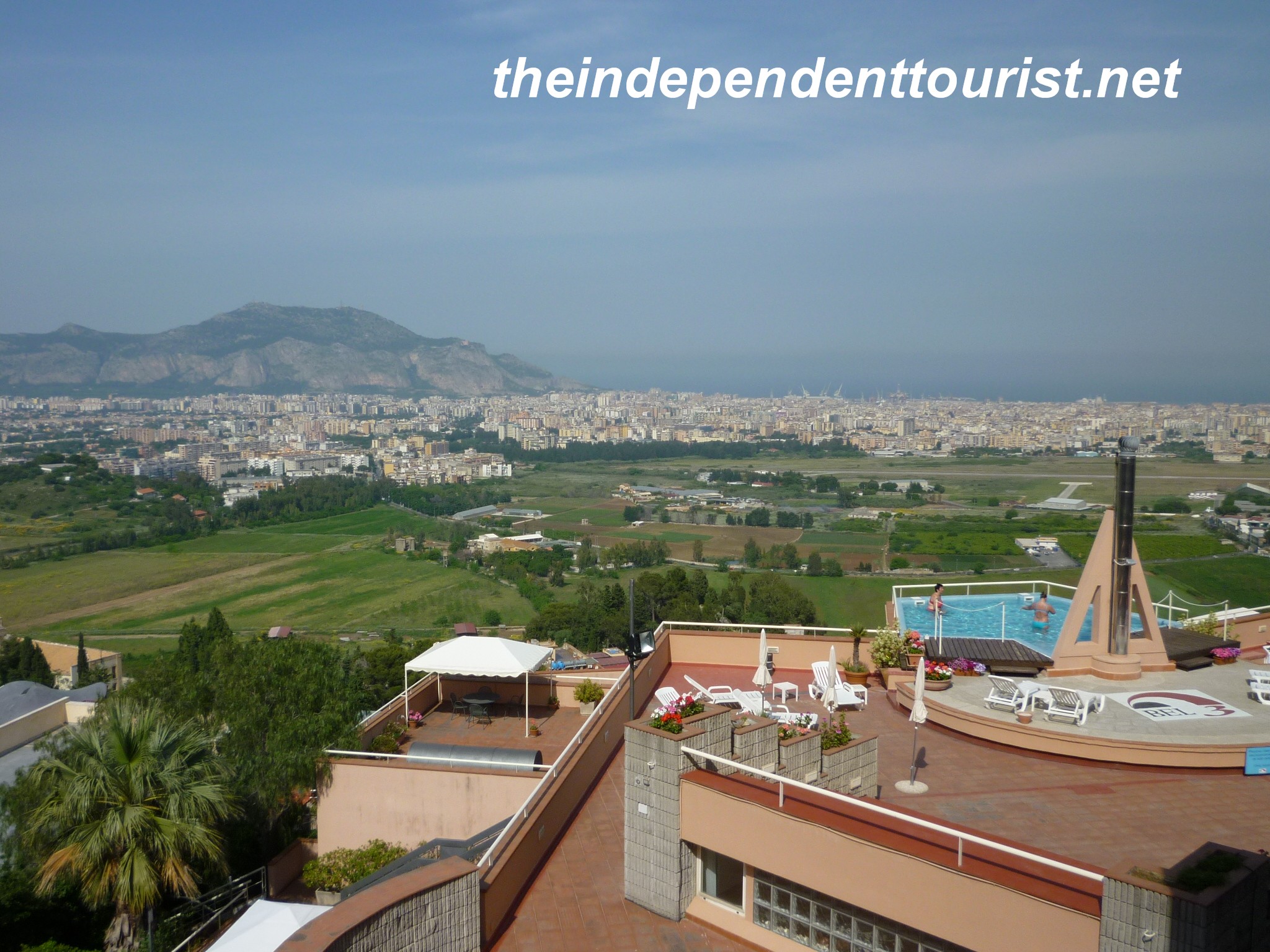
Hotel Bel 3 Palermo, Sicily, Italy

Hotel Bel 3 Palermo.

Since Sicily is the largest island in the Mediterranean, we flew in to Catania on the eastern coast, and flew out of Palermo (northwest coast), so we could make a counterclockwise tour of the island. Other options to get to the island include a train to Messina (via a short ferry ride) or a ferry from Naples. We rented a car at the Catania airport through Europe By Car. The roads are in good condition and it was easy to navigate to all the sites. There were very few toll roads (Catania-Taormina and Palermo-Cefalù were the only ones we encountered) or major highways, most roads are two lane. I expected to encounter a lot of slow truck traffic and was pleasantly surprised to find very little traffic in general. Most visitors to Sicily travel by tour bus. We did our best to visit sites at hours that would avoid the tourist busloads.

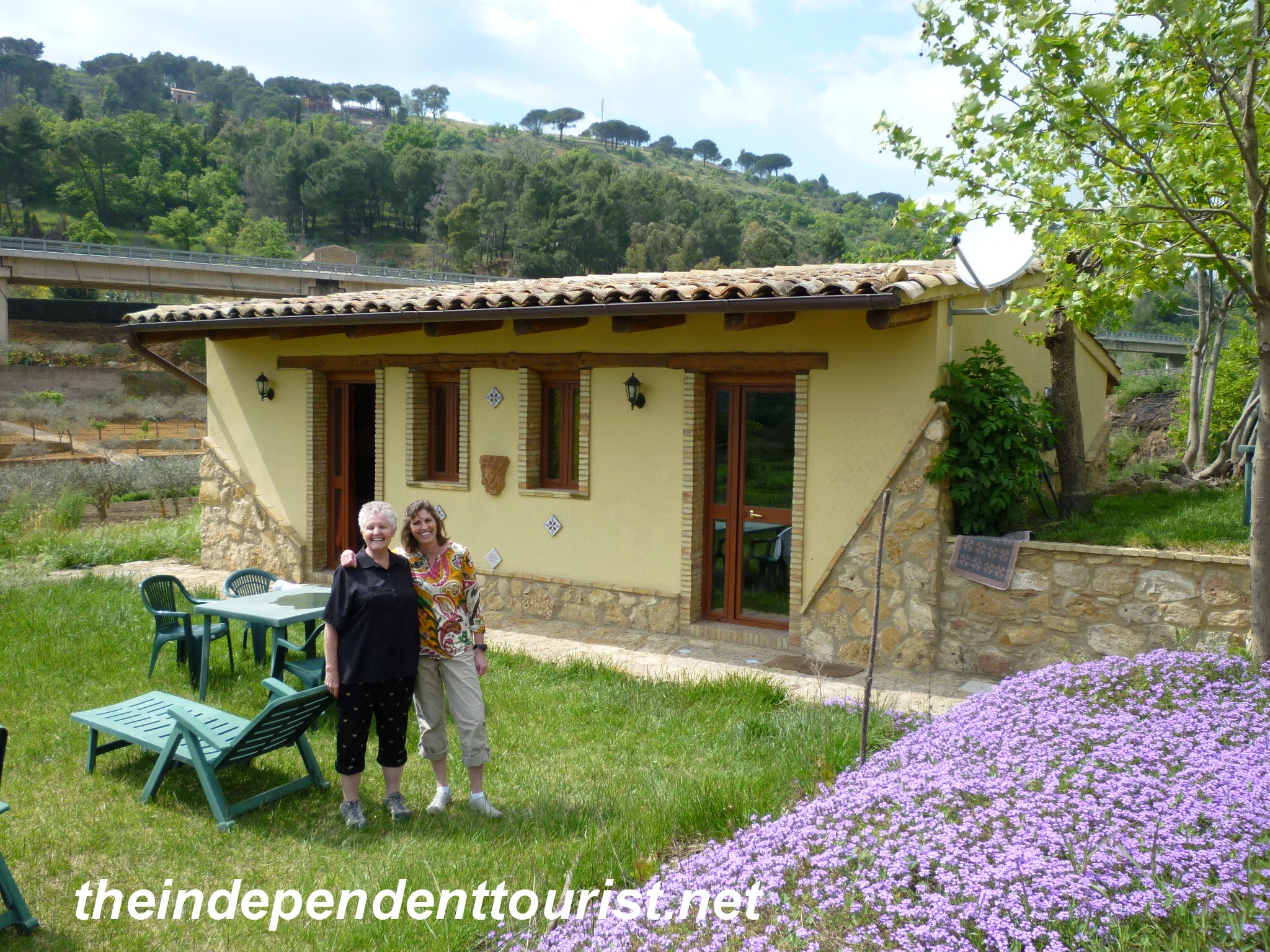
B&B Piazza Armerina, Sicily Italy

B&B private rooms in Piazza Armerina

There are relatively few hotels on the island, so we stayed in bed and breakfast (B&B) accommodations, allowing us to meet local families and get a flavor for life in Sicily. We used BBPlanet.com and Venere.com to arrange the B&B’s. We loved most of the B&B rooms and locations. The Sicilian people are very warm and helpful.  We spent about 10 days on Sicily, which allowed us to cover the island’s main sights and a few less visited sights. We also spent two nights on Malta, taking the ferry from Pozzallo (near Ragusa). See our post on Malta for more information.

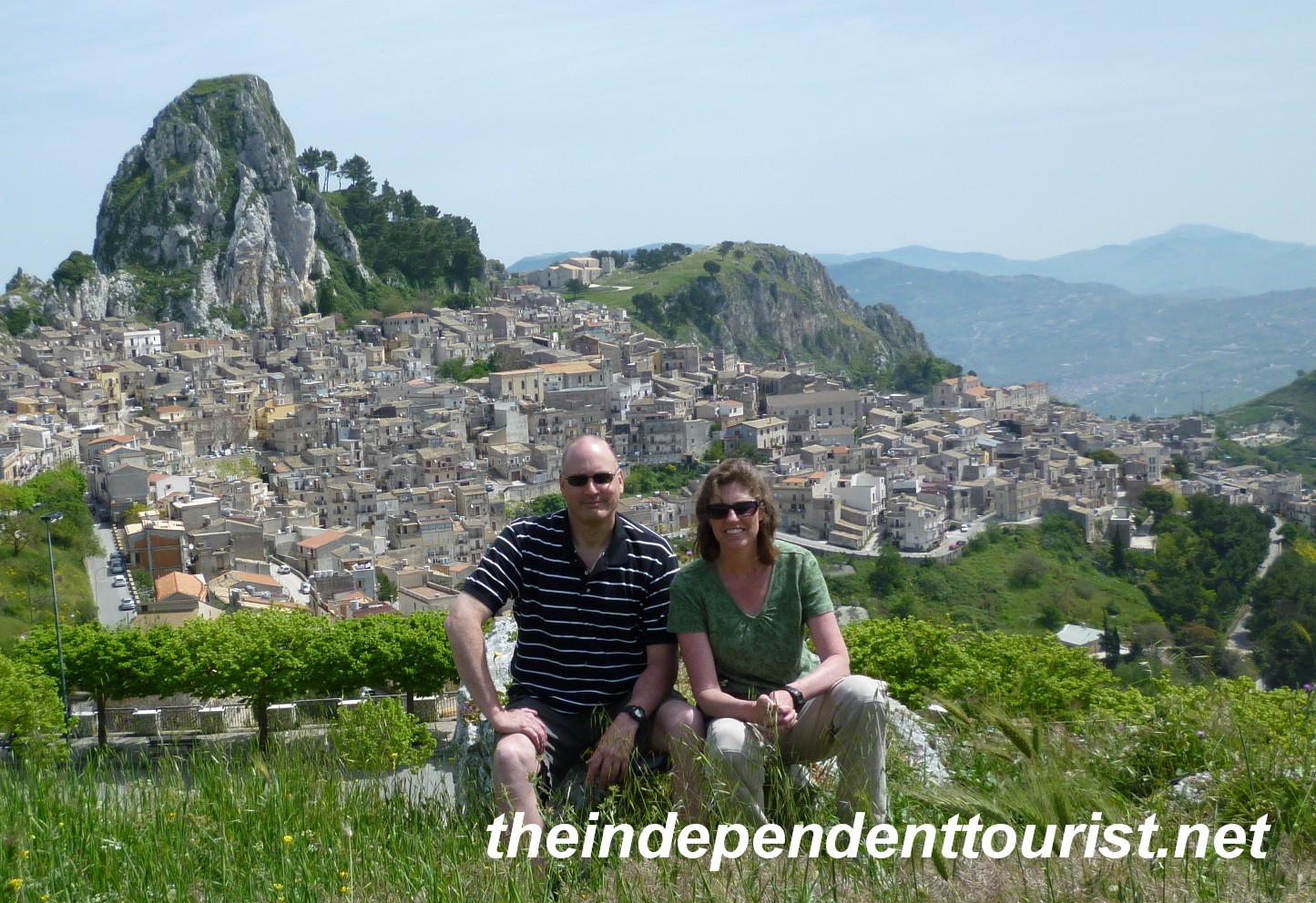
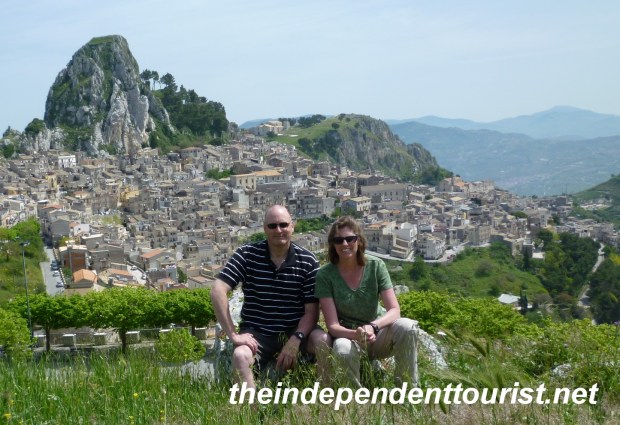
Caltabellotta Sicily Italy

The hilltop town of Caltabellotta in southwest Sicily

Although we had read that English was less widely spoken here, we didn’t have any problem communicating. Occasionally in restaurants ordering food was a challenge given our lack of Italian language skills, although knowing some Spanish certainly helped with understanding Italian vocabulary and in communicating. Plan on putting on some calories since good gelato can be found almost everywhere!

Greek Theater, Taormina, Sicily, Italy

Tour of Sicily: Taormina and Syracuse (Siracusa)

Sicily Italy Map

Sites visited in Sicily.

Taormina

Our first stop was Taormina, about 45 minutes north of Catania. Taormina is compact town wedged between high cliffs and the sea. It was an easily defensible position anciently and in medieval times.

Greek Theater, Taormina, Sicily, Italy

Greek Theater, Taormina.

Roads and buildings seemed to be right on top of each other. Our B&B was on the north side of Taormina, right near the tram that takes visitors down to the beach area. We were within a 10 minute walk to the town. The main sight in Taormina is the Greek Amphitheater, rebuilt by the Romans in the 2nd century A.D.

The setting of this theater is one of the most spectacular in all of Europe, overlooking the town, sea and Mt. Etna.

Taormina Cathedral, Sicily, Italy

Taormina Duomo (Cathedral).

After visiting Taormina we drove up to the village of Castelmola. Set in the cliffs just above Taormina it provides a panoramic view of the whole area. Castelmola is a small village and there is a car park right off the road before entering the village. We hiked up to the castle ruins at the top of the village for a great view.

Castlemola, Taormina, Sicily, Italy

Taormina (with Castlemola at top of hill).

From Taormina, we drove south to Syracuse (about 2 hours), with a quick stop in Motta Sant’Anastasia (picture below-left), just to the southwest of Catania. The Norman tower (“Tower of Motta”), built around 1070, was not open. The town built on a rock outcropping above the plain is quite a sight.

Motta Sant'Anastasia, Sicily, Italy

Motta Sant’Anastasia

 Syracuse (Siracusa)

Our B&B in Syracuse was situated in an apartment building about halfway between the old part of the city (the island of Ortygia) and the Archeological Park Neapolis. Parking is limited in Syracuse-we had to find parking on the streets wherever we could. Once we found a spot, we tried not to move the car and walked around town for most of our stay. Ortygia is a small island connected to the mainland by a bridge. It is full of narrow alleyways, stately buildings and a very interesting Duomo (Cathedral-below) that incorporates the columns of a 5th century B.C. Greek temple and has a beautiful baroque facade. The Piazza del Duomo is quite beautiful as well. There is a good laundromat on Corso Umberto I just a few blocks from the bridge to Ortygia.

Syracuse Cathedral, Sicily, Italy

Syracuse Cathedral-Ortygia.

The next day we walked to the Archeological Park Neapolis which contains a number of old Greek and Roman ruins. We got there early to beat the tour buses.  The street signs are clear and point the way to the Neapolis area. There is one entry fee (about €10) that provides access to the entire historical area.   Sights include the ruins of a Roman amphitheater, Greek Theater (which workers were preparing for performances, held every two years), a votive area behind the theatre, the huge Altar of Heron where hundreds of animal sacrifices occurred, and the Quarry area including the cavernous Ear of Dionysius, where stone for the many monuments of Syracuse came from.

Altar of Heron, Sicily, Italy

Altar of Heron.

Ear of Dionysius, Sicily, Italy

Ear of Dionysius.

One of the other things we did that was very worthwhile was visiting the Catacombe di San Giovanni (Catacombs of St. John), which date from at least 300 B.C. There are at least 10,000 burial spots here.

San Giovanni Church, Syracuse, Sicily, Italy

San Giovanni Church.

It is located in the heart of modern Syracuse, close to the Neapolis. The church above ground is in ruins, but the catacombs below are quite well preserved. The only way to visit is with a guided tour. There are several tours each day, and we happened to arrive just as a tour was starting. The cost was about €4. The tour starts in the underground Cripta di San Marciano which is in the form of a Greek cross and includes some frescoes. The tour then proceeds through sections of the massive catacombs.

Catacombs of San Giovanni, Syracuse, Sicily, Italy

Catacombs di San Giovanni.


Ragusa Ibla, Sicily, Italy.

Tour of Sicily: Noto, Ragusa Ibla and Piazza Armerina

Sicily Italy Map

Sites visited in Sicily.

From Syracuse we drove to Noto, only about 45 minutes by car. Noto is a UNESCO Word Heritage site, with several stately streets, churches and palaces.

Cathedral of San Nicolo, Noto, Sicily, Italy

Cathedral of San Nicolo.

One of the more interesting things we noticed was that as we were driving into town, a convoy of 16 Ferraris passed us. After we found a place to park, we walked into the center of town and noticed all the Ferraris had parked in a row right in front of the town hall (Palazzo Ducezio) apparently for a meeting. A convention of Ferrari owners? Sicily is known as the home of the Mafia, and this was as close as we came to seeing any signs of it.

We climbed the bell tower of San Carlo al Corso church for a good view of the city.

San Carlo al Corso Church, Noto, Sicily, Italy

View from San Carlo al Corso Church Bell Tower.

From Noto we drove to Ragusa, another UNESCO World Heritage site (less than 60 minutes’ drive), and specifically to Ragusa Ibla, the old part of the city set on a hill top.

Ragusa Ibla, Sicily, Italy.

View of Ragusa Ibla (old city).

The drive itself is scenic, over the deep valleys on high modern bridges climbing the hilly countryside of this part of Sicily. There was a large car park just below Ragusa Ibla, which is separated from the newer part of the city by 340 steps. It is worth the climb up these stairs for a good view of Ragusa Ibla. We then went into Ibla, walking to the Duomo (San Giorgio), and then down to the town square, and out to Giardino Ibleo (gardens) overlooking the valley. Ragusa Ibla is a classic baroque town of the 1700’s.

San Giorgio Cathedral, Ragusa, Sicily, Italy

San Giorgio Cathedral

From Ragusa, we drove to Pozzallo and caught the night ferry to Malta (see Malta blog post).

Upon our return to Pozzallo from Malta, we drove up to Piazza Armerina (about a 2.5 hour drive), to visit the world famous mosaics of the Villa Romana del Casale, which is just a few kilometers outside the town.

Villa Romana del Casale, Piazza Armerina, Sicily, Italy

Villa Romana del Casale, near Piazza Armerina

I was surprised that the entry fee was only €3, and discovered the reason was due to the closure of part of the site due to restoration. Most of the site is covered by a glass structure, like a greenhouse. The Villa is large, with many rooms. The floor mosaics are in excellent condition due to their being covered by mud since the 12th century. The original owner must have been very wealthy to decorate the Villa so lavishly.

Piazza Armerina, Sicily, Italy

Piazza Armerina.


The town of Piazza Armerina is bypassed by most tour buses and tourists, and gave us a feel for a “real” Sicilian town. We wandered up and down a few streets and to the Duomo (Cathedral) for a good view of the surrounding countryside.

The next morning we drove northwest about 30 minutes to visit the ruins of Morgantina, originally inhabited around 1000 B.C. There are great views of the countryside and Mt. Etna in the distance. We found very few tourists at this site, making it a pleasant stop without crowds.

Morgantina, Sicily, Italy

Ruins in Morgantina

Temple of Castor and Pollux, Agrigento, Sicily, Italy

Tour of Sicily: Agrigento, Selinunte, and Segesta

Sicily Italy Map

Sites visited in Sicily.

These three locations are the main Greek Temple sites in Sicily. From Piazza Armerina we drove through Barrafranca and Pietraperzia on our way to Agrigento. The springtime clear air and verdant green hills made this 2.5 hour drive very enjoyable.

Temple of Castor and Pollux, Agrigento, Sicily, Italy

Temple of Castor and Pollux (city of Agrigento in background).

We had heard that the scenic aspects of the Valley of the Temples in Agrigento was somewhat spoiled by the city being so close to the site. We were pleasantly surprised that the view is still quite beautiful, and the Temples sit on a wooded ridge between Agrigento and the sea. The site is large, so plan on a good walk to see the various temples. We visited in the afternoon and the light was perfect since the sun was setting over the Mediterranean.

Temple of Concord, Agrigento, Sicily, Italy

Temple of Concord

 Our B&B was in the center of the old part of Agrigento high up on the hill, and had a fantastic view of the Valley of the Temples.  Several of the streets were just wide enough for a small car to pass with about 1-2 inches to spare on each side. Most tour buses go directly to the temples and do not go into Agrigento. We would recommend a visit to the old part of the city. We found a good restaurant and enjoyed climbing stairs between the levels of the old streets. We stopped at the Convento di Santo Spirito and just peeked in since it was getting ready to close. The nuns saw us and invited us in for a look and in Italian did their best to explain to us the various features of the historic abbey-very friendly people.

Temple E, Selinunte, Sicily, Italy

Temple E, Selinunte.

The next morning we drove to Selinunte (northwest along the southern coast), with a short detour through the hill top town of Caltabellotta. Of the three temple sites, Selinunte was probably the least interesting, although it has a great setting on the coastline. The site is very spread out—it is about a 15-20 minute walk between the two main temple areas (the Acropolis and the Eastern hill). If one is rushed for time, be sure to visit Temple E (490 BC) on the Eastern hill, which is closest to the main parking. The main thing I enjoyed was hiking around the ruins of Temple G (Eastern hill) with the tumbled columns and being struck by the size of the blocks for the columns.  How did they erect and assemble such huge stones for these temples? Amazing.

Segesta Temple, Sicily, Italy

Segesta Temple.

Segesta. Don’t miss Segesta. It is about 40 miles north of Selinunte, not too far off the road on the way to Palermo. This temple is in the countryside, and in a very peaceful setting. The temple was never finished. The car park is close to the temple. On the hill just to the east of the temple there is a 3rd century BC Greek Theater and the ruins of the ancient town of Segesta.

Segesta Theater, Sicily, Italy

Segesta Theater.

The view of the valley and temple of Segesta is incredible from the Theater. There are buses every 30 minutes that take visitors up to the Theater, or it can be walked.  I wish we had walked down to the car park rather than taken the bus given the picturesque views of the temple.


Monreale Cathedral, Sicily, Italy

Tour of Sicily: Erice and Monreale

Sicily Italy Map

Sites visited in Sicily.

Erice, Sicily, Italy

Street Scene-Erice

Erice is a well-preserved medieval town dramatically set on a high peak southwest of Palermo, and a good overnight stop between Segesta and Palermo. The views of the coast and the surrounding valleys are well worth the steep drive up the hill.

Erice, Sicily, Italy

Our B&B-Il Carmine, former monastery

Our B&B in Erice was an old monastery right inside the walls of the town. It was a great location, but the beds were hard! Our stay gave us an appreciation for the austerity the monks must have endured.

Norman Castle, Erice, Sicily

Norman Castle, Erice

Walking around the perimeter of Erice, wandering through the town square and visiting the castles make Erice a great stop. 

Monreale Cathedral, Sicily, Italy

Monreale Cathedral Interior

From Erice we drove to Monreale. The interior of the Monreale Cathedral (dating from 1172) has some of the finest gold mosaic biblical scenes in all of Europe, and I marveled at the effort and expense required to create these mosaics. Monreale is just a few miles from Palermo, so don’t miss it.

Monreale Cathedral, Sicily, Italy

Monreale Cathedral Apse Exterior

There is a convenient bus and car park just below the Cathedral. Like many churches and other sites in Sicily, Monreale cathedral closes in the middle of the day for a couple hours, so get there in the morning or the later afternoon


Caccomo, Sicily, Italy

Tour of Sicily: Cefalù and Caccamo

Sicily Italy Map

Sites visited in Sicily.

Cefalu, Sicily, Italy

Cefalu, Sicily

Cefalù is on the northern coast of Sicily, about 40 miles east of Palermo. We made a stop here on a day trip from Palermo. It’s fast road between the two cities, and we paid a couple small tolls as we got closer to Cefalù. The old town and Duomo are set below the rock cliffs (La Rocca) and the sea.

Cefalu Cathedral, Sicily, Italy

Cefalu Cathedral and Square.

La Rocca can be hiked, leading to some prehistoric ruins (Tempio di Diana) and 12th century castle ruins. If we had allowed more time, I would have loved to hike up La Rocca.  The Duomo of Cefalù is one of the great Norman Cathedrals of Sicily, and dates from 1131. There is a pleasant piazza right in front of the Duomo that is good for a relaxing meal. There is also a beach near the town, but it was cloudy and the sea was rough on the day we were there.

Caccomo, Sicily, Italy

Caccomo, Sicily

While in Cefalù, I saw a picture of the small town of Caccamo, and decided to take a side trip to this town on our way back to Palermo, and I’m glad we did. It was just about 6 miles off the Palermo-Cefalù highway. Caccamo is a quiet little town set on a hillside overlooking a valley. We went through the Norman castle at the west end of town (not too much to see, it is undergoing renovation), and then wandered the streets down to Chiesa Madre di Caccamo. Drive to the eastern side of the town for a great view of the town and valley.

Caccomo, Sicily, Italy

Chiesa Madre di Caccamo.


Palermo, Sicily, Italy

Tour of Sicily: Palermo

Sicily Italy Map

Sites visited in Sicily.

Of all the locations we visited in Sicily, Palermo was probably our least favorite. It has some interesting sights (shown below), but lacks much open space in the central area, and with a few exceptions, lacks any real grand attractions. There is a lot of trash everywhere, so it feels somewhat dirty, run down and overcrowded. Hey, this is Italy. In these regards, it is similar to Naples. We spent a day and a half in Palermo (including Monreale) and felt satisfied with what we saw in that time.

Cripta dei Cappuccini, Palermo, Sicily

Skeletons in the burial dress in Cripta dei Cappuccini

Our first stop was the Cripta dei Cappuccini, in Convento dei Cappuccini. Seeing all the remains of men, women and children still dressed in their finest clothes of the period and displayed in standing form on the walls from the 1600’s to 1800’s was a sight I will never forget. The Convent is in the proximity of the main road from Monreale into Palermo.

Other sights in Palermo:

Palermo Cathedral, Palermo, Sicily

Palermo Cathedral.

The Palermo Cathedral is big, but more interesting from the outside than inside. It was rebuilt many times over the centuries, and like a number of churches in Palermo has Arabic as well as Norman influences. The exterior architecture has interesting features from the 1400’s-in particular the Portico and Towers.

Cappella Palatina, Palermo, Sicily

The mosaics of Cappella Palatina

The Cappella Palatina. Part of the Norman Palace in Palermo. This is the most stunning sight in Palermo, and almost equal to Monreale Cathedral. Founded in 1132. It has stunning gold mosaics and also intricate carved wood ceiling.

Palermo, Sicily, Italy

“Fountain of Shame” – Fontana Pretoria

Palermo, Sicily, Italy

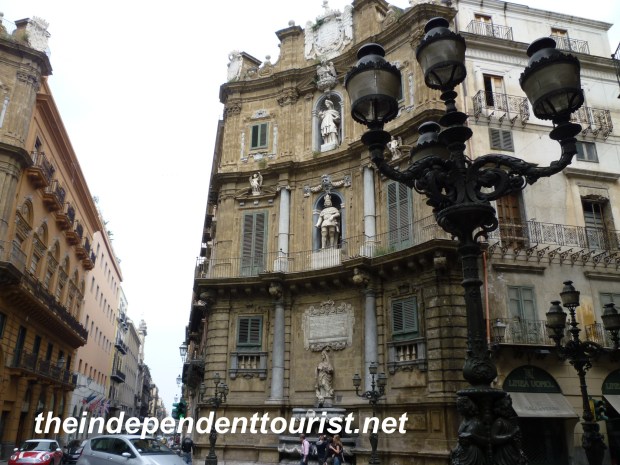
Quattro Canti intersection – Palermo (fashion district, dates from 1600’s)