Author: Paul Terry

I love to travel. I've been fortunate to visit about 75 countries so far. I prefer to travel independently to get off the beaten path a bit. I also try to find good deals to make my travels more affordable.

The Ihlara Valley– A Canyon with Byzantine Rock-Cut Churches

The Cappadocia region of Turkey is full of amazing sights and one of them is the Ihlara Valley, located about 80 km southwest of Göreme, Turkey, which was our home port in Cappadocia.

The entrance to the Ihlara Valley.
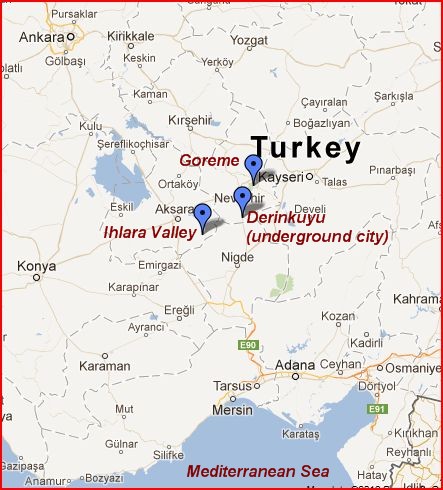
The Ihlara Valley is 80 km southwest of Goreme.

Since there is so much to see in Cappadocia, we almost bypassed this valley and I’m very glad we didn’t.  A great day trip from Göreme is to go to Derinkuyu (one of the underground cities in the area) in the morning (about 35 km south of Göreme), and then visit the Ihlara Valley in the afternoon. We beat the crowds to Derinkuyu (see my separate post on Derinkuyu) since they stop at Kaymakli underground city first. We then drove out to Ihlara, and had the valley and rock-cut churches pretty much to ourselves.

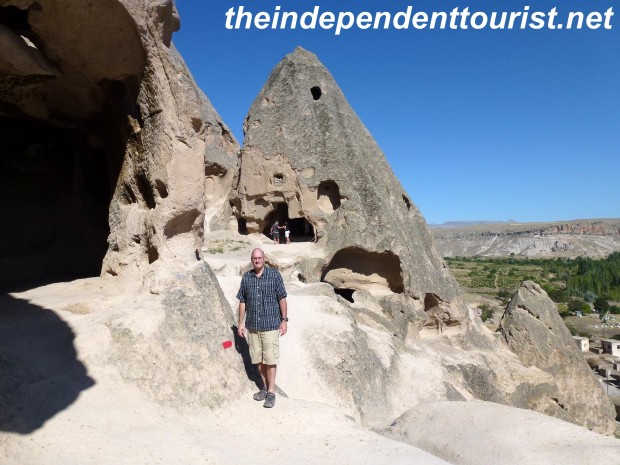
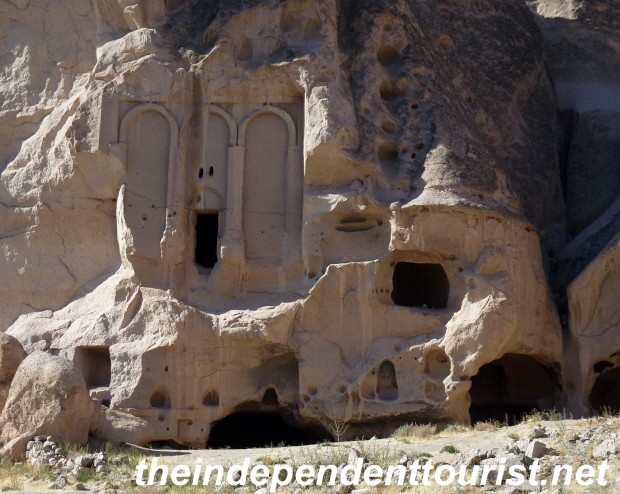
There are numerous churches cut into the canyon walls (note the opening in the lower right of the picture).

The churches cut into the sides of the canyon walls date from the 11thcentury, carved by Byzantine monks.  There were originally 60 churches in the valley. Many of the churches contain frescoes, but some are badly damaged (not surprising given the 1,000 years of history and open access to tourists). The DK Eyewitness guidebook says that there are only 10 or so churches open, however, it appeared to us that at least 15 were open.  We visited 6 churches in just a couple hours working our way up one side of the river towards Ihlara and back towards the stairway on the other side of the canyon.

The entrance to Karanlikkale Church, Ihlara Valley.

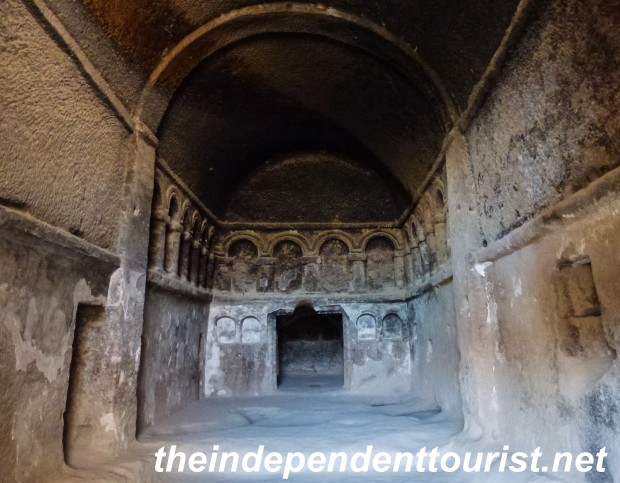
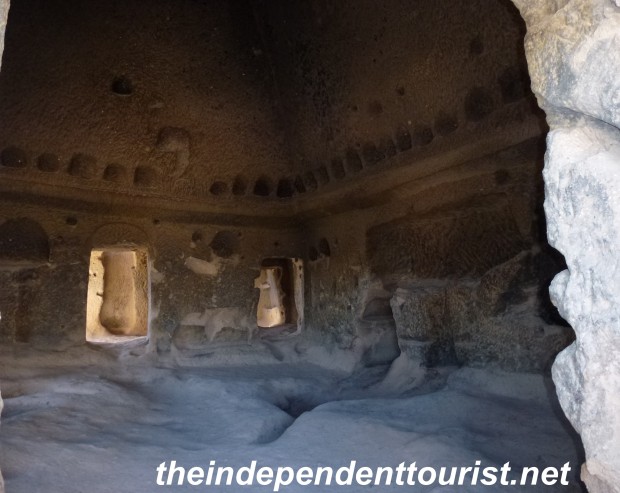
The large main chapel of Karanlikkale Church, Ihlara Valley.

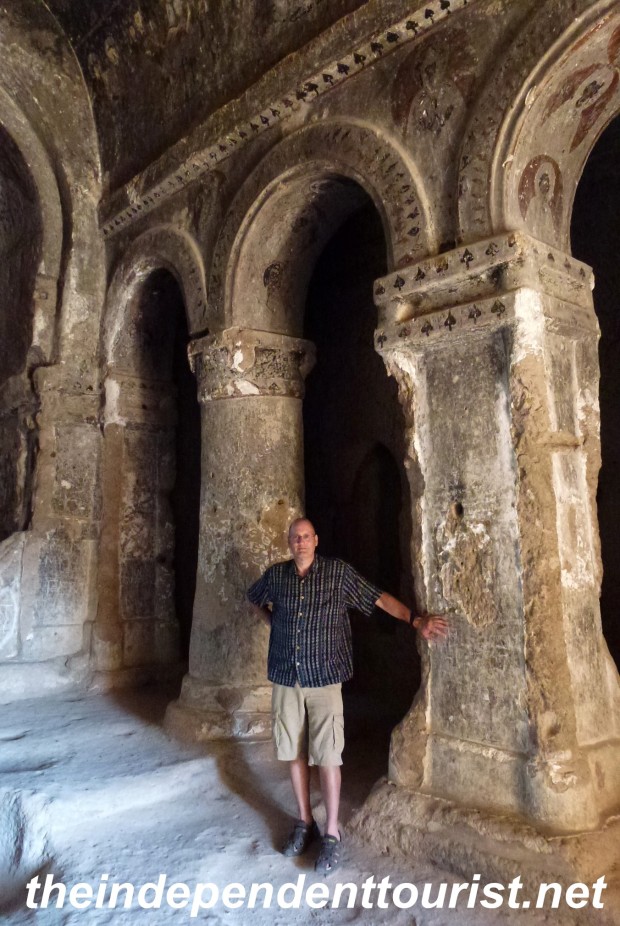
Ceiling detail of Karanlikkale Church, Ihlara Valley.

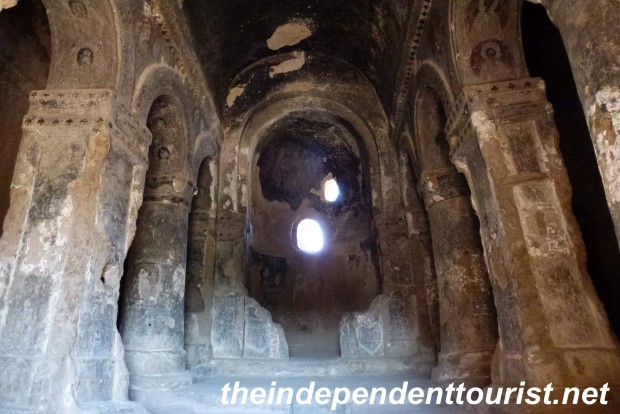
Another large room in Karanlikkale Church, Ihlara Valley.

The frescoes of Kokar Church, Ihlara Valley.

Another room, Kokar Church, Ihlara Valley.

The landscape driving out to Ihlara in September is pretty brown and dry, reminding me a bit of the Wyoming landscape with rolling hills (but with more farming fields and no sage brush!). As we arrived at the small town of Ihlara, the canyon all-of-a-sudden appeared below us with green foliage and the small Melindiz River running through it. It’s a completely different world from the surrounding area, and the beauty of the canyon with the availability of water is probably why the Byzantine monks a thousand years ago chose this spot. Even though the official name is the Ihlara “Valley,” “canyon” is a much more appropriate term for this narrow gorge.

Walking along the green, shady valley floor–Ihlara Valley.

The rooms of Egritas Church (note the tombs in the floor), Ihlara Valley.

Tomb in Egritas Church, Ihlara Valley.

The canyon is 15 km (about 9 miles) long and runs from the town of Ihlara on the south end to the town of Selime in the north. We entered from the midpoint entrance on the west side where there is a large parking lot, a ticket office and snack shop. A good stairway (360 steps) winds down into the canyon from the rim. From the canyon floor, one can either walk along the dirt path on the near side visiting the churches or cross the bridge over the river and visit the churches on the far side going north and south.  The churches are sign-posted on the main trail and most are just a short scramble up side paths a hundred feet or two up into the cliffs. There is a restaurant about midway between the two ends of the canyon, on the valley floor, to the left after you descend the stairway.

Entrance to Purenliseki Church, Ihlara Valley.

Some of the churches and rooms on the canyon walls are not accessible, such as these.

It cost 3 TL per car to park and 8 TL (1.8 TL per 1 USD) per person to visit the valley. Selime Cathedral area is included in the ticket and should not be missed (see my separate post on Selime Cathedral).
Selime Cathedral –The inspiration for the setting in Star Wars Episode 1

After hiking through a portion of the Ihlara Valley we hopped back in our car and stopped at a small store. A friendly Turkish gentleman spoke with us at the store, and when he found out we hadn’t gone to Selime Cathedral, he strongly urged us to do so—we’re so glad we did, I can’t believe we almost missed it! An added bonus was that the entry fee for Selime Cathedral is covered by the Ihlara Valley ticket (8 TL per person). (For a map of the general area click here.)
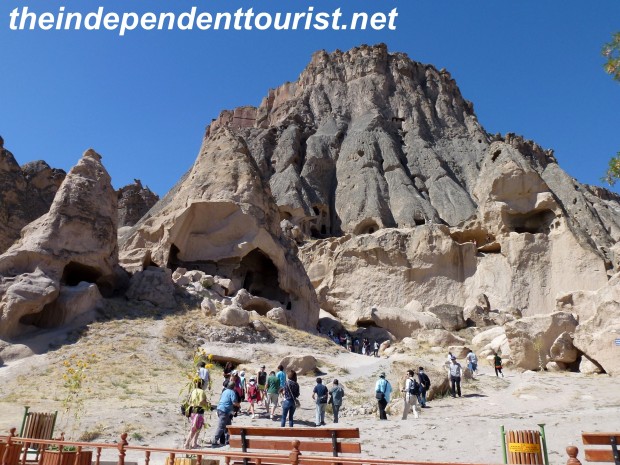
Hiking up the hill to Selime Cathedral (note the carved cave entrances everywhere).
Selime Cathedral along with numerous other rock-carved buildings sits at the northern end of the Ihlara Valley just across a highway. This area is “other worldly” and was the inspiration for part of the location set in Star Wars Episode 1, the location where Anakin Skywalker’s “pod race”  took place, if you saw that movie.

The landscape of Selime Cathedral area–hiking up.

The exterior area on the hillside around Selime Cathedral.

Entrance to one of the churches at the Selime Cathedral site.

Interior of another church at the Selime Cathedral site.

This room has two levels, and walkways around the 2nd level.

Selime Cathedral does not look like a cathedral in the traditional sense. The main church is the largest of its kind (carved out of rock) in Cappadocia, and the site contains numerous other caves and rooms for the monks (living quarters, kitchens, chapels, etc.) in the side of a mountain. Most of the structures here are from the 13thcentury.

Interior of Selime Cathedral.

Another interior view of Selime Cathedral.

Possibly the Chapter House of Selime Cathedral.

Allow at least an hour to visit this site.  Hiking up to the caves does involve some scrambling along the narrow and steep rock trails.

Another exterior view of the carved churches and other rooms.

Due to its easy access from the road, Selime Cathedral was far busier that the Ihlara Valley itself.

Derinkuyu Underground City—Living Below in Times of Peril

Our group at the entrance to Derinkuyu underground city.

About 35 km south of Göreme, Turkey is Derinkuyu, a small city with a fascinating history. At the southern end of town is the entrance to the 6th century underground city, which is the largest in this area. There are at least 130 more underground cities in Cappadocia, about 30 of which are open to the public. For a general map of the area, click here.

The low, narrow passageways in Derinkuyu–they must have had one-way traffic rules! Some of the passageways are quite long and steep.

These underground cities were built to provide protection for the Byzantine Christian villagers during raids by the Persians and Arabs in the 6th and 7thcenturies. Derinkuyu housed 10,000-20,000 people, plus all kinds of animals during periods of raids (up to 3-4 months at a time).  It has 8 levels, most of which can be visited. Features include air shafts, kitchens, a well, baptistery, church, confessional and rolling stone doors to seal off lower sections in case of invasion.

A rolling stone door to seal off portions of the underground city in case of a breach at the upper levels.

Although a little hard to tell, this is looking up through an air shaft over one hundred feet up – the little light spot in the lower center of the picture is the opening at ground level.

An intersection between levels of the underground city.

The confessional booth–the priest would go in the passageway on one side and the sinner on the other side to share his/her confession (the hall is connected but totally dark).

Baptismal font–the font is deep enough to stand in (notice the spout in the middle of the picture), meaning the Byzantines must have practiced baptism by immersion.

A meeting room – for the town council?

When you have 10,000 people living together for a few months in crowded conditions, some will not live to see daylight again. This photo is in the necropolis, reached down a long passageway separated from the living areas.

Going down into this carved-out city was fascinating; however I cannot imagine living down there for months as the Byzantines did with thousands of people on top of each other with animals, a graveyard, and all the associated issues of waste, water, fires, air, food, and just about everything we take for granted. Coming back up to the surface must have been a very joyous occasion!

The entry fee is 15 TL per person and parking was 2 TL per car (1.80 TL per 1 USD).  Allow about 2 hours for a visit to this fascinating site.

Ten Things That Make Turkey a Great Vacation Destination

We just returned from two weeks in Turkey and had a fabulous time. Our vacation was really three separate trips: Cappadocia, Southwest Mediterranean Coast, and Istanbul. Here are some things to know before you go.

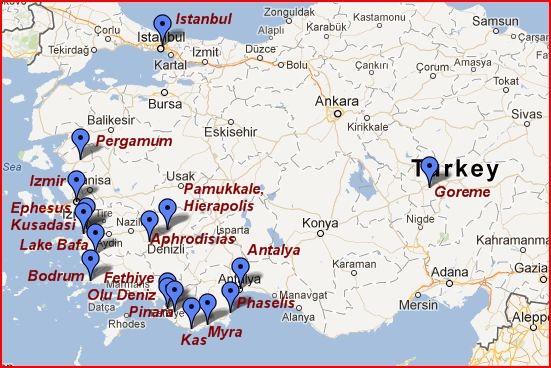
Our primary destinations in Turkey (two week trip). We flew to Kayseri (near Goreme), then to Antalya on the south coast and drove west around the coast up to Izmir. Then, flew from Izmir to Istanbul.

  1. So Much To Do. We could have stayed a week in each location we visited rather than a day or two. Between the natural scenery and historical sights, it would be easy to spend a week in one spot. In some cases we spent a couple nights, and in others just one night. Especially along the coast, with the multitude of beaches, possible boat trips and islands, there is a lot to see and do. I don’t’ regret our itinerary, I just wish I’d had a month instead of two weeks for this trip. It’s just a trade off as to how much ground you want to cover in one trip.

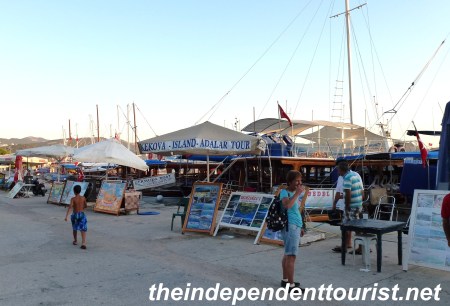
    The tour boat docks in Kas. The boats go to islands, coves, sunken ancient cities for half or full day trips.

  2. Amazingly Friendly People. The Turkish people were some of the most helpful and friendly people we have met anywhere. In Göreme (Cappadocia), we arrived very late at night via a car rental from Kayseri, and Google Maps failed us in finding our hotel. We met a couple gentlemen and they had us follow them to our hotel to make sure we knew where it was. In another location, people gave us fresh vegetables from their garden, as we stopped for gas and visited with them for a few minutes.

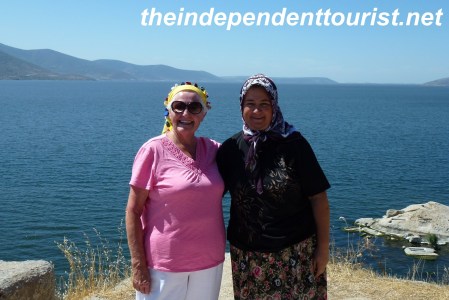
    Our friend in Herakleia with my mother-in-law showing us around the ruins (and selling nice scarves).

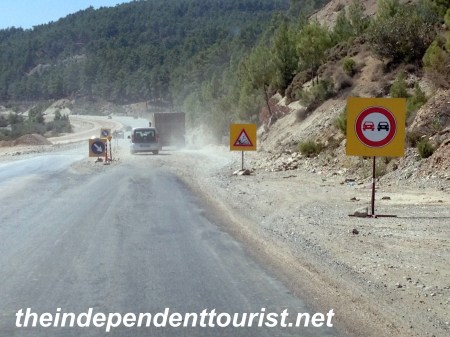
  3. Taking the Road Less Traveled. It’s easy to get around Turkey by rental car. Historical/tourist sights are well marked with brown signs (like many in the US). Roads and directions in general are well-marked. Many roads are being upgraded, so be prepared for some construction. I had heard stories about crazy Turkish driving habits, but didn’t find it much different than Italy, for example. Having your own transportation will allow you to visit many sights before or after the crowds. We had the Library of Celsus (Ephesus) pretty much to ourselves in the late afternoon. Gasoline and diesel are expensive, however, around $10 US/gallon. While there aren’t many toll roads, don’t get on them without first getting a toll card available from gas stations. I learned the hard way, paying a $25 US fine for a $1 toll.

    Typical road construction in Turkey

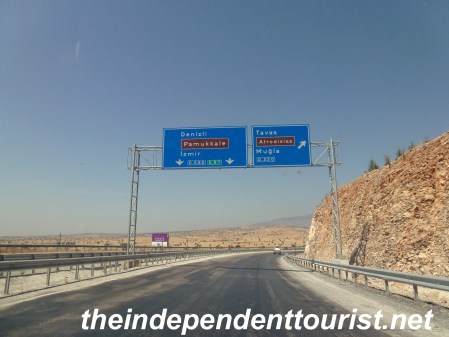
    Road signs in Turkey – easy to follow, and sights were well-marked.

  4. Blow Your Socks Off Scenery. How about mountains, pine trees, picnic areas and Roman ruins all nestled around three perfect bays with turquoise clear water and perfect for swimming? Phaselis Beach and ruins (about 60 km west of Antalya) was one example of the incredibly scenic Turkish coast.

    One of the scenic bays at Phaselis.

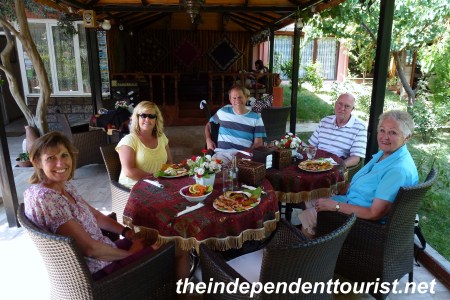
  5. Excellent Food and Restaurants. The Turks love grilled meats and fish dishes. In addition to good Turkish cuisine, we ate some excellent Indian dishes and pastas. We found restaurants open from about 11 am throughout the day, making eating whenever you want very easy. Salads were fresh and most dishes were served as an art form.

    Another gourmet meal in Pamukkale.

  6. Accommodation Options.  Our accommodations averaged about $75 US per night for two people for decent rooms. Breakfast was included everywhere, no additional charge. Most locations had beautiful terraces where one could enjoy breakfast or dinner taking in the beautiful  scenery.

    The view from our hotel in Kas on the south coast of Turkey (the island in the left side of the picture is part of Greece).

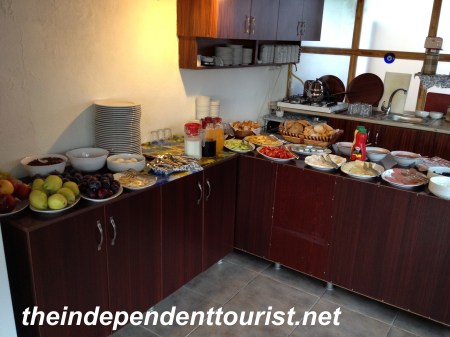
    Typical breakfast spread–fruits, tomatoes, olives, cucumbers, cheese, breads, some sliced meats, hard boiled eggs, and chocolate cold cereal – not sure why chocolate is so popular!

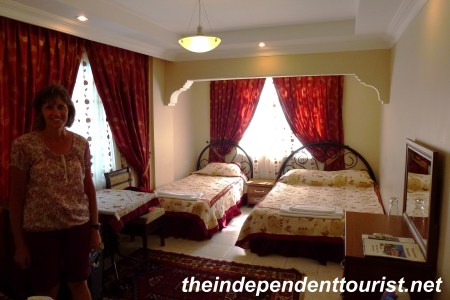
    Our comfortable room at the Venus hotel in Pamukkale.

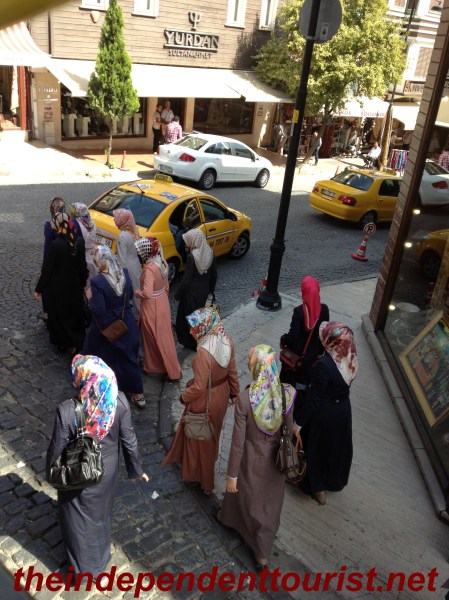
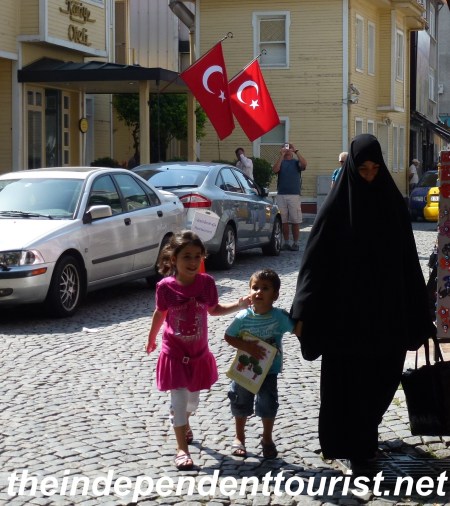
  7. Religious Tolerance & Moderation.  We often get asked “is it safe?” Short answer:  Yes! While Islam is the predominant religion (be prepared to get woken up every morning a 5 am for the call to prayer), the people are very tolerant of other religions. One sees a variety of dress on the streets—from very conservative Muslim dress to very Western styles.

    A popular style in Turkey–head scarves and long trench coats–even in 80 degree F weather!

    A woman in more traditional Islamic dress.

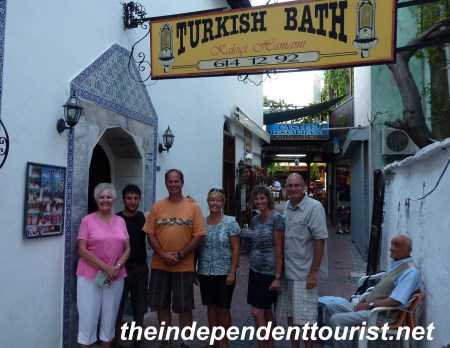
  8. A Turkish Bath.  We got our first (and only) Turkish Bath experience in Kuşadasi. It was a mixed bath (men and women), and pretty modest. It is a multi-part process—sauna, exfoliation, soaping and rinse. Some baths have separate facilities for men and women. The person doing the scrubbing works you over pretty hard—be prepared for some bruises as they work the muscles! It was a fun experience.

    A Turkish Bath house in Kusadasi.

  9. A Balloon Ride in Cappadocia. I’m thinking that most other balloon rides would be boring now. Our balloon ride over the unique Cappadocian landscape was a never-to-be forgotten experience. I will say more about this adventure in a separate post. Save your pennies, the ride is not cheap, about $130-150 US/per person.

    The stunning landscape of Goreme, Cappadocia seen from our balloon.

  10. Awesome Weather. We visited in September. Every day was perfect—sunny and clear. While the Mediterranean coast was warm (mid-upper 80’s F) the humidity was low, and the water was perfect for swimming. We read in our travel books about mosquitoes and were prepared with repellant but didn’t notice any mosquitoes (and few bugs of any kind).

Also, Turkey is not a cheap country, many prices are stated in Euros, especially in Istanbul. There are entry fees at almost every historical and tourist site and those add up over time. It would be great if the Turkish government created some sort of membership pass for the historical locations for tourists, since they have a pass for nationals. Please note that there is a pass available (“Museum Pass”, good for 72 hours once activated) in Istanbul that covers the Hagia Sophia, Topkapi Palace and Harem, Chora Church, and two museums. In addition to saving a little money, it allows you to bypass the ticket and entry lines and go right into the site. There is a booth to purchase the pass right next to the Hagia Sophia, it costs 72 TL (1.8 TL = 1 USD).

Penshurst Place – An English Fortified Manor Home

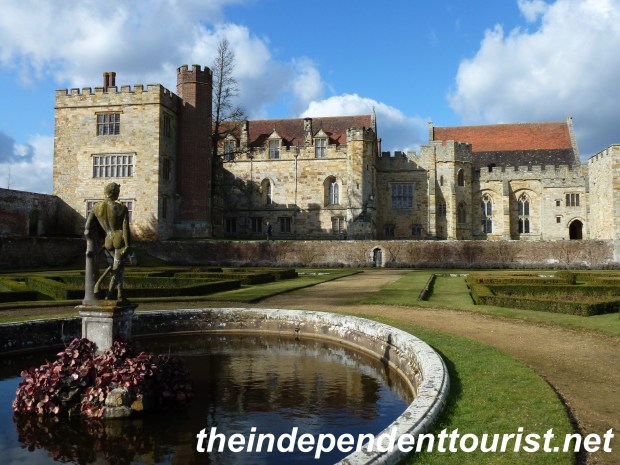
A view of Penshurst Place from the gardens. The Baron’s Court (Great Hall) is on the right.

A beautiful example of a medieval (and then Tudor) fortified manor house is Penshurst Place, located in the picturesque village of Penshurst, about 85 miles south of London’s Heathrow airport.

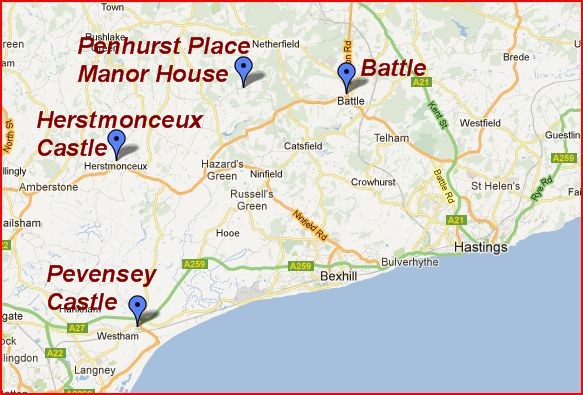
Location of Penshurst Place, in southern England. (forgive misspelling of “Penshurst” on map)

I visited this estate as part of a day trip from London that took me to Pevensey, Herstmonceux Castle, Battle (Hastings) and finally Penshurst.

herstmonceux-castle_england-3

A view of Herstmonceux Castle (dates from 1441), part of the Queen’s University, Ontario Canada.

Penshurst Place and Gardens

This historic mansion is not on the typical tourist “radar” but for a taste of life in aristocratic England in the 14thcentury, take the time to visit this beautiful castle-home.

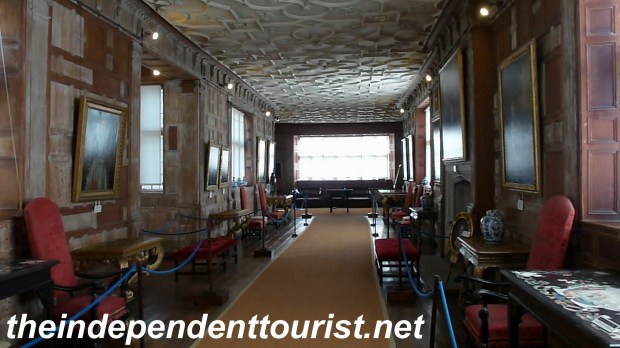
Interior view of Penshurst Place–note the detailed wood work on the walls and ceiling.

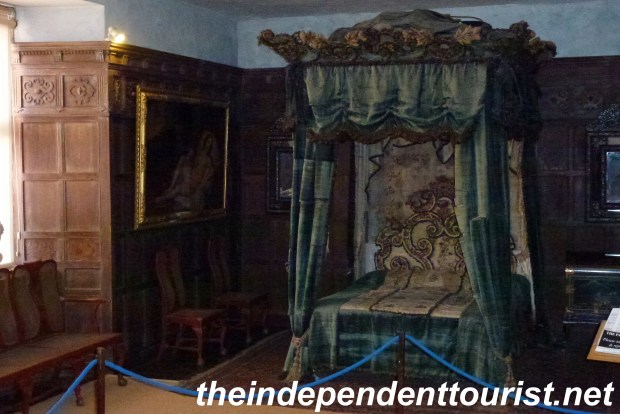
A bedroom in Penshurst Place–note the wood work on the walls and beautiful bed.

I was very impressed how beautiful this estate is—the stone work, interior decorations and landscaping—even in February I could tell how much care went into the well-manicured landscape. Some people come to tour only the gardens.

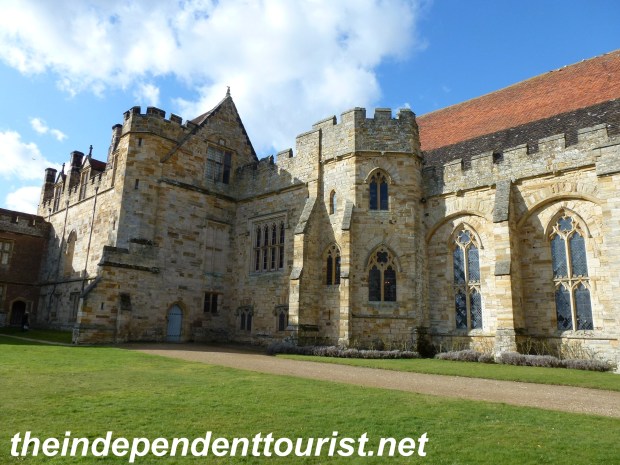
Another view of Penshurst Place.

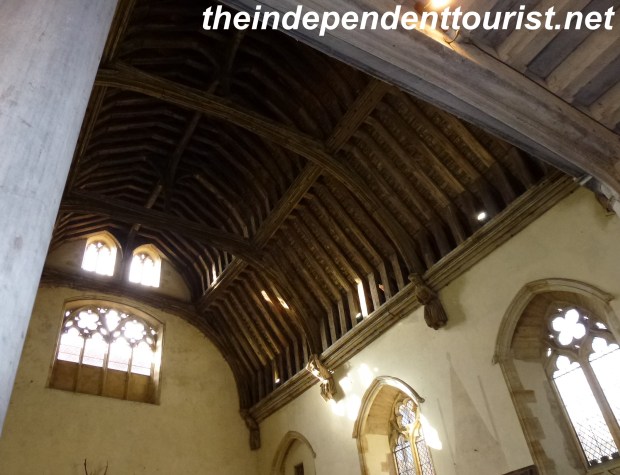
The outstanding feature of Penshurst Place is the Baron’s Court (also known as the Great Hall) with its original chestnut wood beams from 1341.This room (and the entire estate) is now used on occasion for weddings, conferences and other events (pictures aren’t really allowed in the Baron’s Court, but I got a quick one of the ceiling!).

A snapshot of the 14th century ceiling of the Baron’s Hall.

Sir John de Pulteney built the Manor house on 4,000 acres he purchased in 1338. In 1382 the defensive features were added—making it almost a castle—including eight large towers and crenellated walls. King Henry VIII owned this home for a period of time, and today a descendant of the Sidney family, who received the home as a gift from Henry, is the custodian.

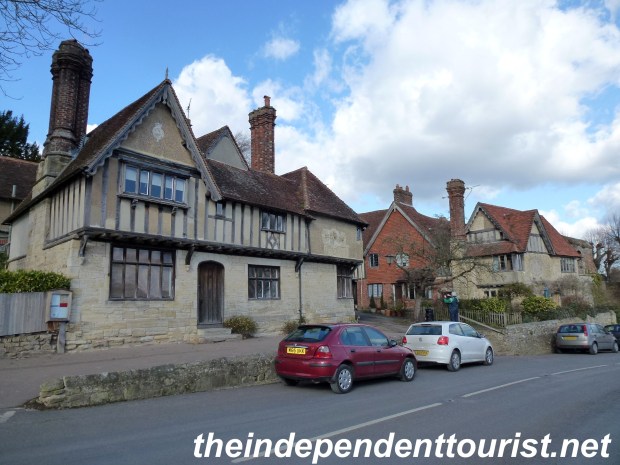
A view of the village of Penshurst.

Old timbered houses in the village of Penshurst.

Penshurst Place is part of the English Heritage system, meaning purchasing an English Heritage membership allows entry to this site and many others for one fee. The single entry fee as of February 2012 was £9.80 for the house and gardens. Visit penhurstplace.com for more information.

Le Mont-Saint-Michel –The Very Symbol of Medieval Europe

A view of Mt-St-Michel from the causeway. The Arcade Tower in lower center provided lodgings for the Abbot’s soldiers.

On the northwest coast of Normandy, France lies the most striking image of medieval Europe – the abbey fortress of Le Mont-St-Michel. The fortress and tiny village is now an island connected to the mainland via a causeway.  At one time the area surrounding the mount was forest and now it is a vast tidal flat—the tides are very strong and in the Middle Ages provided excellent protection, along with the natural defenses of a steep hill surrounded by walls and towers. There is no better image of medieval Europe than this soaring abbey sitting on a rock pinnacle surrounded by a village and walls and towers.

Exterior view of the Refectory and Knight’s Rooms. The three stories of the monastic complex were built in only 16 years.

Interior view of the Knight’s Room. The room was named after the Knights’ Order of Saint Michael created by Louis the XI. This was the scriptorium (or study) where the monks devoted their time to copying texts and studying ancient manuscripts.

The site was dedicated to Saint Michael, the patron saint of high places on the 16th of October, 708 by St. Aubert, the bishop of nearby Avranches.  Construction of the abbey and associated buildings were done in phases over hundreds of years, requiring design ingenuity and engineering due to the steep slope of the mount and the weight of the huge stone buildings. The site became a Benedictine abbey in 966, and a few monks still remain. The abbey buildings we see today are mainly from the 13th – 15th centuries, although the original foundations of the abbey date back to 1017. The picturesque belfry and spire were added in the 1800’s.

Walking up the Grand Rue to the Mt-St-Michel Abbey as pilgrims have done since the 12th century.

Mont-St-Michel was a pilgrimage site, and saw a large number of pilgrims, including children (called “The Pastoureaux”) which first took place in 1333, and continued until the French Revolution in the late 1700’s. They were typically boys ages 8-12, sent by their parents to ask the Archangel Michael to save their families from the plague. Many of them never made it home, due to the dangers and risks associated with such a trip.

A view of the abbey towering over the village.

The drive to Mont-St-Michel takes about 4.5 hours from Paris (235 miles or 378 km).  We flew in to Paris in the morning, rented our car, and were at the mount by early afternoon. I recall the last segment of our drive, just as we passed the town of Avranches, when my daughter yelled out “there it is!”  It was thrilling to see the mount in the distance, soaring above the grey sea against a cloudy sky.

No problem parking on the causeway on our way in to Mt-St-Michel.

This area of France has a number of interesting sights including the beaches where the Allied forces landed on D-Day in June 1944. I suggest visiting Mont-Saint-Michel early or late in the day—the mount receives over one million visitors a year, and is one of the most popular sights in Europe, let alone France. If you want to reduce the crowd effect even more, visit off-season. We visited in November and had no problem parking or gaining entry. The walk up to the abbey is very steep, with many steps along the way.

Mont-Saint-Michel is 378 km west of Paris Charles De Gaulle airport.

If you visit France, do not miss the premier sight of Mont-St-Michel. Also, just across the English Channel near Penzance, England is the “sister” to Mont-Saint-Michel, called “St. Michael’s Mount.” While not quite on the grand scale of Mont-Saint-Michel, it is still a great sight, and is also an island just off the coast, with walkway that is covered at high tide. View my post on St. Michael’s Mount here.

Reference:  Mount Saint-Michel by Jean-Paul Benoit, Editions Jean-Paul Gisserot.

Pevensey Castle-The Beginning of the End for Saxon England

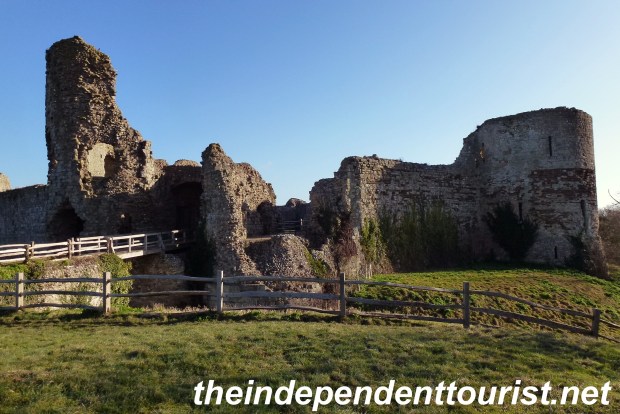
Entrance to Pevensey Castle.

Pevensey Castle is near the English Channel on the south coast of England, about 12 miles from Hastings and about 90 miles from London’s Heathrow airport. Pevensey was the landing spot for Duke William of Normandy, on 28 September 1066. William earned the title ‘William the Conqueror’ in the famous Battle of Hastings just 17 days later. The Saxon king, Harold, was in northern England at the time of the landing, and raced with his army south to meet William. His army fought valiantly and at one point appeared to have carried the day, but in the end Harold was killed and the course of English history changed forever. The famous battle took place near Battle Abbey (see my post on Battle for more information), which is actually north of Hastings and about 11 miles from Pevensey.

A view of the exterior and moat of Pevensey Castle.

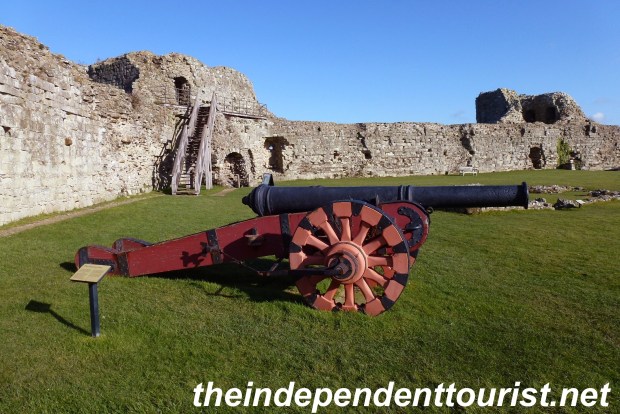
Interior grounds of Pevensey Castle.

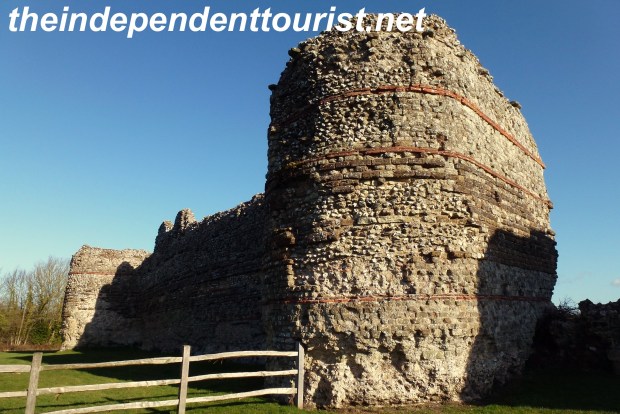
Roman Walls (1,700 years old) still guard the entrance to Pevensey Castle.

Pevensey has been a strategic location since Roman times, when a fort called Anderita was built here in 290 AD—parts of the original Roman walls remain. It was a defensive post against early Saxon raids. The castle was built inside the original Roman walls in the 12thcentury. Pevensey was also further fortified in 1588 in case of invasion by the Spanish Armada. In 1940 ‘pill boxes’ (gun emplacements) were added to the castle to defend against a possible German invasion. These are still visible.

Pill box is visible in top center of picture–narrow slit for WWII guns. Medieval projectiles stacked below.

While Pevensey Castle is very ruined, it is interesting to visit the site since it has such strong historical connections. It is part of the English Heritage system, and individual tickets are £4.90. It is a favorite area for walkers from Pevensey village.

St. Nicolas Church in the village of Pevensey. 13th century.

Pevensey Castle is close to several other interesting sights in this part of southern England, including Battle, Herstmonceux Castle and Penhurst Place Manor House. I visited all these sights in a day trip after arriving at Heathrow airport from the U.S. early on a Sunday morning.

References: Signs posted on castle grounds.

Locations of sights near Pevensey Castle, England.

Horezu Monastery—A Great Example of the Brâncovenesc Style of Architecture

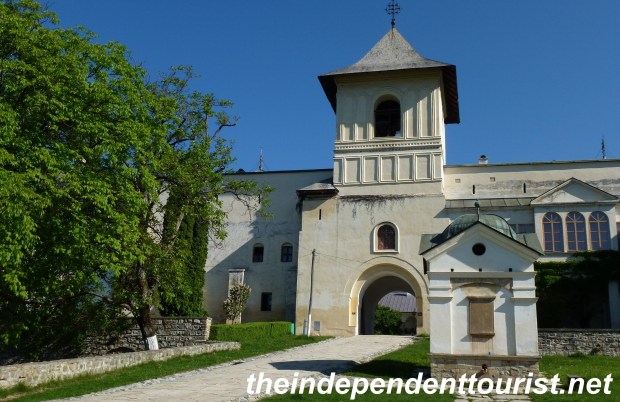
The entrance to Horezu Monastery.

From Hunedoara and Corvin Castle we drove southeast to Horezu (via Târgu Jiu and an incredibly narrow mountain river gorge). Horezu, in the region of Wallachia, Romania is home to Horezu Monastery, a UNESCO World Heritage Site. The monastery is located just a few kilometers outside the village of Horezu–known for its brown pottery.

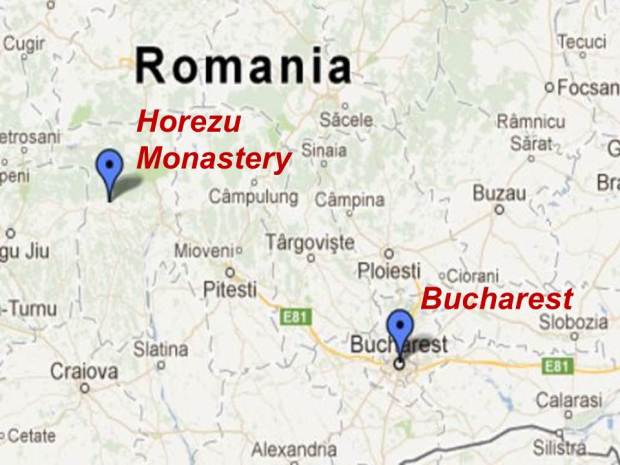
Horezu Monastery is about 136 miles northwest of Bucharest.

The monastery was founded in 1690, during the reign of Constantin Brâncoveanu (1654-1714). Brâncoveanu brought about a cultural renaissance to Wallachia. He met an unfortunate end to his life by being arrested, tortured and executed in Constantinople (Istanbul) in 1714, along with his four sons. He and his sons were declared saints and martyrs of the Romanian Orthodox Church in 1992. His work at Horezu gave him immortality by becoming the center and most famous example of an architectural style he established, now known as Brâncovenesc, which combines Western (Venetian) and Oriental (Ottoman) influences.

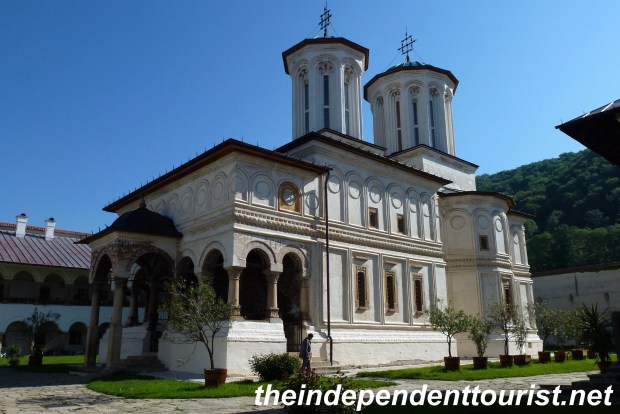
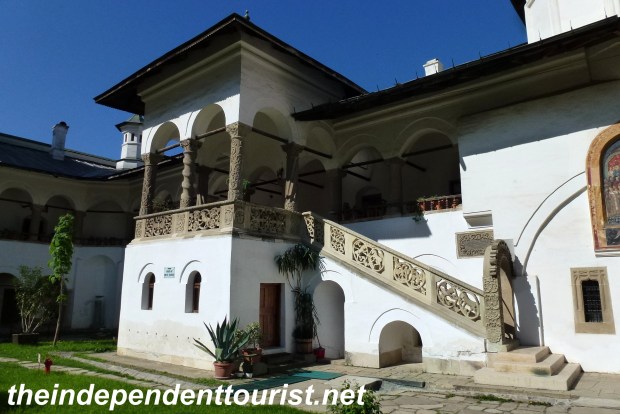
View of the Great Church, with its ten-pillared porchway.

A Brancoveanu porch with a stone balustrade carved with animal motifs.

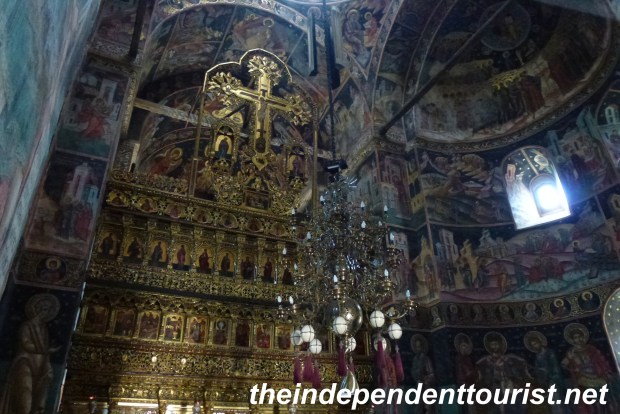
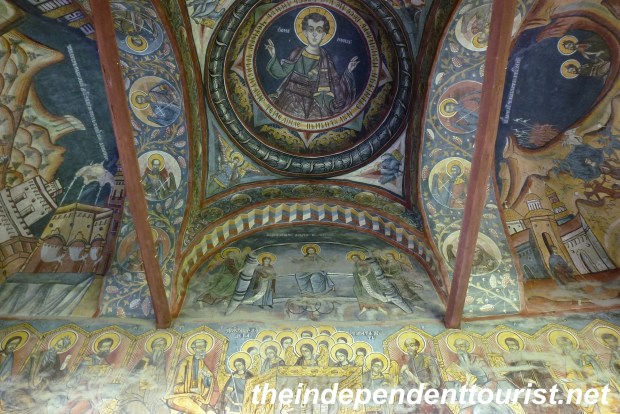
In the 17th and 18thcenturies, the Horezu monastery was a prestigious fresco-painting school. In the Great Church one can see why. This Church, dedicated to the Roman Emperor Constantine and his mother, Helena, contains outstanding frescoes which are original from 1694, although they were blackened by the smoke of fires of Turkish slaves who camped here (and thankfully now restored). I loved the frescoes in the main chapel and also in the refectory. There is no entry fee to the monastery.

Interior of the Great Church.

The frescoes inside the Refectory.

In the summer, the monastery opens 20 rooms for guests, so if you’ve ever wanted to live the life of monk, this is your chance. Keep in mind no food is served, so bring your own or be prepared to go back into town.

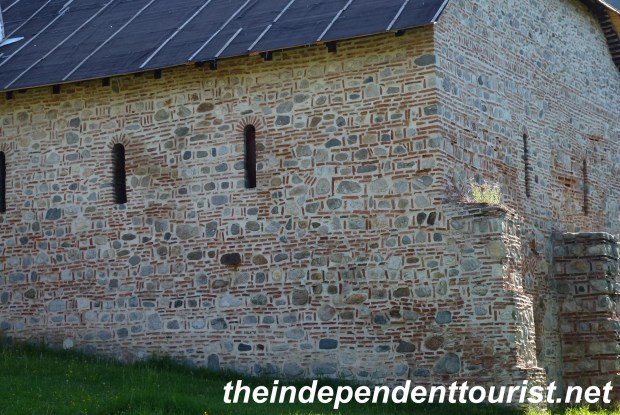
A building with interesting construction techniques just outside the monastery–note the walls.

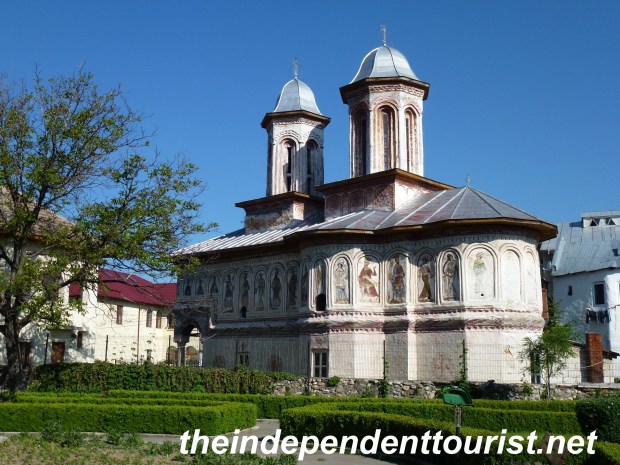
The little town of Horezu had an interesting church with great frescoes.

A little church in the village of Horezu–also beautifully decorated inside and out with frescoes.

The ceiling of the porch in the little church in Horezu village.

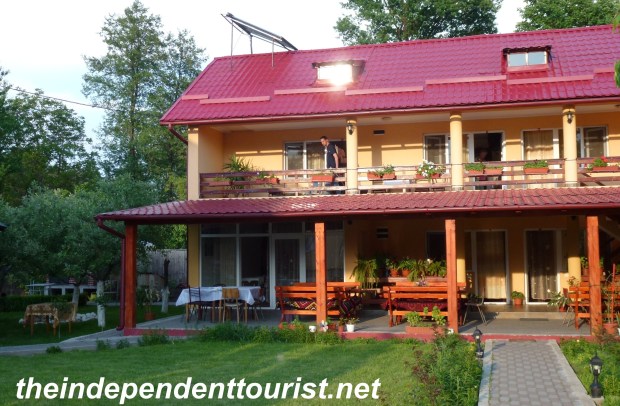
We stayed in a lovely pension in Horezu, called Pension Criveanu.

Our pension in Horezu, Romania.

The Monastery of El Escorial – A Great Day Trip from Madrid

El Escorial is huge–a view from the western side.

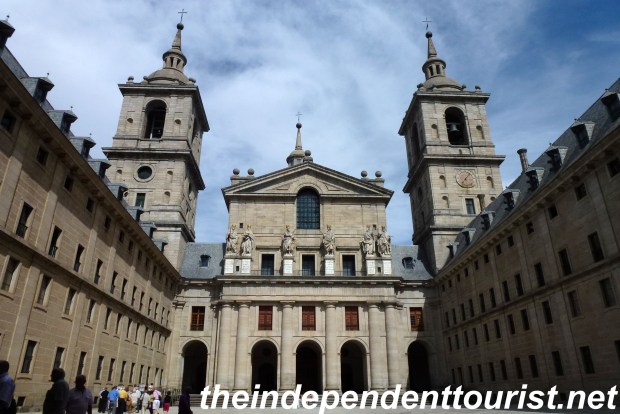
El Escorial (the official name is The Monastery of San Lorenzo de El Escorial) is in a beautiful setting, on a hill looking towards Madrid, Spain with green tree-covered mountains as a backdrop. It is massive. Getting a good picture of the exterior is a challenge given the size of the building. It is very stern looking—some describe it as looking more like a prison than a monastery and palace. I would agree.

Looking out from the royal apartments onto the well-mainicured gardens.

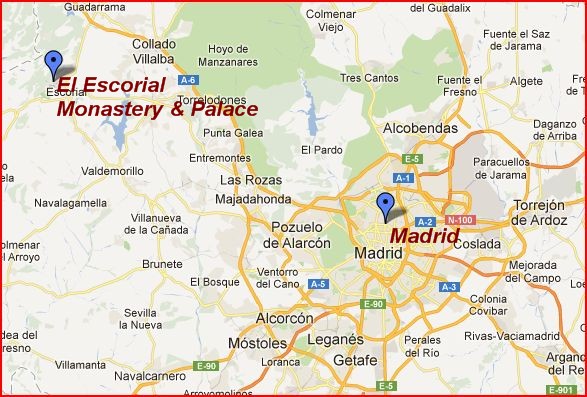
While on business recently in Madrid, I had an afternoon free up and decided to visit this sight which is located about 48 km northwest of Madrid. I had missed the monastery during a previous holiday in Spain, so it was really a pleasure to have the opportunity to visit during this trip.

El Escorial is just 48 km northwest of Madrid, Spain.

History

The monastery was built between 1563 and 1584 at the suggestion of King Philip II of Spain, who also closely supervised its construction.  Its uses were very clearly specified in a charter in 1565:  A convent for monks of the Order of St. Jerome, a church, a public and private palace, the royal and princes pantheons, a seminary, a school, a library, a hospital and rooms for scientific research. Many rooms are still in use today. The building is constructed from huge blocks of granite, and I cannot imagine all the blood, sweat and tears that went into cutting, hauling and placing these massive blocks, most of which are larger and taller than a person.

The northern (main) entrance to El Escorial (although used as an exit for tourists, the tourist entrance is on the eastern side).

Other Visit Information

Photographs are not allowed in most parts of the monastery, and it is heavily secured—there are security guards posted in just about every room along with cameras; however I was able to capture a few images, with permission. Tours are self-guided, either with an audio guide or just with the signage posted in Spanish and English.

The ceiling paintings in a main stairway.

Although I’m sure I saw just a small portion of the entire complex, I was able to see exhibits of the construction techniques, rooms where the royal family lived, the pantheon where the kings and queens are buried, a long hall with rooms of tombs of royal children who did not live into adulthood, and another long hall with amazing wall paintings of successful battles by the Spanish Kings, an incredible library—due to both the ceiling artwork and the priceless volumes it contains, and the basilica which is so huge it reminded me of St. Peter’s basilica in Rome, and various other rooms.

The artwork on the ceiling of the magnificent library.

The entrance to the huge basilica from the inner courtyard at El Escorial.

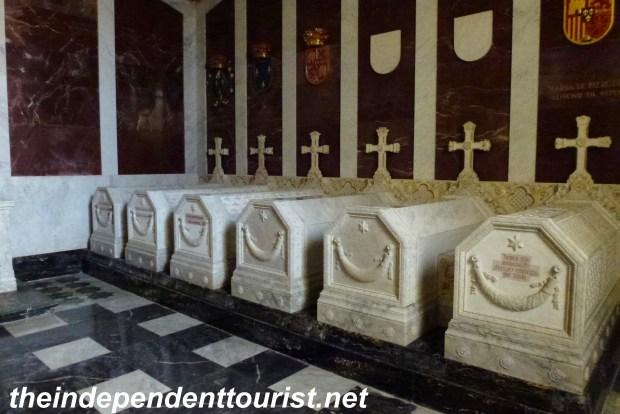
El Escorial’s pantheon–resting place of many kings and queens of Spain.

The tombs of royal children–many did not make it to adulthood.

There is a €10 entry fee and I would suggest allowing two hours for your visit. The town of San Lorenzo also is pleasant with many restaurants near the monastery.

Travel Logistics

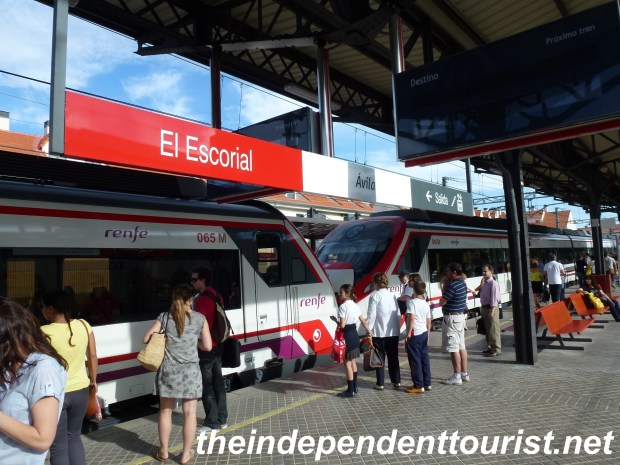
Trains depart from Madrid hourly (I caught the Renfe train at the Nuevos Ministerios station, which is a metro and train station) and the trip takes just about one hour to reach the town of El Escorial. A round trip ticket was €7.60.

The train statiion at El Escorial. The trains are very clean and efficient.

Please note that the monastery is actually located in San Lorenzo de El Escorial and upon arrival at the train station there is a bus (timed to meet the incoming train) immediately outside the station that will take you to San Lorenzo (which is just a couple km further uphill) for €1.30 each way.  After your visit, you can catch this same bus back to the train station, which again is timed to allow you to arrive back at the train station a few minutes before the next train to Madrid—very nice system!  There is also bus service to San Lorenzo from Madrid.

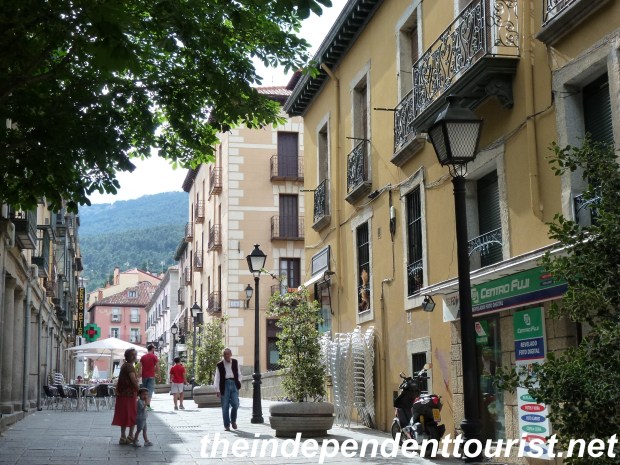
The pleasant town of San Lorenzo de El Escorial.

The monastery is open until 8 pm during the summer, allowing a late visit if desired. Since this is a popular tourist attraction, I was surprised to see ample available auto parking available directly on the north side of the monastery, even in mid-June; however most people probably arrive by tour bus or train as I did.

Corvin Castle—The best castle that (nearly) no one will see

The main entrance to Corvin Castle.

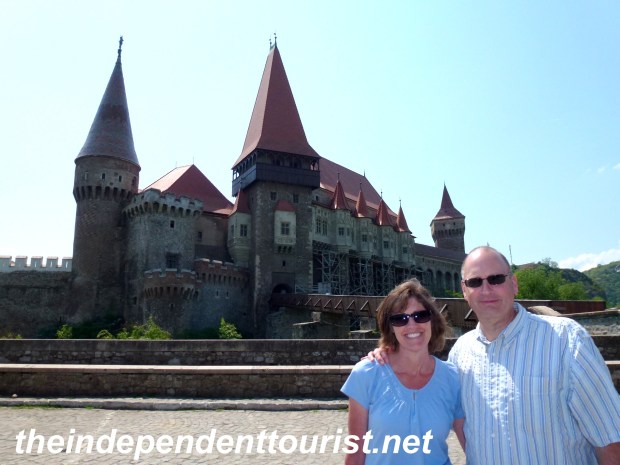
One of the best castles in Romania is Corvin, a 14th century castle located in the city of Hunedoara, at the western edge of Transylvania. This castle receives few visitors since it is a bit off the beaten path in Transylvania and since Romania in general is off the beaten path. We drove to Hunedoara from Sibiu, which took about 2 hours. The castle is at the western edge of the city, on a slight hill. The city of Hunedoara has a communist-era feel owing to several old (closed) steel mills located here due to the iron ore in the nearby hills. The iron deposits were even known by the Romans. For a map of locations visited in Romania click here.

The Council Hall of Corvin Castle.

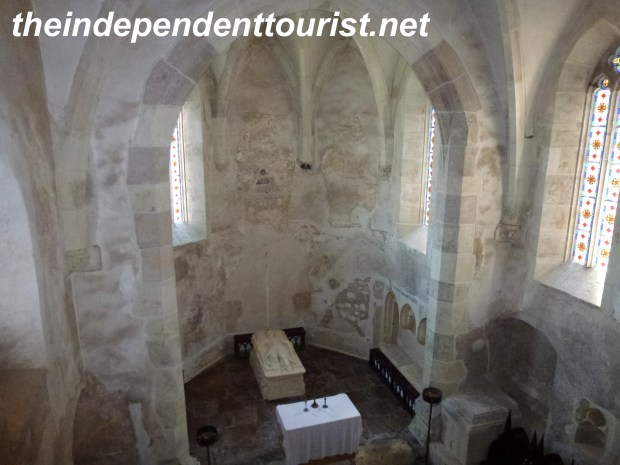
The chapel at Corvin Castle.

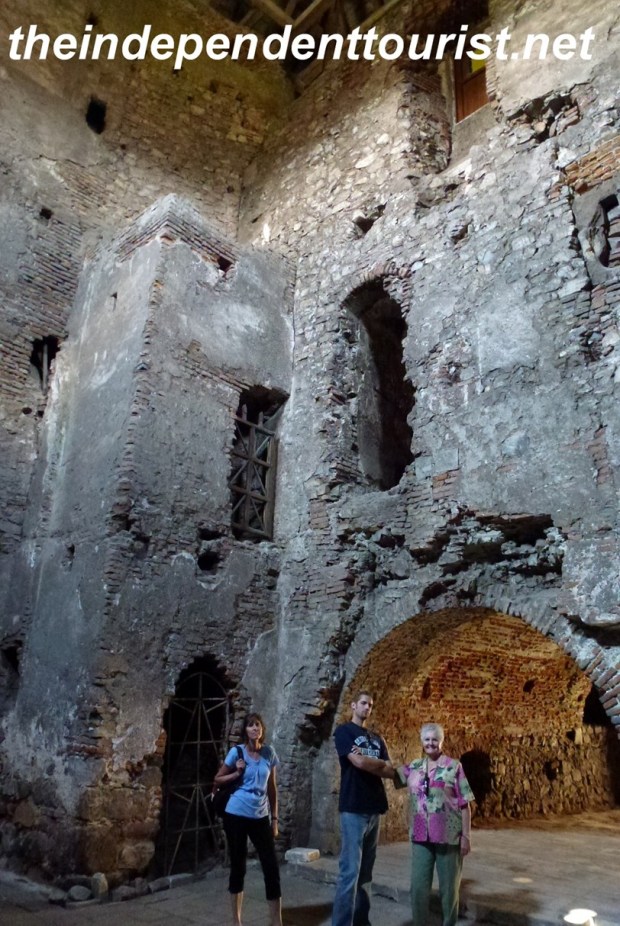
The eerie unrestored part of Corvin Castle–Dracula would be right at home!

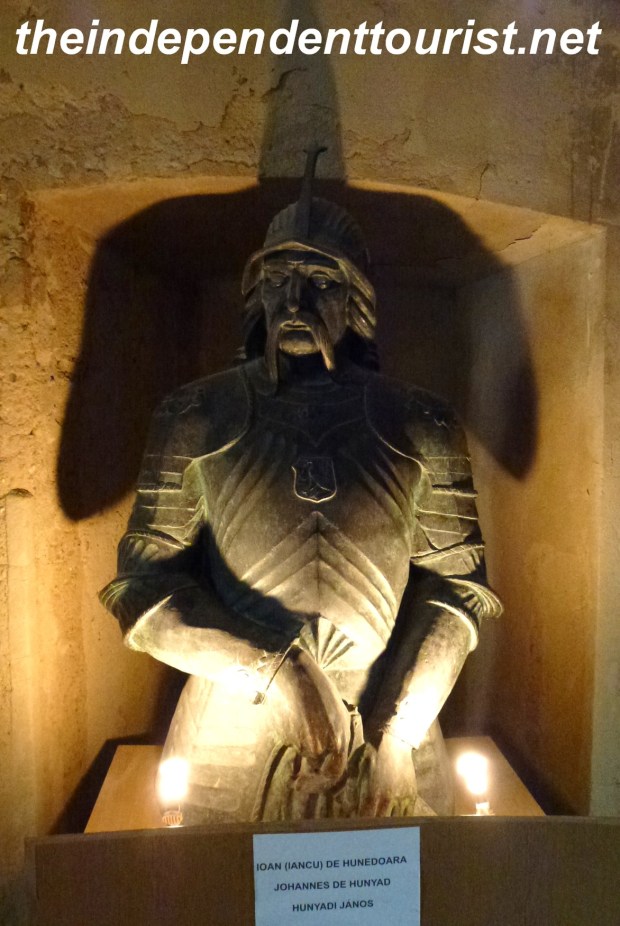
The castle and the town get their names from two kings (Ioan Huneadoara and his son, Matthias Corvinus), considered among the greatest Hungarian rulers of Transylvania.

A statue of Ioan of Hunedoara, the Hungarian King responsible for the rebuilding of Corvin Castle in 1453, the town where the castle is located bears his name.

In the 14th century, Turkish prisoners had the fun job of hewing the castle walls out of solid rock. Also, in the 15thcentury, three “lucky” Turkish prisoners had to dig a well, and were promised their freedom by King Ioan after its completion. It took them 15 years to dig about 100 feet deep, when they finally found water. Ioan was dead by the time they finished, and his wife, Elisabeth, revoked the king’s promised and had the three prisoners put to death. Upon learning their fate, one of them wrote on a stone in the well: “You may have water but you have no soul.” I wonder if those words haunted Elisabeth.

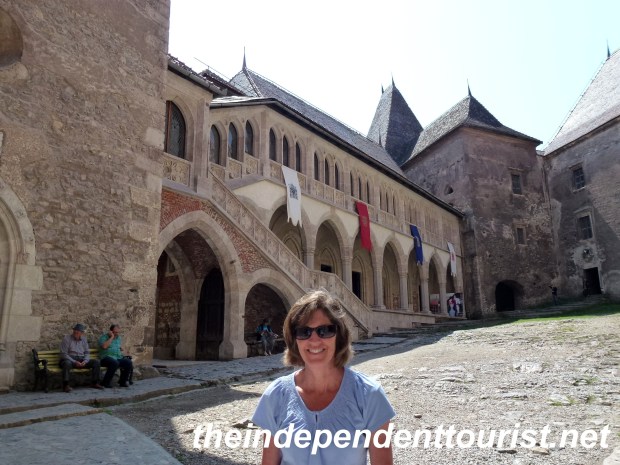
The inner courtyard of Corvin Castle.

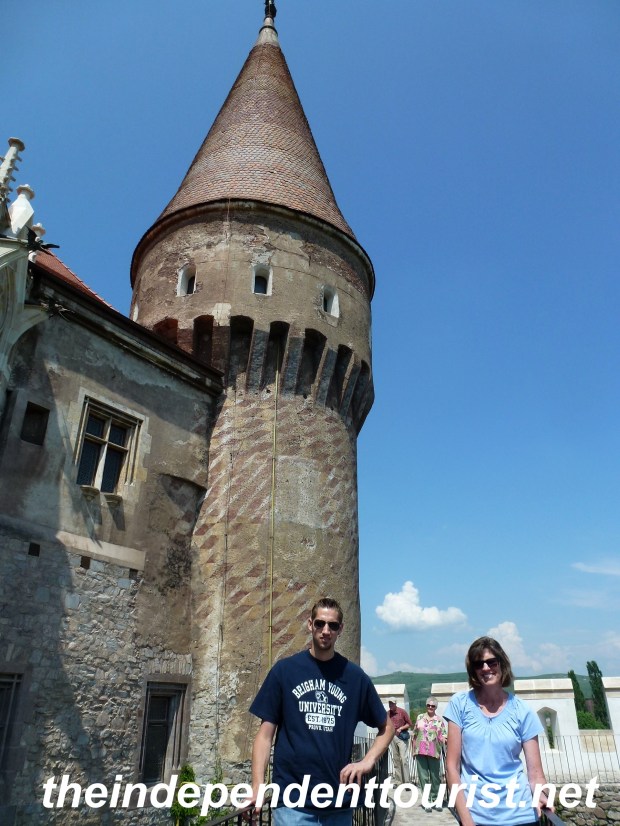
The Mace Tower, Corvin Castle. Note the traces of 15th century frescoes on the outside.

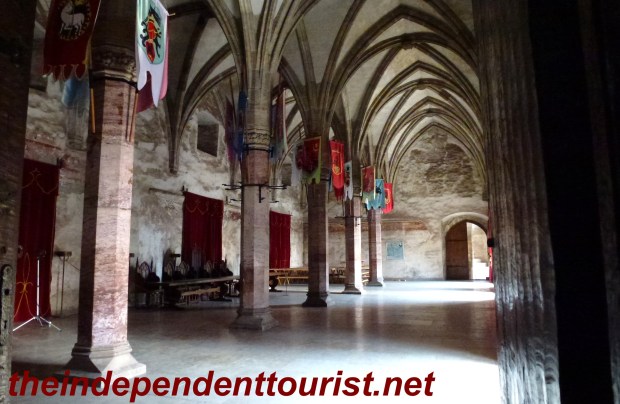
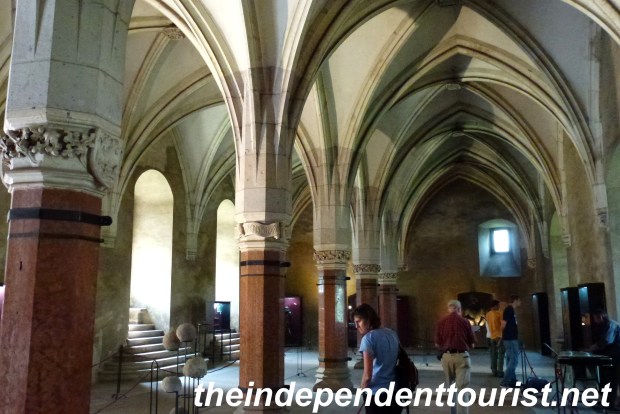
The Knights Hall at Corvin Castle.

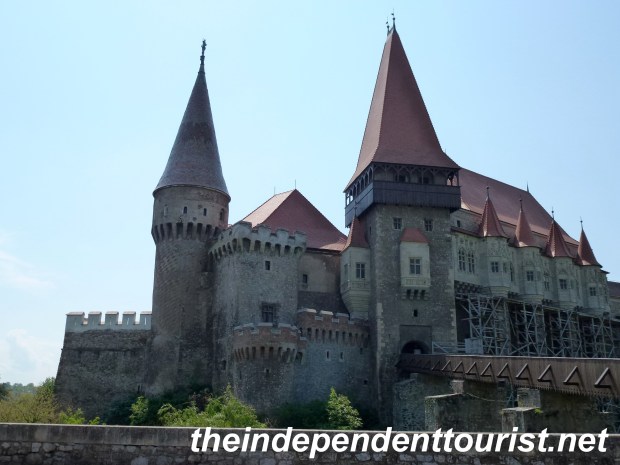
One more view of Corvin…a classic castle, with a long drawbridge over the huge moat.

Jules Verne thought enough of this castle to include it in his book, Around the Word in 80 Days, in 1873. It is one of the great medieval castles in Europe. The entrance fee was 10 lei (3.3 lei to the US dollar) and a photo pass was 5 lei.

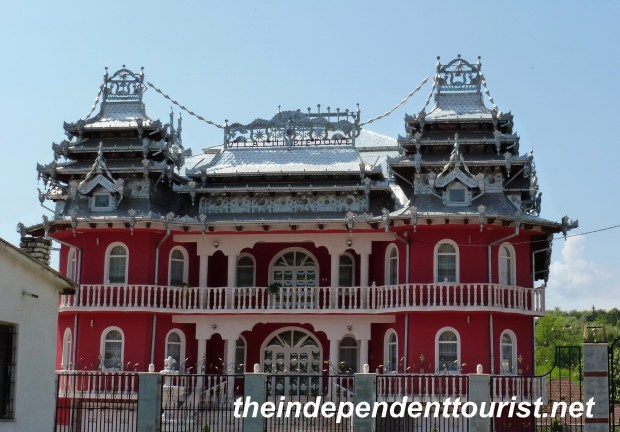
We noticed these very unique metal roofs all over Hundedoara. Hungarian influence?

References: Informational signs throughout Corvin Castle.