England

The Birthplace of Winston Churchill – Blenheim Palace

If you have seen the recent movie “Gulliver’s Travels “(2010) with Jack Black, you may recognize that the palace of the King of Liliput is actually Blenheim palace, just north of Oxford, England (it’s not on the shore of a tiny island as depicted in the film!). Although Jack Black creatively extinguishes a raging fire in the palace, I am happy to report that it is in good shape in real life.

Blenheim Palace (3)

The grand entrance to Blenheim Palace.

Blenheim palace was the birthplace of Sir Winston Churchill (1874), the legendary prime minister of the UK from 1940-1945 and again 1951-55. I read Roy Jenkins’ 1,000 page history of Winston Churchill several years ago.  If you enjoy history, I suggest this book.  He was an extraordinary historical figure—prolific writer, painter, statesman, and political leader during a very dark period of world history.  As I read about this life, I was amazed how much he accomplished — he received the Nobel Prize for Literature and was the first person to be made an honorary citizen of the United States.  There is a good exhibit on Winston’s life in the palace.

Blenheim Palace

A view of Blenheim Palace from the gardens.

Blenheim palace was built in the early 1700’s, and has been the home of the Dukes of Marlborough (the Churchill family) for 300 years. One of the remarkable rooms in the palace is the library, which is 180 ft. long, and was designed by Sir Christopher Wren, who also designed St. Paul’s Cathedral in London. The palace is set on a beautiful country estate, with large manicured gardens.

The palace is open to the public, and contains a number of attractions including the butterfly house, a maze, and cafeteria.

If you are in the vicinity of Oxford (a great city also), be sure to stop by Blenheim Palace.

Blenheim Palace Map

Blenheim Palace is north of Oxford, about 2 hours by car from London.

Southwestern England Part 1: Nunney Castle, Wells Cathedral and Glastonbury Abbey

Southwest England

In August 2009, my wife, son, and I finally made it to Southwestern England—the counties of Somerset, Devon and Cornwall. We had wanted to visit this area for a long time. It is a beautiful area of England, but a little “out of the way” since there are no large cities in this region, and it “dead ends” literally at “Lands End.” This part of England is a little less visited by foreign tourists. It is popular summer destination for the British, however, and during August we found the area full of families and caravans (travel trailers) on vacation. In the U.S., most campers stay in State or National Parks. In England, it seems most of the caravan parks are privately owned, and most campers park in fields, or where possible, close to a beach area. As beaches in England go, the southwest has some of the best in England. Even if the temperatures are in the mid 70’s F, you will find locals out on the beach.

Be aware that many of the roads seem even narrower, more like Wales, with many cars pulling trailers that take up more than half the road, some spots are a very tight squeeze! Pull in your side mirrors to keep them from getting broken or scratched by the hedgerows and passing traffic.

The three sites below are all in close proximity, we were able to visit all 3 on the day of our arrival at Heathrow.

Nunney Castle

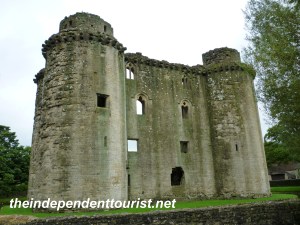
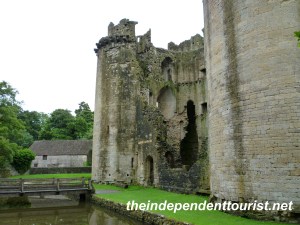
Nunney Castle is in the village of Nunney. It’s a smaller castle and is free of charge. It was constructed in the 1370’s for a veteran of the Hundred Years’ War with France. It has a moat around it, and 3 of the 4 outer walls and all four towers are intact. As with most castles in England, it fell victim to Cromwell’s parliamentary forces in the 1600’s, when castles were no match for gunpowder and cannons.

Another view of Nunney Castle

The castle is part of a park in the village, right next to a stream. It is considered a French design, and reminded us a little bit of Bonaguil Castle in France, with the round towers. Learn more here.

Wells Cathedral – West Facade

Wells Cathedral. Wells Cathedral (its construction is believed to have begun in the 12th century) is world-renowned for its exterior decorations on the West facade (see picture). There were originally 160 statues in niches on the western facade and towers of which 120 remain (another source says 127 of 176 remain–I did not count!).

Wells Market – Cathedral in background

The interior is known for its unusual and innovative inverted arches (making big “X’s” in the transept), to support the weight of the central tower, after the tower showed signs of weakening in the 14th century. Much of the stained glass is original from the 14th century also. Don’t miss the Chapter House and Lady Chapel with their incredible intricate ceiling vaulting. We also enjoyed wandering through the Saturday market in the town square of Wells, right next to the Cathedral.

Glastonbury Abbey

Glastonbury Abbey. Glastonbury town and abbey are steeped in legend going back to biblical times. This is one of the oldest inhabited sites in England. In the 1100’s, religious sites did everything they could to attract pilgrims, so the rumor spread that this was the burial spot of King Arthur and Guinevere, based on skeletons exhumed on the site. Glastonbury, a Benedictine abbey, was one of the richest monasteries in England and even today, the remaining ruins are beautiful. Unfortunately, much of the abbey’s stone was used by the local people for other buildings after King Henry VIII’s dissolution of the monasteries in the 1500’s. The grounds are well-kept, and there are some other interesting buildings on the site, including a 14th century Abbot’s kitchen.

Glastonbury Abbey View

For a great view of the surrounding area, visit Glastonbury Tor (tower) too. It’s a 15th century tower on a hill overlooking the town. There is almost no parking on the road leading to the tower, so I waited by the car while my wife and son quickly climbed up the hill to the tower.

Less Traveled Northern England-Part 3 (of 3): Lindisfarne, Bamburgh, and Hadrian’s Wall


Sites visited in Northern England

Lindisfarne

Lindisfarne or Holy Island, is an ancient sacred Christian site, dating back to 635 AD. The Lindisfarne Gospels manuscript (early 700’s) was written here. I had first heard about this area from a friend in the UK, and I was glad I had the opportunity to visit.

Traveling to Lindisfarne

Lindisfarne

Lindisfarne Castle, on Holy Island.

The only way to visit this little town, abbey ruins, and castle easily, is at low tide, not unlike St. Michael’s Mount in southern England. It is connected to the mainland by a road, and it is an eerie feeling driving out on the wet paved road over the sandy seabed and seeing lots of tide pools, seaweed, and warning signs about the fast rising tides. If you don’t want to spend the night on the island of Lindisfarne, find out about the tides and plan your visit accordingly. Having no idea of the tide schedule, I lucked out and arrived with about 2 hours to spare before the tide came back in, and it was just enough time to visit the abbey ruins and castle. There is a large car park a short way from the little town center and a shuttle that provides transportation to/from the car park and castle, which is probably a 15-20 minute walk. I took the shuttle given the warnings from the driver about when I needed to leave.

Lindisfarne Castle Interior

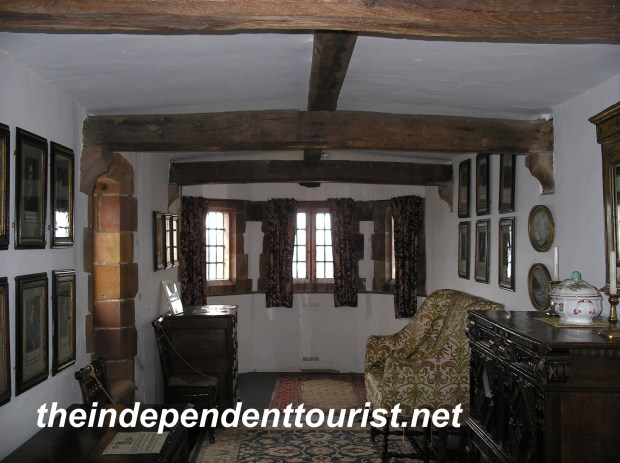
Lindisfarne Castle interior.

The castle (16th century) is very small, and more of a grand bungalow on a rock mound. With the cold weather and the warm fires inside, I was almost transported back 400 years.

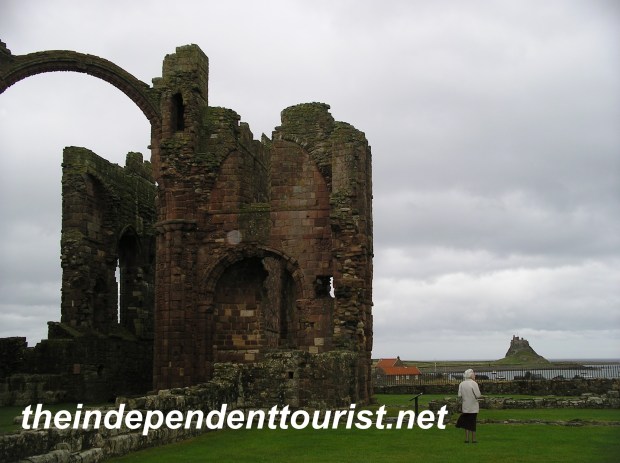
The abbey is in ruins and has a great view of Lindisfarne Castle and Bamburgh Castle. The monks at the abbey had some protection from Viking (and Scottish) raids due to nearby Bamburgh Castle. The area here is windswept and subject to storms and cold weather almost any time of year—even in October.

Lindisfarne Abbey

Lindisfarne Abbey (Lindisfarne Castle in lower right).

It gave me a sense of what it would have been like to have lived here 1200 years ago as a monk—working in a silent, cold room copying manuscripts in these frontier parts of England in ancient times.

Bamburgh Castle

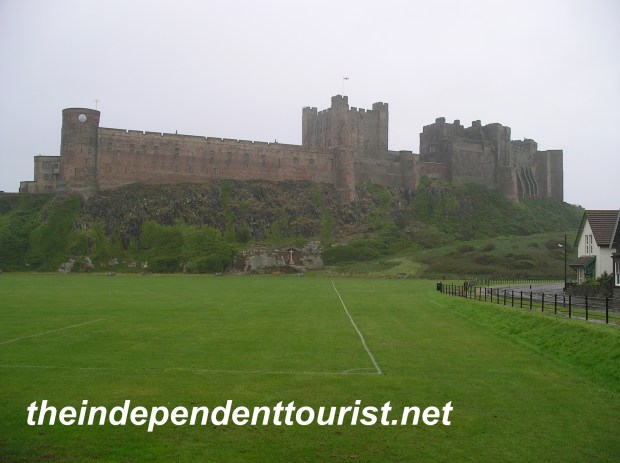
Bamburgh Castle.

Bamburgh Castle

From Lindisfarne, one can see Bamburgh Castle (12th century) just south along the coast sitting on a volcanic outcropping. Once back on the mainland, it takes just a few minutes to drive to Bamburgh. It is a large castle, with a beautiful wood ceiling in the King’s Hall and various displays in the Keep. I think it’s one of the finest castles in England.

Hadrian’s Wall

Hadrian's Wall

Hadrian’s Wall.

From Bamburgh I headed south back towards Newcastle to spend the night. Newcastle is a great jump-off point to visit Hadrian’s Wall, built by the Roman Emperor Hadrian in 122 AD. It is 73 miles long and formed the northern border of the Roman Empire at one point. I visited two spots along the Wall, Chester’s Fort and Housesteads Fort.

Chester's Fort on Hadrian's Wall 2

Chester’s Fort.

These sites are Roman camps along the wall that housed the legions. Both camps are worth visiting and have good interpretive signs. Even in October, I saw a number of hikers along the trail that follows the Wall.

Hadrian's Wall Housestead's Fort 4

Housestead’s Fort latrine.

From Housesteads I drove through the Yorkshire Dales National Park towards Harrogate, which felt like traveling above the tree line in Colorado—a barren, windswept landscape-so different than most of England.


Less Traveled Northern England-Part 2: Durham and Alnwick

Northern England

Sites visited in Northern England.

Durham Cathedral

Durham Cathedral 2

Durham Cathedral.

The next morning I drove north to Durham, to visit its famous Cathedral (completed 1133). I had heard that Durham Cathedral was a great example of Norman architecture, built for both religious and defensive purposes.  The design of this Cathedral is a cross between Romanesque architecture and Gothic. It has a typical Gothic-like three isle nave, with a cross rib vaulted ceiling, but the pillars are much heavier (with interesting decorations), and the side isle arches are rounded— more like other Romanesque-era churches. Be sure to check out the arch stone work in the Galilee Chapel. The Cathedral overlooks the River Wear and I recommend going for a short walk along the river to get a good view of the Cathedral, and enjoying the peaceful river setting.

Durham Castle

Durham Castle.

Durham Castle is right next door, but since it is part of Durham University, and classes were in session, a tour was required and I did not take the time to wait for the tour.

Alnwick (“Ahn-ick”) Castle

Alnwick Castle 2

Alnwick Caslte.

Although I have not read the Harry Potter books, I had heard that this castle was used for scenes from the first movie (during the Quidditch game). What a classic castle. It is the second largest inhabited castle in England (dates from 1309, the home of the Duke and Duchess of Northumberland) and has been well maintained. It sits on a large green estate on the edge of Alnwick town, overlooking the River Aln and valley. The landscape surrounding Alnwick Castle is some of the prettiest I’ve seen in England.

Alnwick Castle 6

Alnwick Castle from River Aln.

Less Traveled Northern England-Part 1: York, Scarborough and Whitby

I have to admit that although I have visited England at least 13 times, I still feel the excitement of the anticipation of seeing another “undiscovered” castle or town when my plane lands at Heathrow airport. I hop off the plane and breeze through the immigration process and then take the shuttle to the rental car (“car hire”) lot on the airport perimeter for a day or two of sightseeing before a week of work. After navigating my first of many roundabouts for the day, I regain the feel of driving on the left side of the road and then I’m ready to go.

Northern England

Sites visited in Northern England.

Renting a car is an economical way to see the UK. I usually use National or Alamo Car Rental. It is a convenient way of visiting many sights that are hard to get to by train. UK train travel has become quite expensive, due to deregulation of the train system, and as a consequence, the highways have unfortunately become more crowded.

Northeast England is a remote, less visited region of England, and yet it has some of the finest medieval and Roman sites in the UK. It’s about a three hour drive from Heathrow up the M1 Motorway to Leeds and then about 45 minutes east along the A64 to York. Beyond York north and east are the sites of Scarborough Castle, Whitby Abbey, Durham Castle and Cathedral, Hadrian’s Wall, Alnwick Castle (of Harry Potter fame), Lindisfarne Castle and Abbey, and Bamburgh Castle. There are a number of castles on the northeast coast due to the long history of Scandinavian raiders, even back to the time of the Romans.

York

The road signs on the outskirts of York (on the A64) warn drivers to park in one of the park-and-ride lots and not to try driving into the town. I have visited York twice, both times in October, and had no problem parking right in town at that time of year.
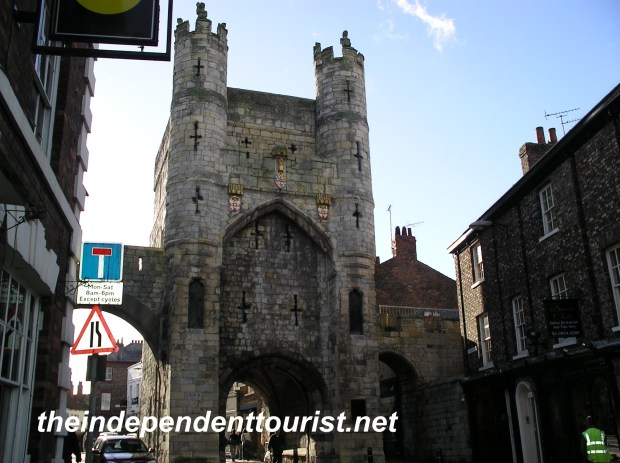
York Gate

One of several city gates in York.


York Wall and Minster

York City Gate and Minster.

The York Minster (13th century) is one the largest churches in northern Europe. York Minster is a great example of medieval Gothic architecture and has beautiful stained glass from the 15th century. Inside the cathedral, be sure to buy a ticket to check out the underground area of the Minster to see the early foundation work and also evidence of the original Roman city engineering with water drainage channels still in use.
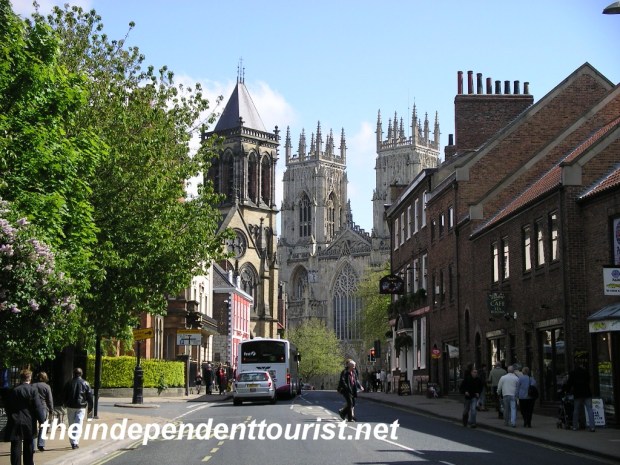
York

View of York and the Minster.

Other things to do in York include walking the walls of the old city, visiting the city’s medieval gates, St. Mary’s Abbey ruins, the York Shambles (a narrow medieval street) and Clifford’s Tower, the only surviving part of York Castle, and the site of a Jewish massacre in 1190.

Scarborough
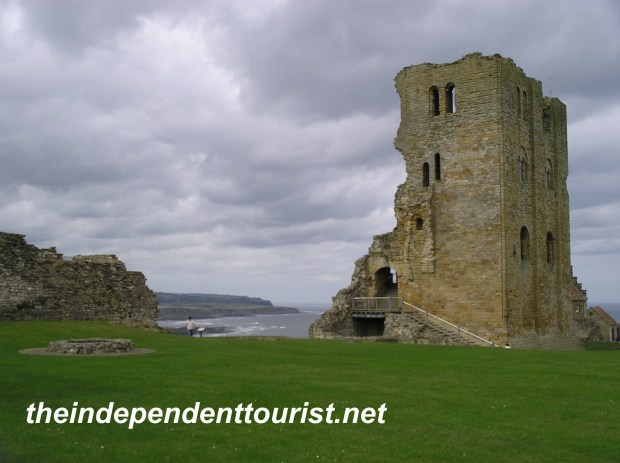
Scarborough Castle 2

Scarborough Castle.

From York I drove out to Scarborough, which is about 1 hour by car. Scarborough Castle is a ruin, but it commands a pretty spot on a high bluff overlooking the coast and North Sea.  There are also foundation ruins from a Roman lighthouse here. Of all the attractions on the Northeast coast of England, this is one that can be skipped without missing too much.

Whitby
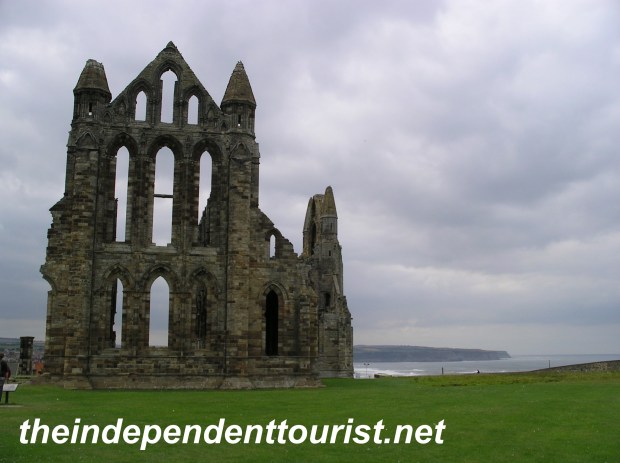
Whitby Abbey 4

Whitby Abbey.

From Scarborough, it is a short trip up the coast to Whitby, which must be an English weekend “getaway” town. I saw lots of locals strolling around the town on the weekend, and sailboats coming back into the harbor in the afternoon. My main interest was visiting the abbey ruins that sit on a bluff overlooking the town and sea. I love old abbey ruins, and the ruins of Whitby (12th century) are considered some of the finest from the medieval period.

Whitby Town

Whitby Town.

I spent the night in Darlington (south of Durham) after a full day which included driving to northern England from Heathrow airport, stopping in York (short visit since I had been there before), and visiting Scarborough and Whitby.