Turkey

The Gate to Hell: The Ancient City of Hierapolis and Travertine Terrace Pools of Pamukkale

The theater at Hierapolis could seat 20,000.

The theater at Hierapolis could seat 20,000.

Put these sights on your “don’t miss” list in Turkey. The combination of the ruins of Hierapolis and the terraces of Pamukkale, famous for the brilliant white travertine pools make this an unforgettable destination. Hierapolis was founded in 190 BC and became part of the Roman Empire in 133 BC. Later on it was part of the Byzantine Empire and eventually faded into obscurity in the 6th century. Among other things, it was a spa town known for its thermal baths, and the warm water still runs here.

The northern gate to Hierapolis.

The northern gate to Hierapolis.

An elevated tomb at the extensive necropolis of Hierapolis.

An elevated tomb at the extensive necropolis of Hierapolis.

The Nymphaeum - in ancient times there would have been fountains everywhere on this structure. This is near Pluto's Gate.

The Nymphaeum – in ancient times there would have been fountains everywhere on this structure. This is near Pluto’s Gate.

The “Gate to Hell” reference applies to a spot on the site known as Pluto’s Gate (Pluto was a deity of the underworld), and the lethal vapors bubbling up from the waters running underneath the city were used to sacrifice animals as part of sacred pagan rites, with hallucinating priests performing the ceremonies (not unlike Delphi in Greece). This spot was undergoing excavation during our visit in 2012, and a recent article confirms this historical reference. Also, it’s believed that the apostle Philip met his death here (by stoning and crucifixion) in AD 80.

Frontinus Street - the main thoroughfare in Hierapolis.

Frontinus Street – a main thoroughfare in Hierapolis.

Swim in the warm waters among the ruins.

Swim in the warm waters among the ruins.

You can swim among the ruins, and this water is the basis for the white travertine terraces, which are just at the edge of the ancient city on a ridge overlooking the town. Pamukkale means “cotton castle” which is an apt description as you gaze at the terraces from below. The travertine terraces are formed from white limestone residue as the carbon dioxide escapes the water.

Where the ruins and travertine meet - this tomb is half-buried by the travertine residue.
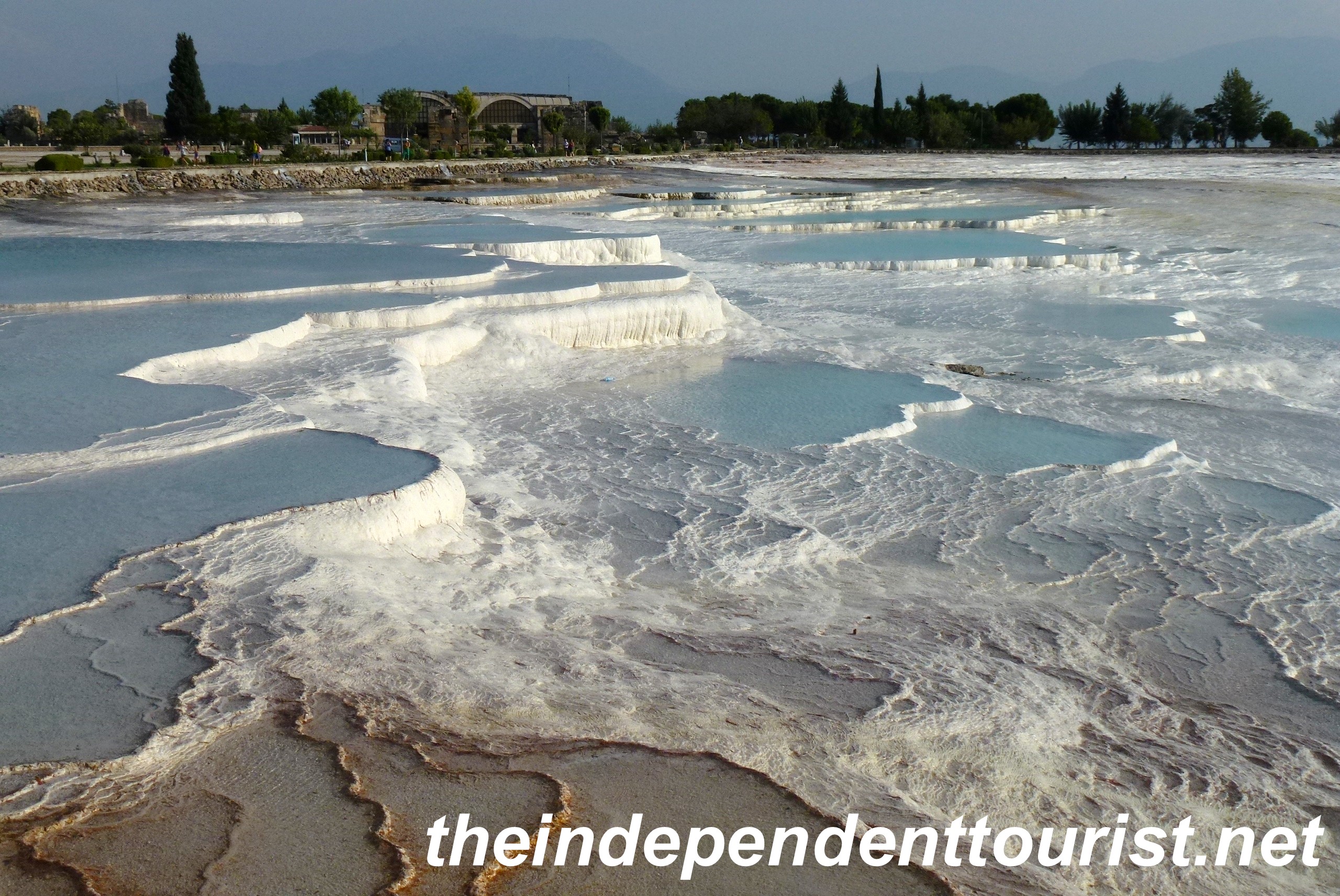
Where the ruins and travertine meet – this tomb is half-buried by the travertine residue.

Some of the travertine terraces at Pamukkale.

Some of the travertine terraces at Pamukkale.

The setting sun reflecting on the travertine pools.

The setting sun reflecting on the travertine pools.

A few practical tips:

  • Visit the site in the afternoon (there is a parking fee of 5 TL and an entry fee of 20 TL per person (1.8 TL per USD) for both the ruins and travertine pools). By late afternoon the mobs and tour buses are leaving. We arrived about 3:30 pm (in September) and this was perfect timing to see everything and to watch the setting sun reflecting in the travertine pools.
  • Keep in mind the ruins of Hierapolis are significant and spread out. Depending on your interest in ruins, you can easily spend 2-3 hours exploring.
  • An ‘artificial’ section of the travertine pools are open for visitors to walk on.  Plan to take your shoes off and roll up your pants. The water is warm and the surface is a bit slippery.

    Walking and wading in the pools.

    Walking and wading in the pools.

  • The thermal pool with the marble column ruins is expensive and requires a separate entry fee which is about $30 US per person. We skipped the swimming but enjoyed the ambience. There is a snack shop right there and you can enjoy the picturesque setting for the price of a soft drink.
  • We stayed at the Hotel Venus in Pamukkale. It was an excellent small hotel, with a pool, nice large rooms, a very good restaurant and great breakfast buffet. It is just 5 minutes or so by car to the ruins. The room was €35 per night.

    Another excellent Turkish meal at the Hotel Venus, where we stayed.

    Another excellent Turkish meal at the Hotel Venus, where we stayed.

  • Pamukkale (which is about 15 km from the large city of Denizli), is a quiet little village and a great place to stay. The drive from Fethiye (on the south coast) took approximately 4 hours (about 200 km, on country roads).

Also fairly close to these sights are the ruins of Aphrodisias, which I will cover in a separate post.

References: DK Eyewitness Travel Turkey, 2008. Lonely Planet – Turkey, 2010.
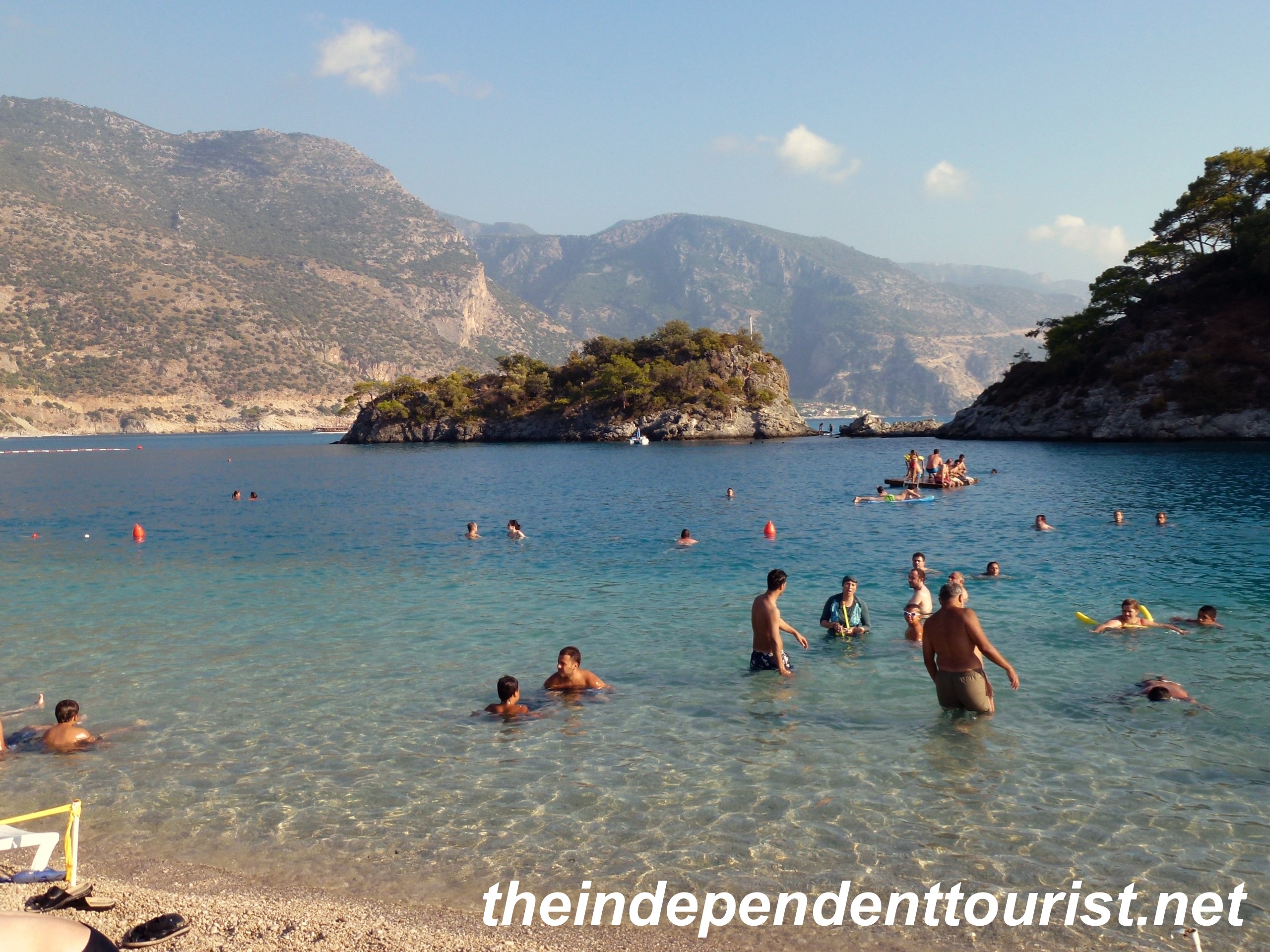
Ölü Deniz Beach – One of Turkey’s Best (and everyone knows it)

The little islands protect most of the beach, making the water very calm.

The little islands protect most of the beach, making the water very calm.

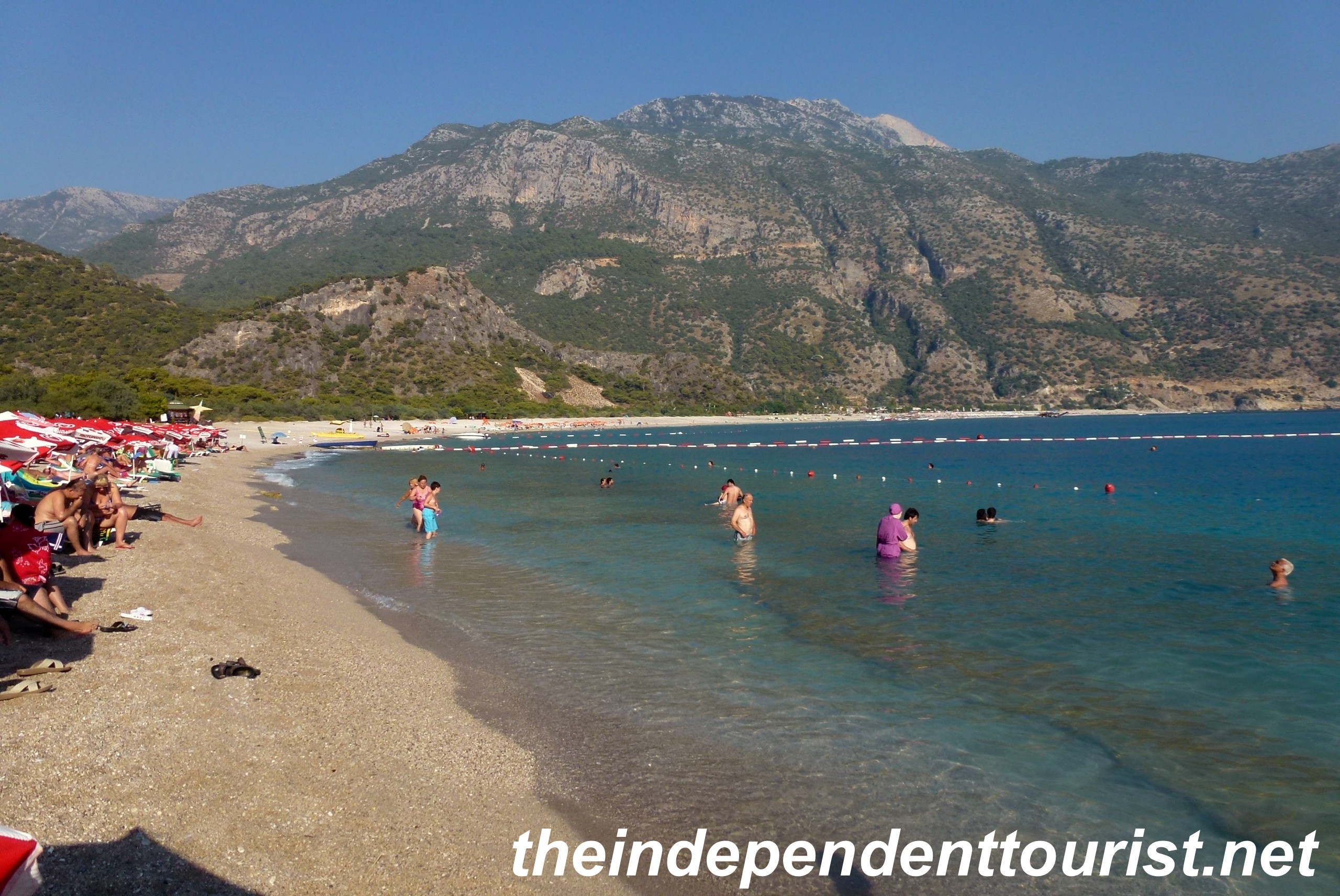
Ölü Deniz beach is about 15 km from Fethiye, and one of the most famous beaches in Turkey. This beach is well known for a number of reasons – its image is on many posters promoting Turkish tourism, it’s a paragliders paradise, calm water, its beautiful setting, a long stretch of lengthy, clean white pebbly “sand,” and a shallow lagoon behind the main beach that’s perfect for toddlers. (Ölü Deniz means ‘dead sea,’ an apt description since the water is so calm).

The long beach at Ölü Deniz.

The long beach at Ölü Deniz.

There is a roped-off safe swim area at this beach.

There is a roped-off safe swim area.

The beach is well-developed, with bathroom facilities, lounge chairs for rent and several snack bars. The entry fee was 7 TL (1.8 TL to 1 USD) per car.  The nearby little village of Ölü Deniz is a hangout for tourists and backpackers, since this is the start of the Lycian Way, which winds its way eastward, ending near Antalya.

This end (near the lagoon) of the beach is quite crowded in the afternoon. Oh well, still a good spot.

This end of the beach (near the lagoon) is quite crowded in the afternoon. Oh well, still a good spot (note the paragliders above the mountain ridge, known as Baba Daği).

Although crowded in late afternoon, we still loved it and I would go back in a hearbeat! We stayed in Fethiye at the Hotel Doruk, a great hotel with a view of Fethiye harbor, although parking a car was a challenge (just a narrow little side street for parking). The hotel was 75 Euros/night. There are some ruins in Fethiye also, but given our short stay and many other stops for ruins we didn’t take the time to visit the ones here.

The restaurant at the Hotel Doruk, overlooking the pool and harbor.

The restaurant at the Hotel Doruk, overlooking the pool and harbor.

Pinara – A Lycian Gem

If you enjoy visiting ancient ruins without throngs of people everywhere, check out Pinara, located northwest of Kaş, not too far from Fethiye. This part of Turkey (known as the Lycian Way) is very scenic. (For a map of sites visited in Turkey, click here).

Kalkan Beach, one of the “postcard” images of Turkey. This stunning beach is just west of Kaş, right where the road turns north and inland towards Pinara.

Kalkan Beach, one of the postcard images of Turkey. This stunning beach is just west of Kaş, right where the road turns north and inland towards Pinara.

Pinara was one of the six major Lycian cities (beginning about 7th century BC). The better-known ruins of Xanthos, which was the capital of Lycia, are nearby as well as the ruins of Letoön.

A view of the theater at Pinara from the agora.

A view of the theater at Pinara from the agora.

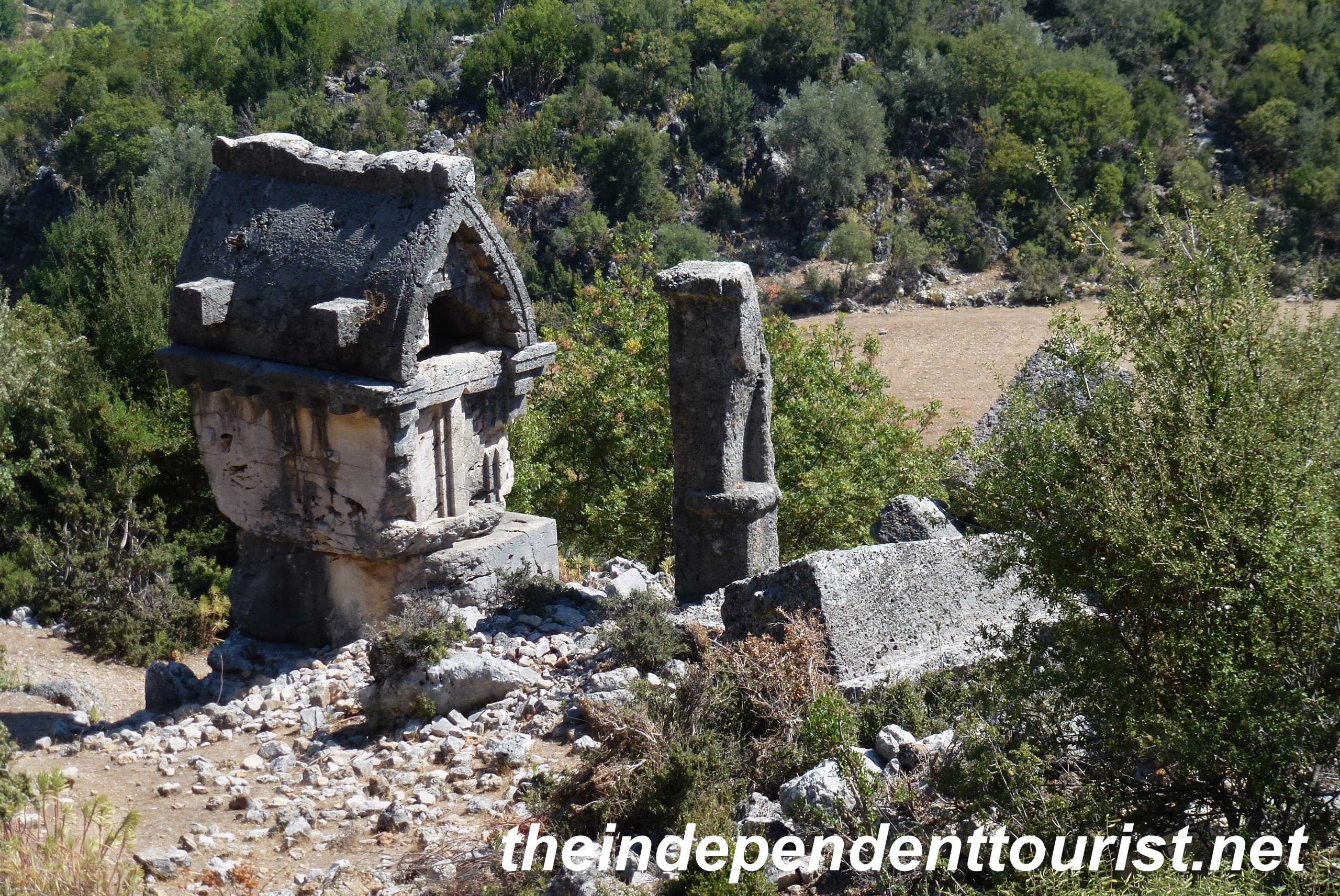
A free-standing tomb at Pinara.

A free-standing tomb at Pinara.

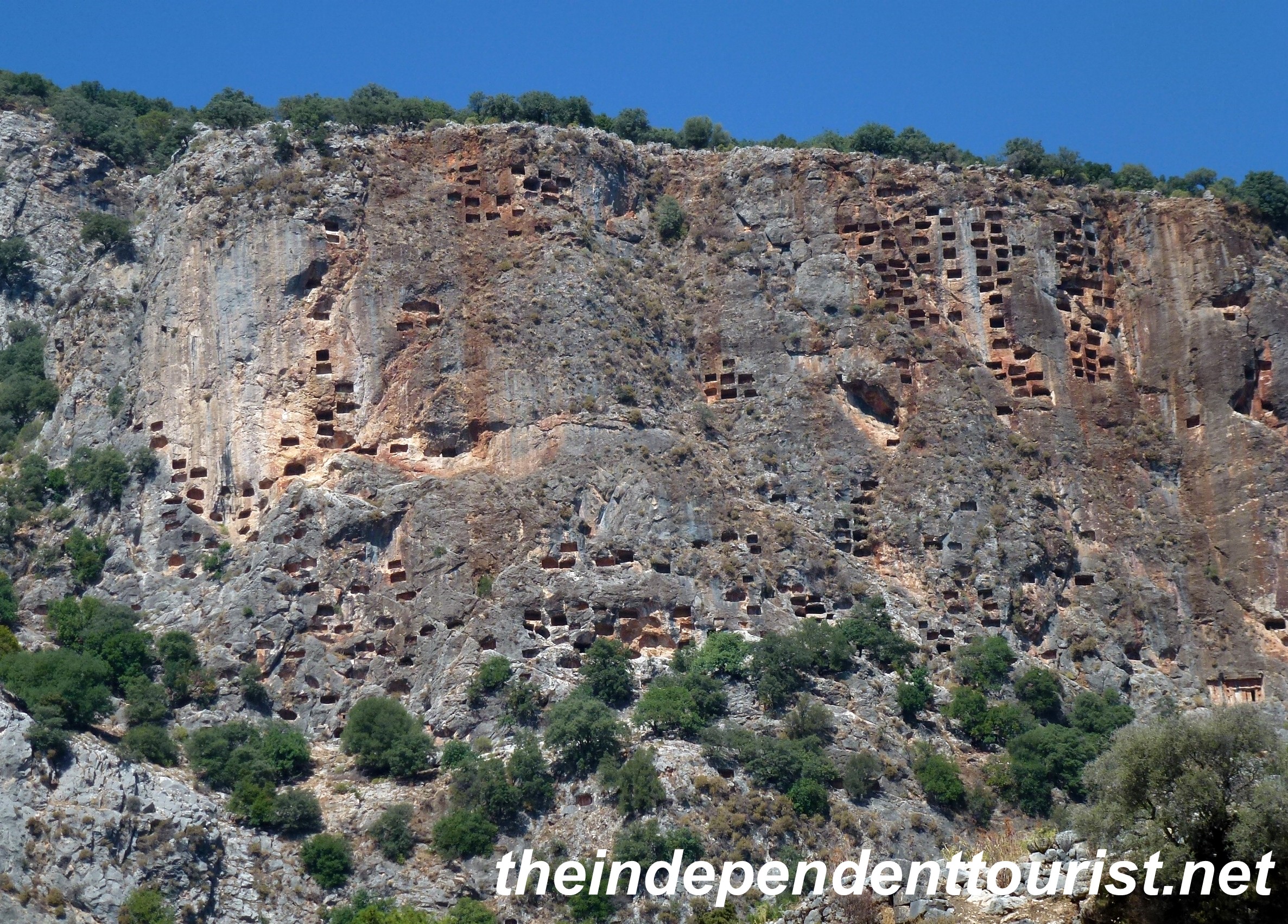
A view of Pinara from the theater.  The hilltop in the middle of the picture is round, giving Pinara it's name. The hillside is covered with tombs cut into the rock cliffs.

A view of Pinara from the theater. The hilltop in the middle of the picture is round, giving Pinara its name (Pinara means “round”). The hillside is covered with tombs cut into the rock cliffs.

Pinara_Turkey (13)

A closer view of the hillside – note the rock-cut tombs into the hillside. How did they do that?

Pinara is a large site and we moved our car a couple times to different locations to save some hiking back and forth. A short history of the site is posted at the entrance but no map was available. Signs point the way to some of the main ruins, but be sure to hike beyond the area around the first parking lot, since there are numerous hidden ruins along faint trails.

Practical Information

Pinara is about 6 km off the main road (D400). The last 2 km of road is dirt/gravel, which is passable by autos.  There were two caretakers at the site, and basic restrooms.  Bring your own water and snacks. The entry fee was 5 TL (1.8 Turkish Lira per USD). The easiest way to visit is by rental car; a brown sign on the main road marks the turnoff to the site, as with other tourist sites throughout Turkey.

One of the house tombs at PInara.

One of the house tombs at Pinara.

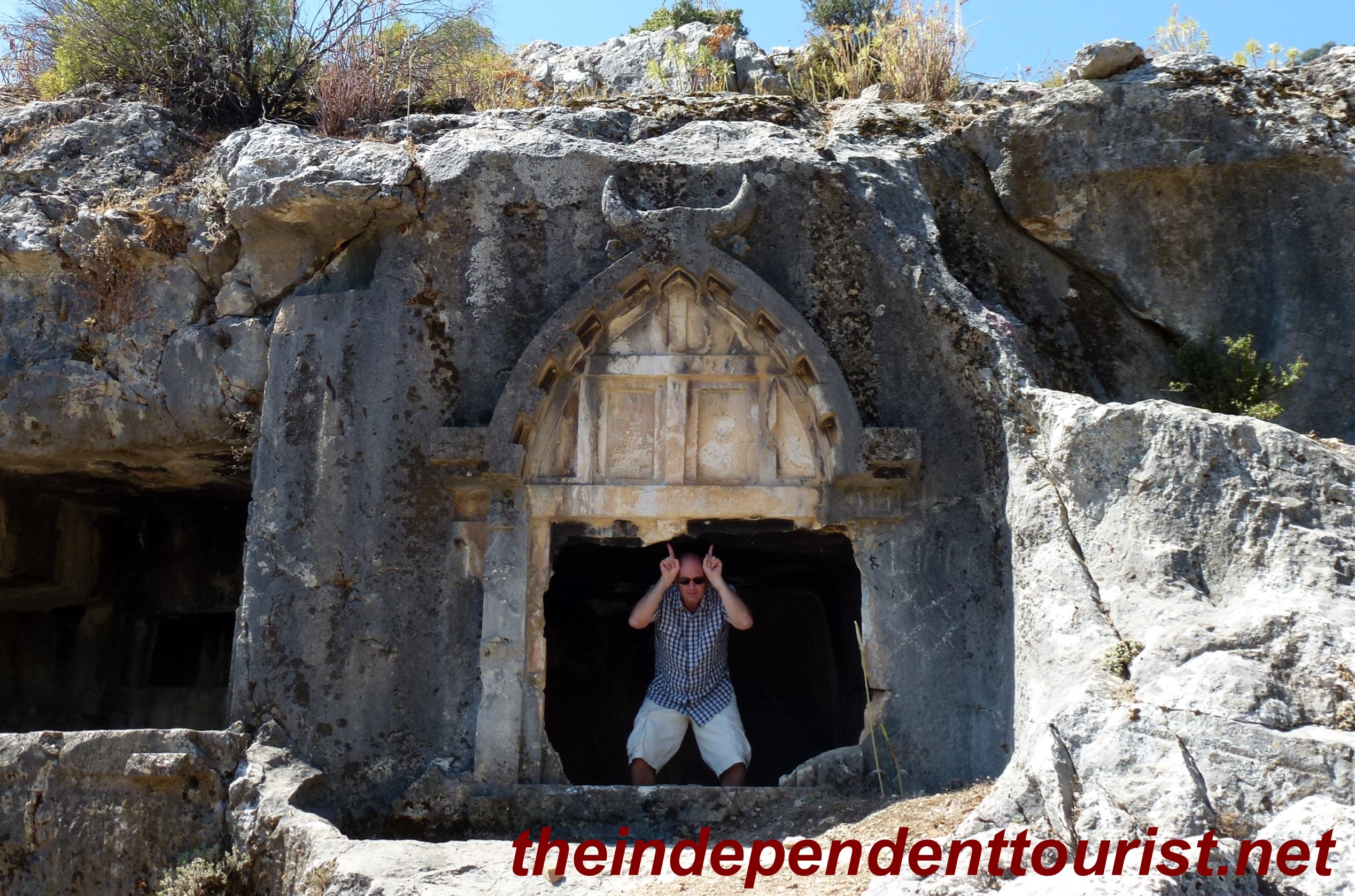
The "Bull-Headed" sarcophagus (note the top of the tomb), near the agora.

The “Bull-Headed” sarcophagus (note the top of the tomb), near the agora.

Allow at least two hours for your visit. A variety of ruins can be explored—a theater, temple foundations, tombs carved out of rock and free standing, an agora, and baths.  We also went up a steep dirt road a few kilometers behind Pinara just to explore the countryside.

I loved this place—the ruins are extensive and interesting, the countryside is scenic, and the fact that there are almost no tourists makes it a great stop.

The temple foundations at Pinara - note the fine stone-fitting work.

The temple foundations at Pinara – note the fine stone-fitting work.

From Phaselis to Kaş, Turkey – Land of the Sun (and Santa Claus)

We drove westward along the southwestern coast of Turkey from Antalya to Kaş in one day, although it’s a pretty long day (187 km of winding and beautiful coastal road) including several stops. After our first stop at the great beach and ruins of Phaselis (click here), we continued westward stopping at Cirali and Myra before getting to Kaş for the night (for a general map of our stops click here). This stretch of southwestern Turkey is known as the Lycian Way, due to the ancient Lycian civilization which inhabited this area and left many traces behind.

Cirali

This is a laid-back backpacker’s beach hangout about 7 km from the main highway with cheap ‘treehouse’ accommodations (think sleeping bags on wooden floors above ground level in the open), very casual outdoor cafes and a good (although with very little shade) beach. No wonder this stretch of Turkey is known as the Land of the Sun.

Examples of the "tree house" accomodations in Cirali.

Examples of the “tree house” accomodations in Cirali.

The beautiful beach at Cirali.

The beautiful beach at Cirali.

Not far from here are the enduring flames (from escaping natural gas), known as Yanartaş (“burning stone”), but since we visited during the day, we did not take the 2 km hike to the flames.  If you try to blow them out, they immediately light again. In ancient times, these flames helped provide a beacon to ships. This beach is also close to the ruins of Olympos, which we unfortunately did not have time to visit.

Myra (near Kale, AKA Demre)

The history of Myra and Lycia - Land of the Sun.

The history of Myra and Lycia – Land of the Sun.

Myra - note the tombs in the hillside.

Myra – note the tombs in the hillside.

View of the rock carved tombs at Myra.

View of the rock carved tombs at Myra.

The ancient city of Myra is just 2 km inland from Kale (no problem locating it with the excellent road signs). Myra dates from 5th century BC and was a significant port city. It was one of the major cities of the Lycian League. Myra is mentioned as a stopping point in St. Paul’s journey to Rome in 60 AD (see the New Testament, Acts 27:5).

Stone carving of actors' masks at the theater in Myra.

Stone carving of actors’ masks at the theater in Myra.

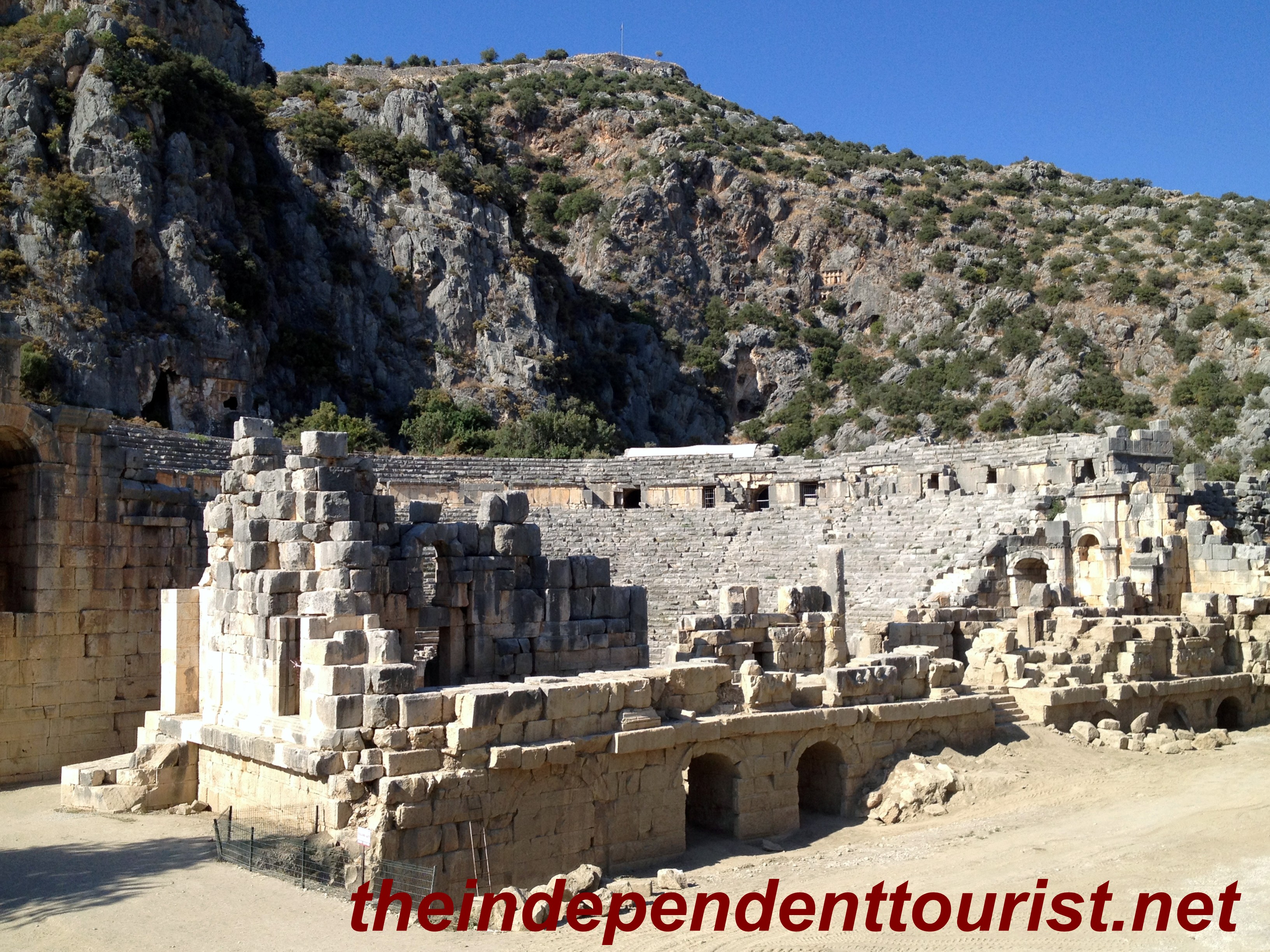
The Roman theater at Myra.

The Roman theater at Myra.

It became part of the Roman empire in 43 BC. Later, in the 4th century under the Byzantine Empire, Myra had its own bishop, St. Nicholas (died 343 AD), who eventually became today’s Santa Claus (“Jolly Old St. Nicholas…”).  St. Nicholas is the patron saint of Russia and lots of Russians love to make the pilgrimage here. The theater at Myra is huge and the nearby house tombs on the hill are a great example of Lycian architecture. The entry fee was 15 TL per person (1.8 Turkish Lira per USD).

Another view of the theater at Myra - there is a fortress at the top of the hill in the distance and tomb in the distance above the theater.

Another view of the theater at Myra – there is a fortress at the top of the hill in the distance and tomb in the distance above the theater.

Kaş

If I had had any idea how much there was to do around Kaş (pronounced “cash”), we would have spent more than one night here.

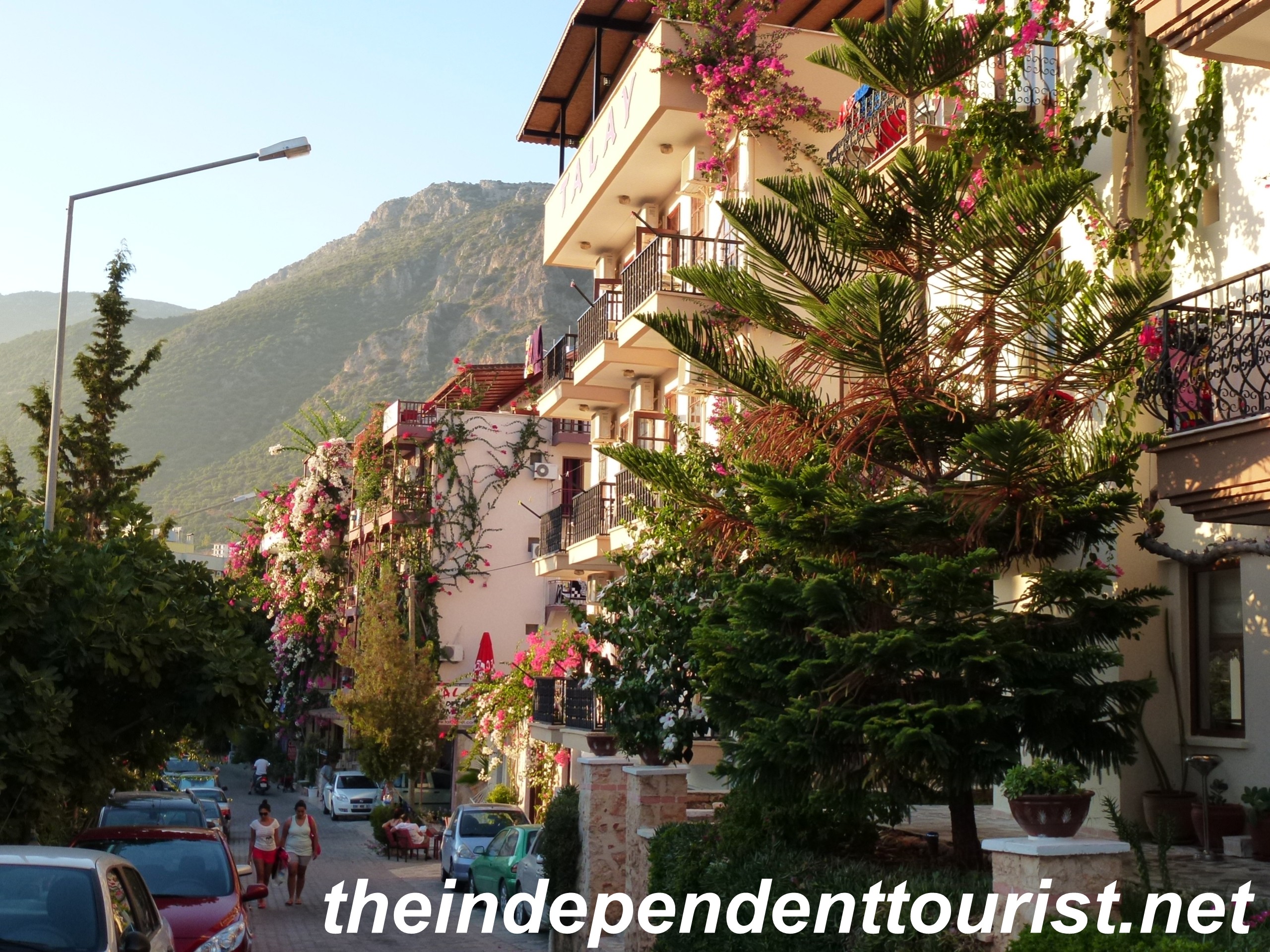
A street scene in Kas. The bougainvillea are everwhere.

A street scene in Kas. The bougainvillea are everwhere.

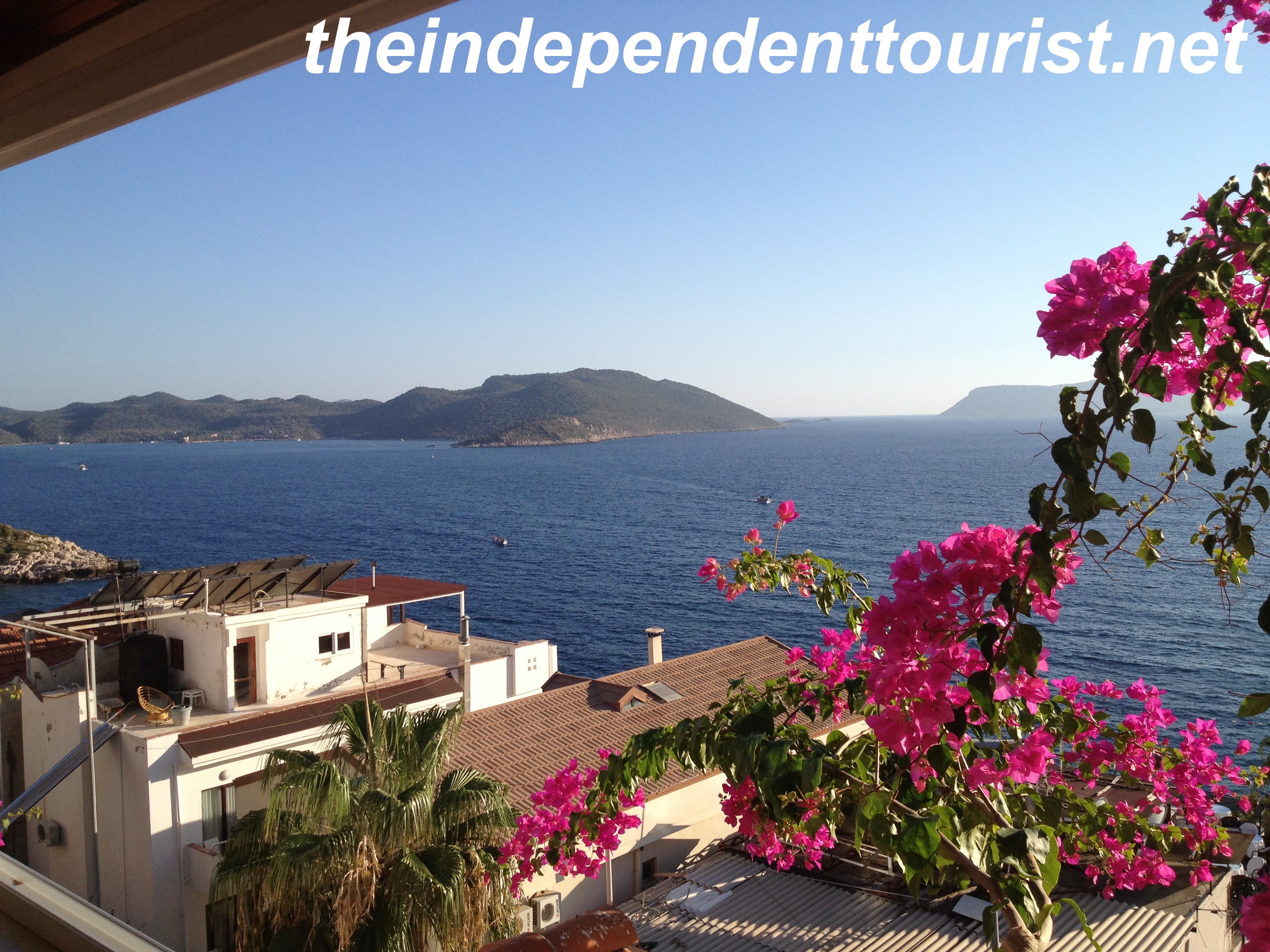
The town is in a beautiful setting, nestled on a steep hillside, with views of the Greek island of Meis (or Kastellorizo) just offshore. We had a good hotel here (Hotel Kayahan), with a fantastic view overlooking the harbor. The only downside to the hotel was that parking is extremely limted–we ended up parking about 200 yards away in a town square.

View from the terrace of the Kayahan Hotel.

View from the terrace of the Kayahan Hotel.

The terrace dining area of the Kayahan Hotel.

The terrace dining area of the Kayahan Hotel.

There are lots of day-trips by boat to be had out of Kaş, with options including secluded beaches, snorkeling, sea kayaking, sunken ruins (such as Kekova Island), a ferry ride to Meis or just lazing around Kaş itself. It would be very easy to spend an entire week in this spot with no chance of getting bored.

Phaselis – Where Antiquity and the Blue Mediterranean Meet

One of my favorite stops in Turkey was the quiet beach park and historic site of Phaselis, which is 58 kilometers west of Antalya. Can you imagine anything better than relaxing on the beach of your choice in one of three small bays, each overlooking the calm, clear, blue water–surrounded by pine trees, with Roman ruins right behind you? I can’t! It is a picture-perfect setting. For a map of this location, click here.

A perfect setting - one of the three bays at Phaselis.

A perfect setting – one of the three bays at Phaselis.

Some of the ruins are right next to the water!

Some of the ruins are right next to the water!

History of Phaselis

Phaselis has a long history, having been founded in the 7th century BC and belonging to many kingdoms over the years. It was a strategic location, with a great harbor. Phaselis was a major trading partner with Syria, Greece, Egypt and other Mediterranean countries. Its main exports were timber, lilium (lily) oil and roses. It was a prosperous community that didn’t worry too much about its overseers.  Alexander the Great came through in 333 BC and the city decided that rather than fight him, they would welcome him outside the city gates with a golden crown–a smart move. Alexander spent time here peacefully before moving on.

The Roman Theater at Phaselis.

The Roman Theater at Phaselis.

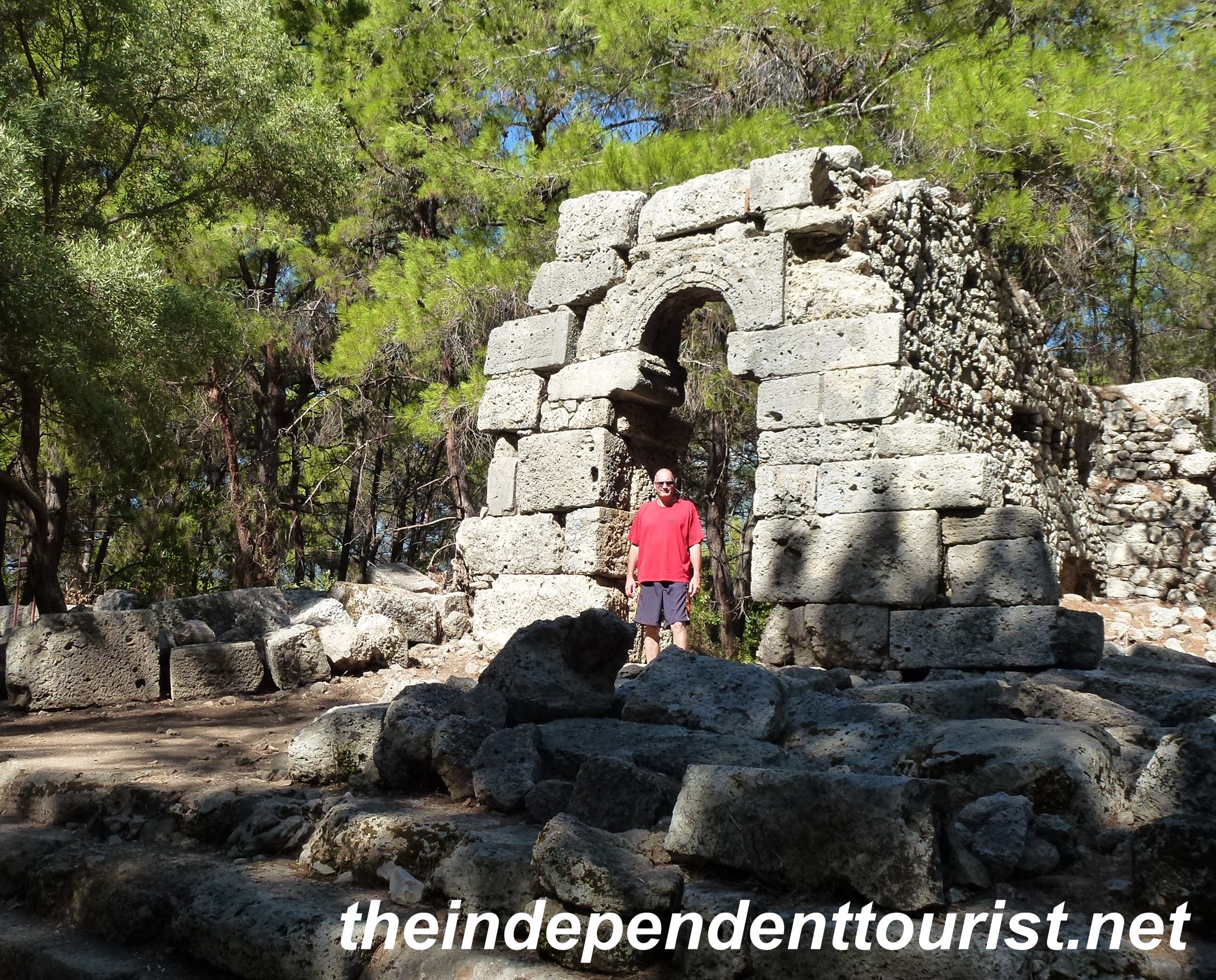
In the agora at Phaselis.

In the agora at Phaselis.

The main street in Phaselis, heading down to the largest bay and harbor.

The main street in Phaselis, heading down to the largest bay and harbor.

Phaselis became part of the Roman Empire in 43 BC and enjoyed 300 years of peace and prosperity. After a brief decline, the city experienced a renaissance of sorts in the 8th century and continued on until it was abandoned during the collapse of the Byzantine Empire  in the 13th century. Much of what we see today are the Roman and Byzantine-era ruins.

Practical Information

Phaselis is a park, with picnic tables, nice restrooms (with showers) and a few small snack stands. The entrance fee was 8 TL per person (1.8 Turkish Lira to the USD). The best way to reach Phaselis is by car from Antalya, either as a day trip or, (as we did) as a stop on the way to Kaş. Day-trip boats from Antalya also bring tourists to spend the day snorkeling and swimming.  The area is big enough that even with a few tourist boats it does not feel crowded—in fact we had the middle bay pretty much to ourselves.

The largest bay at Phaselis with a few boats.

The largest bay at Phaselis with a few boats.

Reference: Information sign-posted in park.

Termessos – A City That Defied Alexander the Great

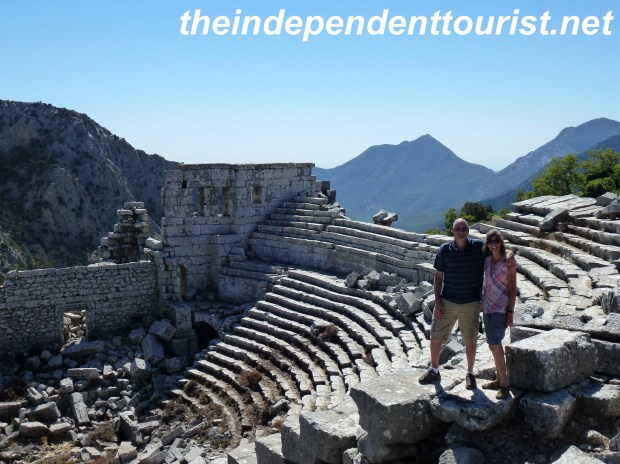
A view of the theater at Termessos.

A view of the theater at Termessos.

A visit to the ancient city of Termessos is a great half-day trip from Antalya, Turkey.  We visited Termessos in the morning and then took a refreshing dip in the Mediterranean Sea at the Konyaalti Beach Park near Antalya in the afternoon. The ruins are about 35 km inland and sits in a narrow and high mountain valley—the road up to the site is good, although winding and somewhat steep. Anciently, this region was known as Pisidia, and due to the fierceness of the people and its strategic defensive location, Alexander could not conquer Termessos (in 333 BC). The Romans who came later chose an alliance with Termessos rather than risk war in 70 BC.

Part of the gymnasium ruins at Termessos.

Part of the gymnasium ruins at Termessos.

The ruins include a large theater in a dramatic setting, an agora, temples, tombs, a gymnasium, necropolis and remnants of houses.

The Tomb of Alcetas - note the figure on the horse above my shoulder.

The Tomb of Alcetas – note the carved figure on the horse above my shoulder.

A dramatic backdrop for the theater at Termessos, which held 4,000 people.

A dramatic backdrop for the Termessos theater, which held 4,000 people.

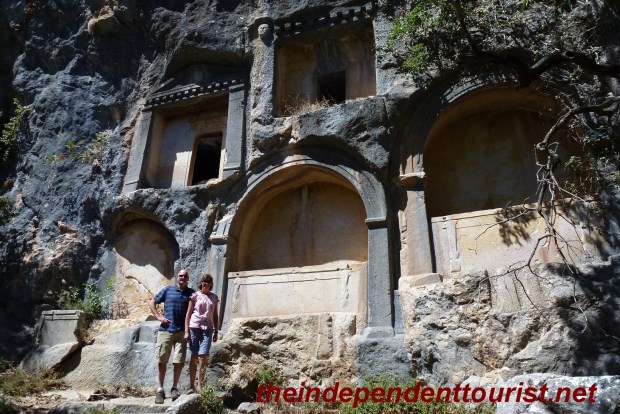
Some of the rock-carved tombs at Termessos.

Some of the rock-carved tombs at Termessos.

Practical Information

There are some interpretive signs at the site and also a small map available at the entrance. The ruins are inside the large Termessos National Park, which is known for its abundance of wildlife. At the entrance to the park is a restaurant and small botanical museum.  From the entrance, a 9 km paved road takes you up to the parking area at the base of the ruins. You will see ruins of some buildings and the massive walls on the road up to the site, giving a feel as to how large this city was.

There are toilets at the ruins but no water or snacks, so bring these items with you. It is a bit of a hike from the parking lot up to the main site, which is large, and mostly hidden from view from the base. The trails are fairly steep, so be prepared with good hiking shoes.  I suggest a loop route, going from the parking lot up to the left of the Artemis-Hadrian Temple (as recognized by the large doorway arch) and returning on the trail to the right (or behind the Artemis-Hadrian Temple). This return trail passes a number of interesting tombs in the rock hillside (see picture above).

The Temple of Artemis-Hadrian near the parking area. The trail behind this temple goes up to some tombs.

The Temple of Artemis-Hadrian near the parking area. The trail behind this temple goes up to some tombs.

Due to the climb from sea level, Termessos is definitely cooler than Antalya and was very comfortable in September. The entry fee was 5 TL per person (1.8 Turkish Lira (TL) to 1 USD in 2012).

Konyaalti Beach Park. On your way back to Antalya, stop at this great beach. There was a 4 TL parking fee, but the beach is free. The water and beach were very clean.

Konyaalti Beach - a great way to spend the afternoon after hiking around Termessos.

Konyaalti Beach – a great way to spend the afternoon after hiking around Termessos.

Antalya – The Gateway to the Lycian Way

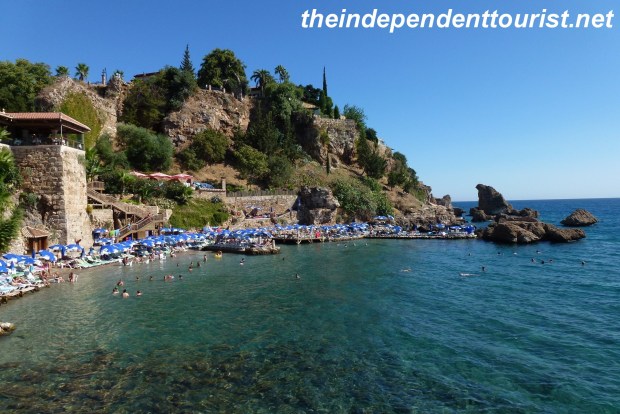
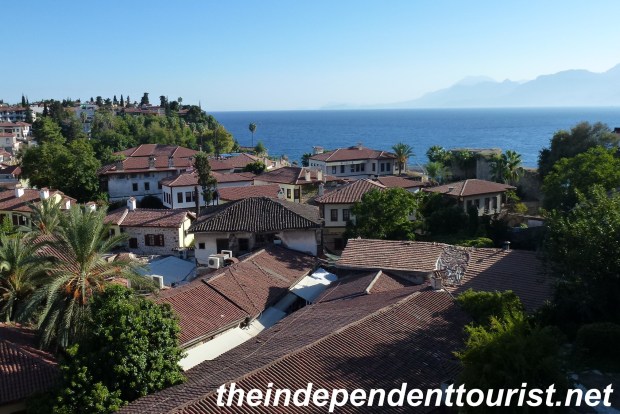
A view of the old town of Antalya with the blue Mediterranean and mountains in the distance.

From Cappadocia we flew to Antalya (via Istanbul). Antalya is on the southwestern coast of Turkey, and has a beautiful setting, centered on a small scenic harbor with pebbly beaches and mountains nearby. It would be easy to spend a week here, by making Antalya your base for exploring this part of Turkey. We spent two nights at the Atelya Hotel in the heart of the old city (parking is tight in the old town, but the hotel had a smal enclosed parking area). For a map of our locations visited in Turkey please click here.

The beautiful coastline of Antalya. We ate at an excellent restaurant overlooking this beach.

The beautiful coastline of Antalya. We ate at an excellent restaurant overlooking this beach.

Anciently, there were six major cities that made up the Lycian League. The Lycian Way is a pathway that more or less follows the coast from Antalya west to Fethiye, connecting these ancient cities and wandering through the forests and along the coast. We were lazy and made this trip by car.

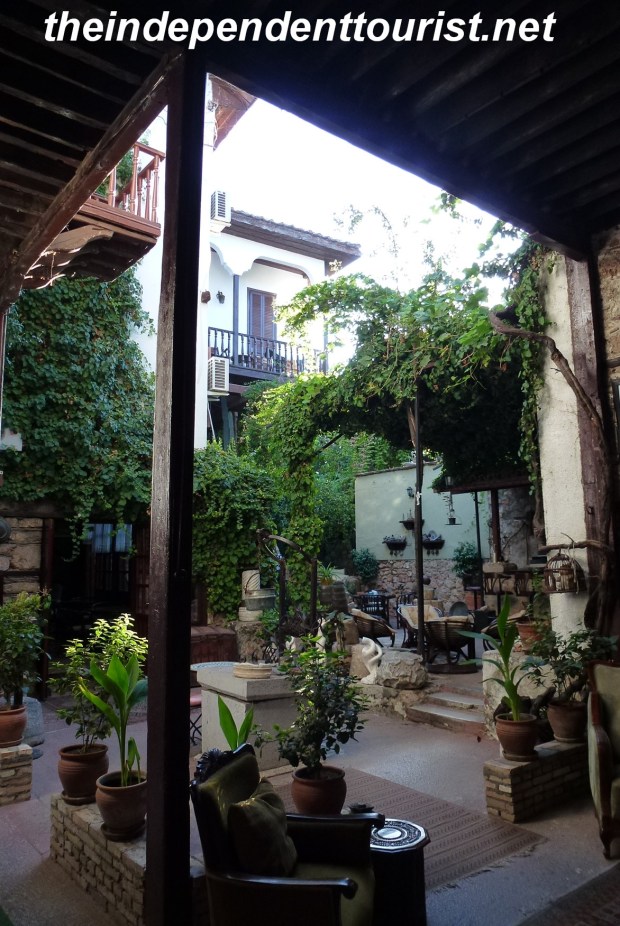
The interior courtyard of the Atelya Hotel, in the old part of Antalya.

The interior courtyard of the Atelya Hotel, in the old part of Antalya.

Antalya was founded in 159 BC and prospered in the Roman, Byzantine and Ottoman periods. There are remnants from these historical eras scattered around the town including walls, towers, mosques, minarets and gates still standing.

The 13th century Fluted Minaret - a major landmark of Antalya.This minaret was once covered in turquoise tiles.

The 13th century Fluted Minaret – a major landmark of Antalya.This minaret was once covered in turquoise tiles.

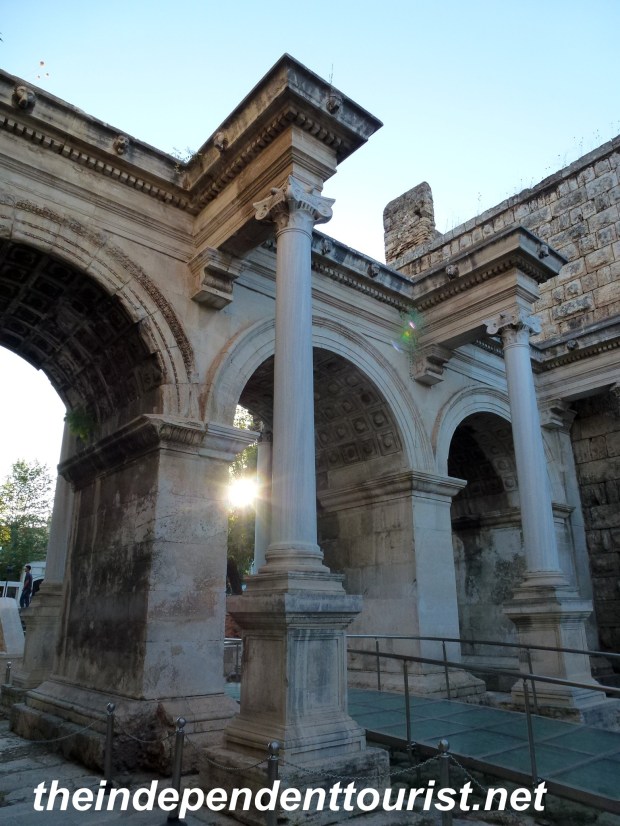
Hadrian's Gate - built to honor the visit of the Roman Emperor Hadrian in 130 AD. Located at the eastern edge of the old city.

Hadrian’s Gate – built to honor the visit of the Roman Emperor Hadrian in 130 AD. Located at the eastern edge of the old city.

The Hidirlik Tower in Karaalioglu Park, a Roman lighthouse.

The Hidirlik Tower in Karaalioglu Park, a Roman lighthouse.

Take time to explore Karaalioglu Park, set on a cliff overlooking the Mediterranean just to the east of the old town.  This side of town is quieter than the western side and has some good restaurants and interesting streets to wander. Antalya is a pretty big city (with a very nice modern airport), but once you’re in the historic area it feels more like a quaint town.

Near Karaalioglu Park. In September, it felt like Spring in Antalya.

Near Karaalioglu Park. In September, it felt like Spring in Antalya.

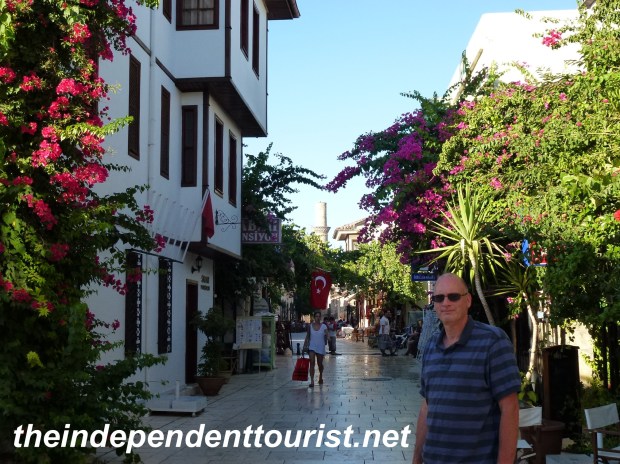
Antalya's old town shopping area.

Antalya’s old town shopping area.

A house in Antalya's old town - in need of some siding repair!

A house in Antalya’s old town – in need of some siding repair!

Nearby are beaches, waterfalls, and many historical sights. Inland (about 35 km) up in the mountains is the massive ancient Pisidian city of Termessos (which we’ll cover in another post). From Antalya you can work your way westward along the coast (the Lycian Way mentioned above)—with numerous ancient ruins and stunning natural scenery, and of course eastward to the grand restored Roman theater of Aspendos and the city of Side. I would seriously consider returning to Antalya and exploring more of this beautiful part of Turkey.

Göreme Open Air Museum in Cappadocia

We spent two very full days in Cappadocia, Turkey and we could have easily spent a week exploring this area. We had our own car, so we could choose the sites we wanted to visit. If you’re planning to take a tour of the area, you can arrange one locally and we noticed there are at least four main tour routes–going northwest, northeast, southwest and southeast from Göreme to cover the varied places of interest in the region. For a map of the sites we visited in Cappadocia, click here. For a map of sites visited in Turkey click here.

The ‘castle’ at Uchisar, near Goreme. This was a fortress and it sits at the top of a hill overlooking the area–rooms and passageways are carved out of the stone.

We stayed in the Canyon View Hotel right in Göreme, which was converted from an old church and built right into the hillside. It’s a decent hotel, and a short walk to the main shopping and dining areas. Göreme itself is a very pleasant and scenic town nestled among the “fair chimney” rock formations of Cappadocia, and a perfect home base during your visit.

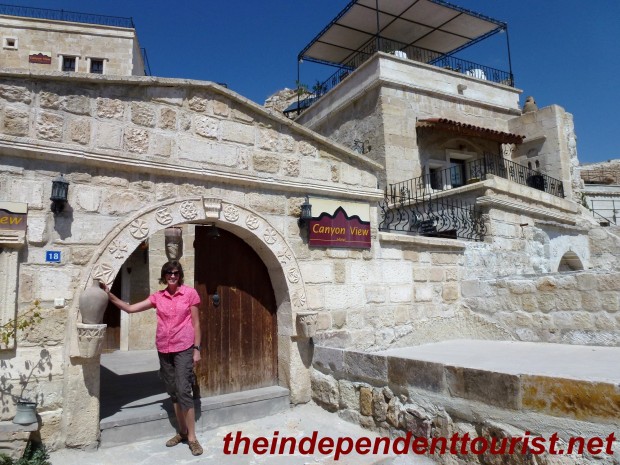
Exterior view of our hotel in Goreme. We ate breakfast on the terrace in the upper right-great view!

Our room at the Canyon View Hotel in Goreme.

We visited the Open Air Museum in Göreme on our first day, after our exhilarating balloon ride. The Open Air Museum, which is a collection of rock-cut churches along a path in the Göreme Valley, is just a kilometer or so outside the town—we walked to it from our hotel. The Göreme Valley holds the greatest concentration of Byzantine rock-cut churches in Cappadocia. Originally this area was a settlement for 20 Byzantine monks, then became a pilgramage site in the 17th century.

A view of the Gorme Open Air Museum–a path winds among the rock formations and rock-cut churches and other rooms.

It seemed that the churches we visited mostly date from the 12th century.  This area was a center for religious thought and life from the 3rd and 4thcentury onwards.  One can get a feel for the life of the monks with all the various types of rooms—storage areas, eating areas, kitchens and of course the chapels.

The monks’ eating area–they would sit on the outer edge and use the table in the middle. Not a lot of leg room!

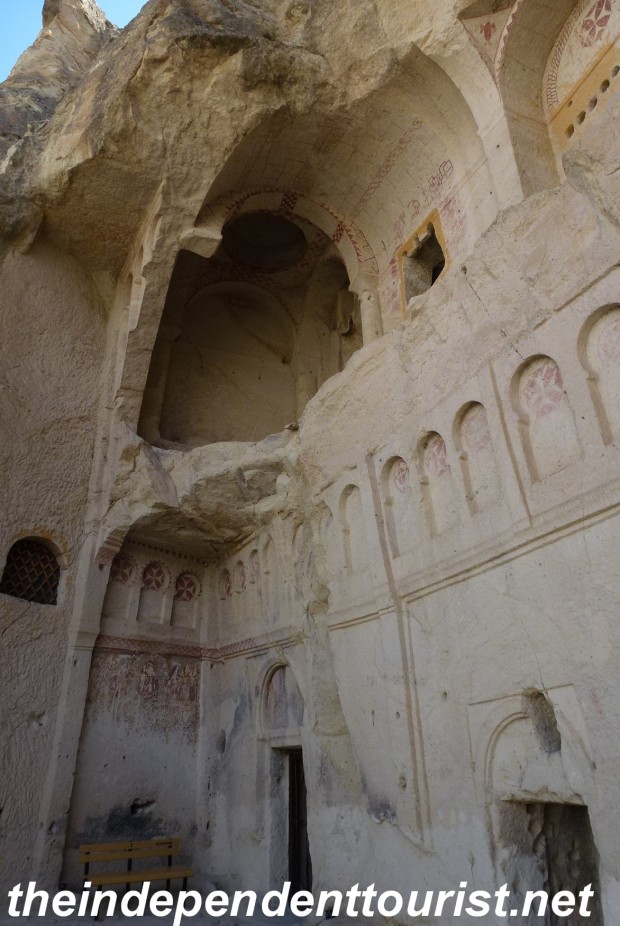
The Karanlik (Dark) Church–behind the wall is a beautiful chapel with well-preserved frescoes. Note how a part of the chapel is now exposed since the rock exterior has crumbled and eroded away. (Dates from end of 12th century).

Many of the chapels contain frescoes of scenes from the Bible, especially the life of Christ and acts of various saints. In some cases the frescoes are extremely well-preserved (with little daylight to damage them). Don’t miss the “Dark Church” (so-called since it has only one small window), the vivid frescoes look like they were painted yesterday. This church requires a separate entrance fee.  Photos are allowed in some churches, but not in the churches with the best frescoes. Don’t miss the Buckle Church (Tokali Kilise) outside the main musuem–just across the road.  It is large and one of the finest churches in Goreme. Your ticket for the Open Air Museum includes this church. Unfortunately, I was not allowed to take pictures inside.

The frescoes of the Carikli (Sandals) Chapel. (Dates from the end of the 12th century).

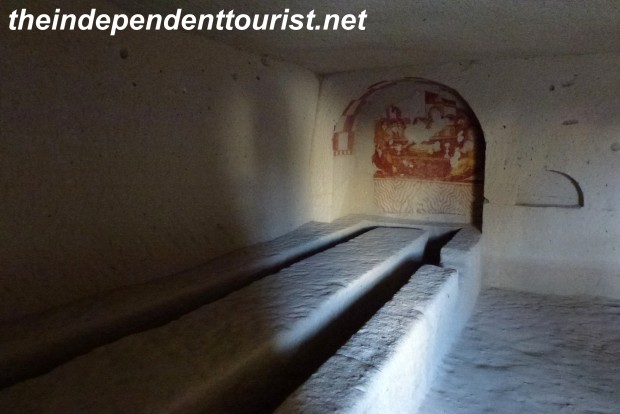
Interior of the St. Barbara Chapel. The chapels vary greatly in the detail of the artwork and frescoes.

The Open Air Museum is a UNESCO World Heritage Site, and the entrance fee is 15 Turkish Lira (TL) per person and another 8 TL for the Dark Church (the exchange rate is about 1.8 TL per USD).  There are well-marked walking paths to the various chapels in the valley with explanatory signs posted at each one. The Museum is open from 8 am to 7 pm April – October, and 8 am to 5 pm November – March. Allow at least two hours to visit the Open Air Museum.

At the entrance to a pottery shop and store near the Goreme Open Air Museum.

References: Area brochures, posted informational signs, Lonely Planet’s Guide to Turkey 2010, DK Eyewitness Travel Guide to Turkey 2008.

Cappadocia from the Air

I’ve heard people say “we’ve been to Turkey” and when asked about where they’ve been, they may say Istanbul and perhaps Ephesus. My reaction is to think “then you really haven’t seen Turkey.” The Cappadocia region, located in central Turkey, is unique in geography and history. With the spectacular rock pillar formations, and thousands of troglodyte dwellings and churches carved into the soft stone, this area feels like it belongs on another planet, and hence why it’s been an inspiration for a number of movies (see my post on Selime Cathedral). The odd landscape is due to volcanic activity millions of years ago in the form of ash and lava, some of which is very hard and some of which is very soft (called tuff) and easily eroded or carved out. A hot air balloon ride is a great way to get a feel for the topography of the area and was one of our most memorable activities on a two-week trip in Turkey.

The surreal town of Goreme.

We stayed right in Göreme, a fairy-tale looking town with gnome-like homes in the heart of the Cappadocia region. The town of Göreme is ground central for the Cappadocia hot air balloon industry.  Having flown all the way from the U.S. to Kayseri (about 80 km from Göreme, one of two airports serving the region) the day before, and after finally getting to bed at 1 am, we arose about 3 hours later to in order catch our 5 am shuttle van to the balloon center. Every morning almost year round about 100 balloons rise above the landscape to give up to 2,000 tourists a one-of-a-kind view. Some balloons hold as many as 20-25 people, ours held eight, and since there were six of us, it was almost a private tour.  Our grogginess soon gave way to excitement as we neared the balloon launch area—seeing the balloons being fired up against the pre-dawn clear sky was exhilarating.

Here is a photo timeline of our balloon ride:

The balloons filling with hot air against the pre-dawn sky.

H

Lifting off…

More balloons take to the air.

Flying over the town of Cavusin, with a myriad of stone-carved houses.

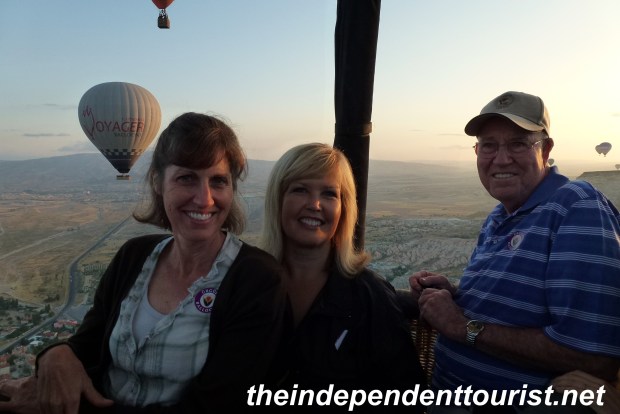
A little groggy, but enjoying the view.

Looking north towards Uchisar castle (the rock formation) from high over Goreme.

From about 1,500 ft up–the town of Goreme and the eroded tuff landscape.

The fairy chimneys of Cappadocia–we floated right through the valley.

The scoop on the balloon rides:

We made our reservations (Ürgüp Balloons) via our hotel in Göreme, prior to our arrival in Turkey. The shuttle van picks you up at about 5 am from your hotel, and takes you to the balloon center, where you’re offered some breads, biscuits, coffee and juice. At about 5:45 am you then head to the balloon launch field, and based on your ID sticker you’re directed to your balloon and crew. At your balloon, you are given a short safety demonstration on how to position yourself for landing and by about 6 am, you’re going aloft. Bring a light jacket, even in the summer. For most of the ride, the balloon is only perhaps 100 feet off the ground, and sometimes less, giving you a close look at the rock formations and dwellings. At one point we went up to about 1,500 feet above the landscape. This ride was a great thing to do on our first day; it gave us a visual overview of the area.

The ride is not cheap, and costs about the same as a ride in the U.S: €130 per person (about $100 US), and this was about €15 more than if we had been in a group of 20. At the end of our ride (60-75 minutes) we made a landing on a flat hill top, and then were treated to champagne and juice to celebrate a safe trip!

At the end of our ride–a safe landing!

Celebrating at the end of our early morning adventure.
The Ihlara Valley– A Canyon with Byzantine Rock-Cut Churches

The Cappadocia region of Turkey is full of amazing sights and one of them is the Ihlara Valley, located about 80 km southwest of Göreme, Turkey, which was our home port in Cappadocia.

The entrance to the Ihlara Valley.

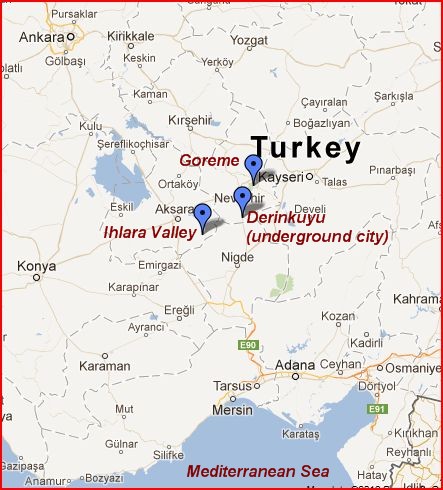
The Ihlara Valley is 80 km southwest of Goreme.

Since there is so much to see in Cappadocia, we almost bypassed this valley and I’m very glad we didn’t.  A great day trip from Göreme is to go to Derinkuyu (one of the underground cities in the area) in the morning (about 35 km south of Göreme), and then visit the Ihlara Valley in the afternoon. We beat the crowds to Derinkuyu (see my separate post on Derinkuyu) since they stop at Kaymakli underground city first. We then drove out to Ihlara, and had the valley and rock-cut churches pretty much to ourselves.

There are numerous churches cut into the canyon walls (note the opening in the lower right of the picture).

The churches cut into the sides of the canyon walls date from the 11thcentury, carved by Byzantine monks.  There were originally 60 churches in the valley. Many of the churches contain frescoes, but some are badly damaged (not surprising given the 1,000 years of history and open access to tourists). The DK Eyewitness guidebook says that there are only 10 or so churches open, however, it appeared to us that at least 15 were open.  We visited 6 churches in just a couple hours working our way up one side of the river towards Ihlara and back towards the stairway on the other side of the canyon.

The entrance to Karanlikkale Church, Ihlara Valley.

The large main chapel of Karanlikkale Church, Ihlara Valley.

Ceiling detail of Karanlikkale Church, Ihlara Valley.

Another large room in Karanlikkale Church, Ihlara Valley.

The frescoes of Kokar Church, Ihlara Valley.

Another room, Kokar Church, Ihlara Valley.

The landscape driving out to Ihlara in September is pretty brown and dry, reminding me a bit of the Wyoming landscape with rolling hills (but with more farming fields and no sage brush!). As we arrived at the small town of Ihlara, the canyon all-of-a-sudden appeared below us with green foliage and the small Melindiz River running through it. It’s a completely different world from the surrounding area, and the beauty of the canyon with the availability of water is probably why the Byzantine monks a thousand years ago chose this spot. Even though the official name is the Ihlara “Valley,” “canyon” is a much more appropriate term for this narrow gorge.

Walking along the green, shady valley floor–Ihlara Valley.

The rooms of Egritas Church (note the tombs in the floor), Ihlara Valley.

Tomb in Egritas Church, Ihlara Valley.

The canyon is 15 km (about 9 miles) long and runs from the town of Ihlara on the south end to the town of Selime in the north. We entered from the midpoint entrance on the west side where there is a large parking lot, a ticket office and snack shop. A good stairway (360 steps) winds down into the canyon from the rim. From the canyon floor, one can either walk along the dirt path on the near side visiting the churches or cross the bridge over the river and visit the churches on the far side going north and south.  The churches are sign-posted on the main trail and most are just a short scramble up side paths a hundred feet or two up into the cliffs. There is a restaurant about midway between the two ends of the canyon, on the valley floor, to the left after you descend the stairway.

Entrance to Purenliseki Church, Ihlara Valley.

Some of the churches and rooms on the canyon walls are not accessible, such as these.

It cost 3 TL per car to park and 8 TL (1.8 TL per 1 USD) per person to visit the valley. Selime Cathedral area is included in the ticket and should not be missed (see my separate post on Selime Cathedral).