Santorini

The Island of Santorini – Black sand beaches and Ancient Thera

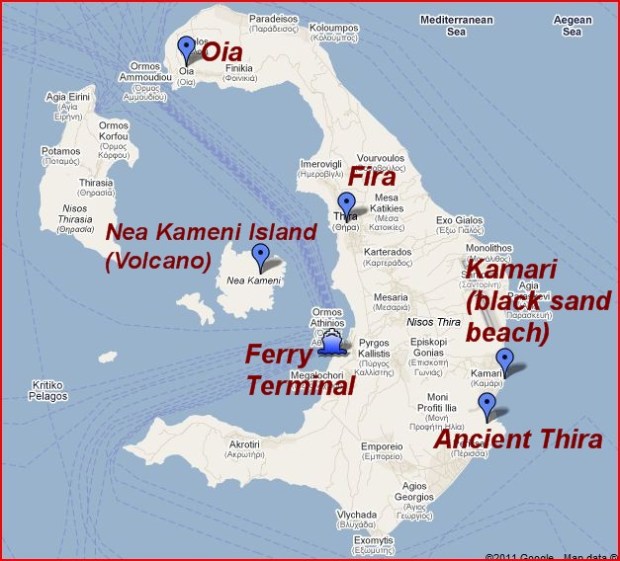
Map of Santorini Island

Map of Santorini Island.

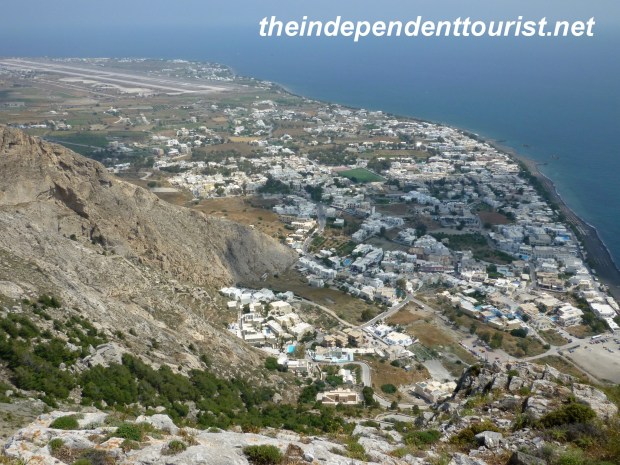
On the east side of Santorini are two towns both with black “sand” (more like “black pebbles”) beaches.  In between these towns on a very high (over 1,000 feet) hill, (called Mésa Vounó) are the ruins of Ancient Thera (also spelled Thira). We took the bus from Fira to Kamári, the location of the northern black sand beach and launch point up to Ancient Thera. There is a small tourist agency at the Kamári bus stop (renting ATV’s etc.), that provides transportation up to the site if one prefers not to walk. The road up to Ancient Thera is steep—with at least 25 switchbacks. We hired a little van to take us up (and back down) the steep road for €10 per person. From the point where the van drops you off, it is still another quarter mile hike to the main site. There is a small entry fee of €2 per person.
Kamari_Santorini_Greece (2)

View of Kamari and black sand beach from Mesa Vouno.
Ancient Thira_Santorini_Greece (2)

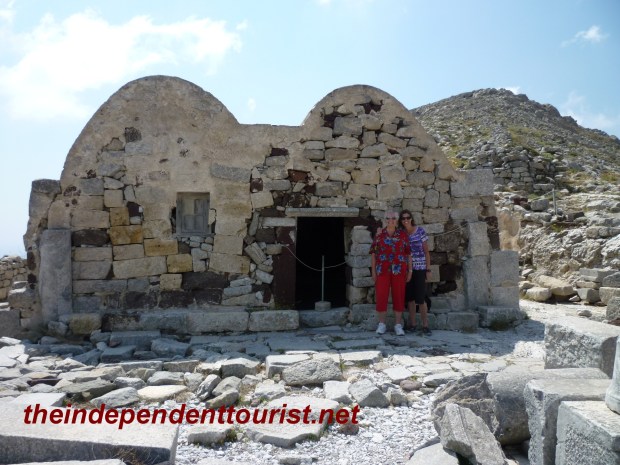
Agios Stefanos Church – 8th/9th century.
Ancient Thira_Santorini_Greece (3)

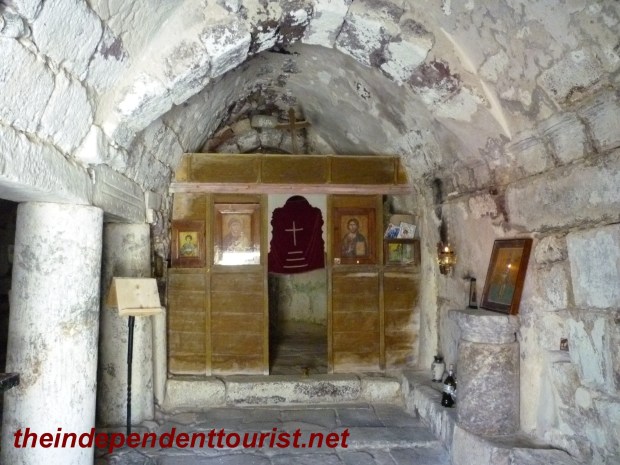
Interior of Agios Stefanos.

After paying the entry fee and prior to reaching the ancient Greek site, there is the little Church of St. Stephen (Agios Stefanos), off the right side of the trail.  The current little church dates from 8th or 9th century A.D., and is built out of the ruins of a 6th century church on the same spot.  Construction in the 8th and 9th century was rough and done quickly, during the tumultuous era of Arab invasions.
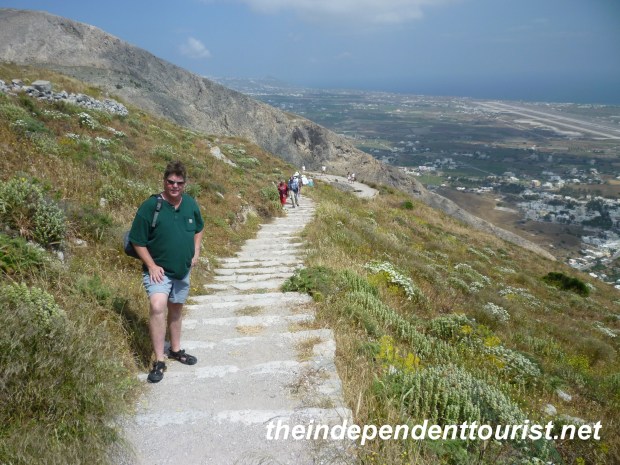
Ancient Thira_Santorini_Greece (6)

Hiking up to Ancient Thera.

Ancient Thera, was first settled by people from Sparta, and was named for their leader, Theras.

It was a Greek city-state founded in the 8thcentury B.C. The city occupied a strategic and fortified position overlooking much of the eastern coast of Santorini, and had cultivatable lands nearby below the city.  Ancient Thera was a large, highly developed city, and consisted of open air sanctuaries, temples, public buildings, a theater, shops, residences, a sophisticate road network, cisterns, and sewage system.  Residences in the city were for the more wealthy people.
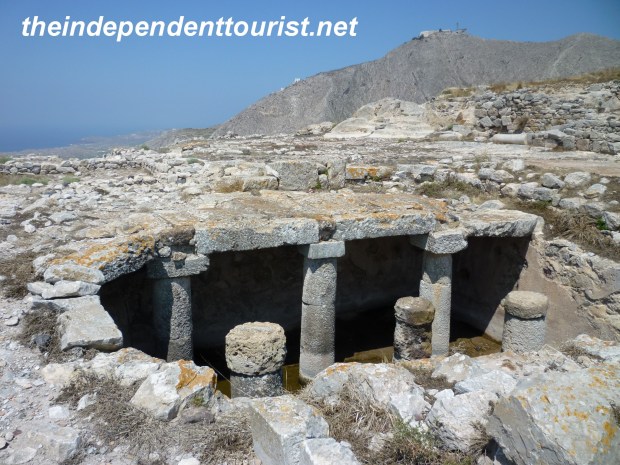
Ancient Thira_Santorini_Greece (13)

Cistern in Ancient Thera.

Most homes were two levels, using local volcanic rock (some of it red stone), and most homes had cisterns below to collect rain water. Most homes had decorative plaster inside and mosaic floors were common (some remnants remain). Thera was a naval base during the Ptolemy monarchs of Egypt (who eventually came under Roman rule), and most of the ruins date from 3rd and 4th centuries B.C.  Beginning in the 3rd century A.D., the city began to decline, but was still inhabited as late as the 8thcentury A.D.  It was eventually excavated in 1896.
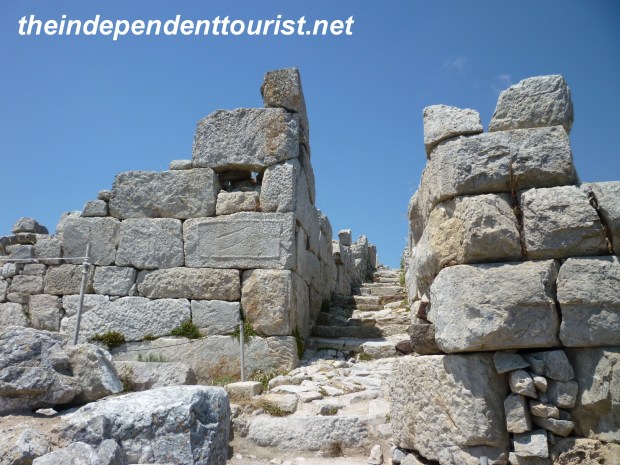
Ancient Thira_Santorini_Greece (21)

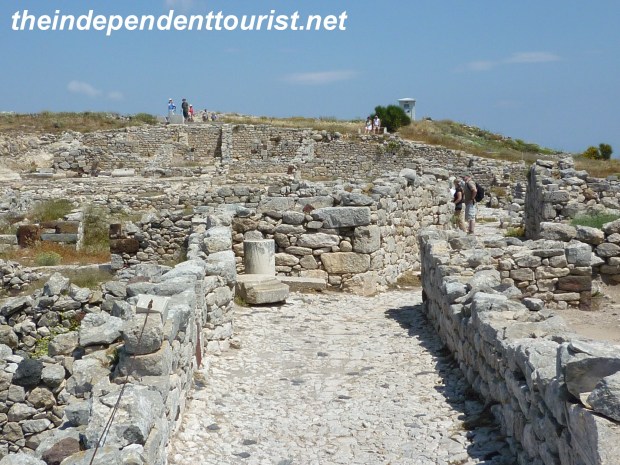
Street corner in Ancient Thera.

Ancient Thira_Santorini_Greece (14)

Street in Ancient Thera.

Kamari_Santorini_Greece (3)

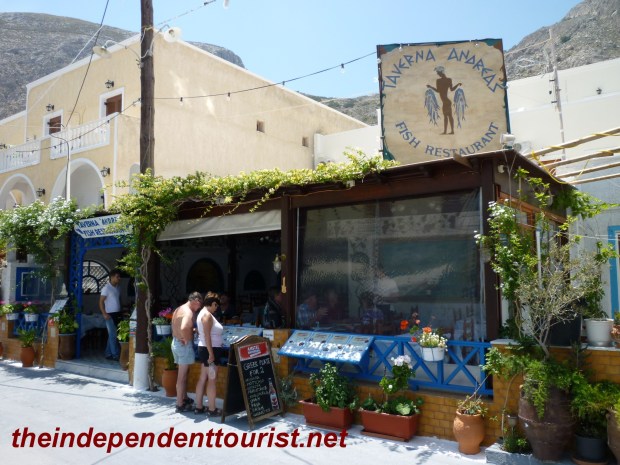
Taverna Andreas in Kamari.

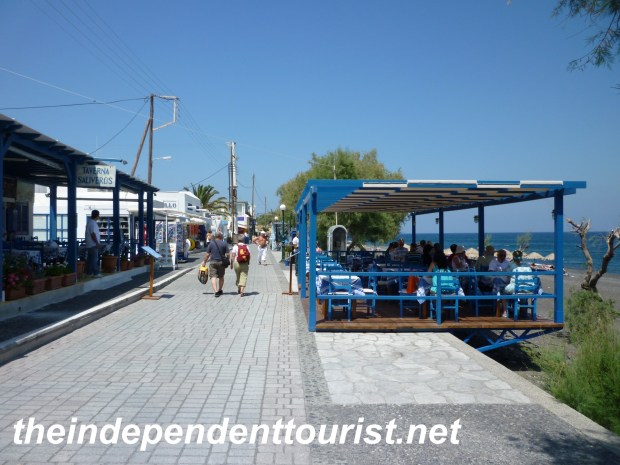
After touring Ancient Thera, we ate lunch in Kamári, at an excellent restaurant (Taverna Andreas). We then walked out on the “boardwalk” by the beach.  It’s lined with small shops and restaurants, but compared with Fira, it’s very quiet and laid-back. The beach is well-maintained—clean with lots of sun chairs, shade and services. Since the beach is mainly small black pebbles, it can get hot in the summer sun (not bad in late May). The view of Mésa Vounó from the beach is dramatic.
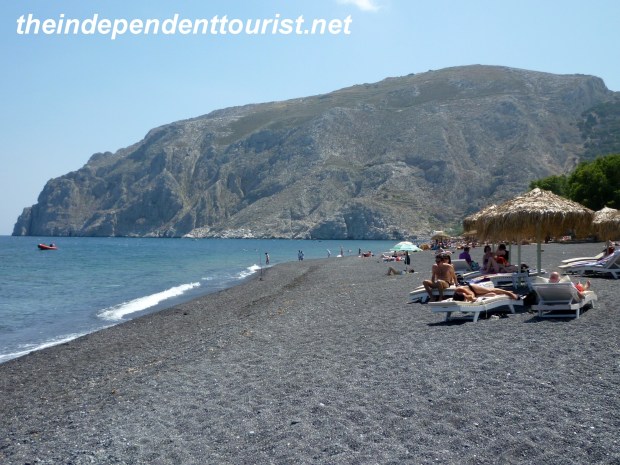
Kamari_Santorini_Greece (5)

Beach at Kamari – Mesa Vouno in distance.

The town of Perissa is south of Mésa Vounó, and also has a black sand beach and tourist services.

Be forewarned that the bus (which runs about every hour) does not look kindly on those with wet swimsuits climbing onboard and getting the cloth seats wet!  Either change before boarding, or ensure you are dry, or plan to stand for the 15-20 minute trip back to Fira.
Kamari_Santorini_Greece (4)

The boardwalk – Kamari beach.

Kamari_Santorini_Greece

Another view of the black sand beach of Kamari.

Reference:  Informational sign posts in Ancient Thera.

The Island of Santorini – Into the Caldera

Map of Santorini Island

Map of Santorini Island.

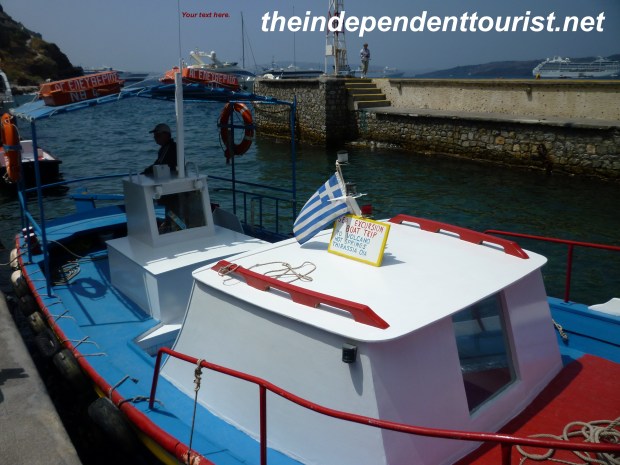
On our first day in Santorini we decided to hike down to the old harbor, directly below Fira. We walked down the 580 steps. We hired a boat for (€15/person or €70 for the boat) to take us out to Nea Kameni island (the volcano) in the middle of Santorini’s caldera. We were glad we made this little trip.

Boat to Nea Kameni Island_Santorini

Our boat to Nea Kameni Island.

The trip to Nea Kameni  takes about 25 minutes, and provides nice views of the rim of Santorini, about 1,100 feet nearly straight up from the sea.

Nea Kameni Island_Santorini_Greece

View of Nea Kameni Harbor.

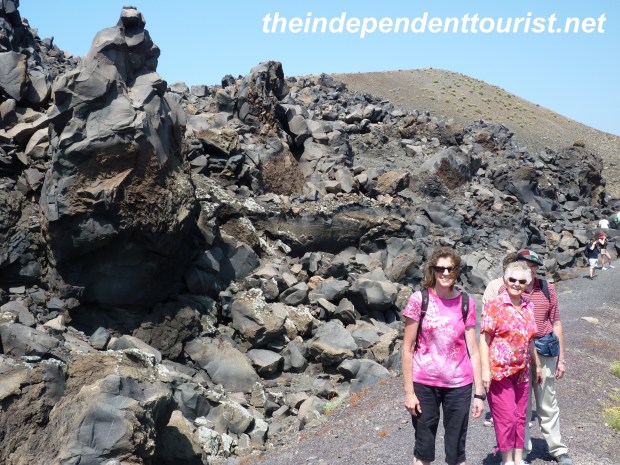
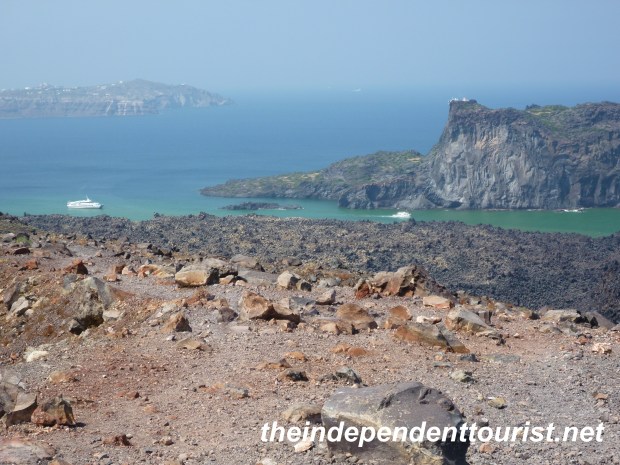
We arrived at the little harbor on Nea Kameni fairly early (around 9:30 am) and had most of the island to ourselves. There is a fee of €2 to hike up to the crater, which takes about 20 minutes. We immediately noticed how barren the landscape is– dark volcanic rock with very little vegetation. It feels like another world. By standing on Nea Kameni island, one gains a perspective on how massive and forceful the volcanic eruption must have been 3,500 years ago to blow about 2/3 of the island into dust!  Santorini has had its share of natural disasters. There were additional eruptions in 198 B.C. and again about 735 A.D. Also, a big earthquake in 1956 leveled Fira and Oia. We enjoyed the great views in all directions, including the little island of Palaia Kameni  just to the west of Nea Kameni—with another extremely rugged landscape.

Nea Kameni Island_Santorini_Greece (6)

Hiking up to the crater.

What I didn’t realize until our trip was that the volcano is still active. At the top, depending on the wind, you might catch a whiff of sulfur odor.  Along the east edge of the crater, we noticed steam coming out of a hole to the side of the trail, and we could tell it was the source of that lovely sulfur smell. I put my hand in one of the vents and was amazed  at how hot the air was—even 3,500 years after the first explosion. We were hoping another explosion wasn’t in store during our stay.

Nea Kameni Island_Santorini_Greece (3)

On top of the crater-view of Palaia Kameni in distance.

The ancient Minoans were not so lucky. Their town of Akrotiri on the south side of Santorini was buried by the explosion in 1,500 B.C. and wasn’t excavated until 1967. Interestingly, no human or animal remains were found, suggesting that the population had some sort of warning and escaped in time. Akrotiri is full of artifacts and great frescoes, some of which are now in the museum in Fira. Unfortunately, Akrotiri has been closed to tourists for several years due to the collapse of the huge roof covering the site. Our visit was in May 2011, and we heard it is supposed to open soon, but no date was given, and “soon” has been a term used for quite a while.

There are no services on Nea Kameni, so take some water and wear good sturdy shoes for the walk.

Reference:  DK Eyewitness Travel: The Greek Islands, Main Consultant: Marc Dubin, 2007.

The Island of Santorini – Fira and Oia

Map of Santorini Island

Map of Santorini Island.

When one thinks of Greece, images of whitewashed homes and churches with blue domes is usually what comes to mind. Well, there is no better location for actually seeing these images of Greece than the crescent-shaped island of Santorini. Seeing Fira (the main town) and Oia (the picture-perfect village at the north end of the island where everyone goes to watch the sunset) in person was really beyond words. We flew to Santorini from Rhodes via Athens. It was a pretty quick connection–we left Rhodes at 4:30 pm, made our connection in Athens and were in Santorini by 7:00 pm–in time for the sunset.

Hotel Keti_Santorini_Greece (3)

View from Hotel Keti (Fira, Santorini). Our room – lower right.

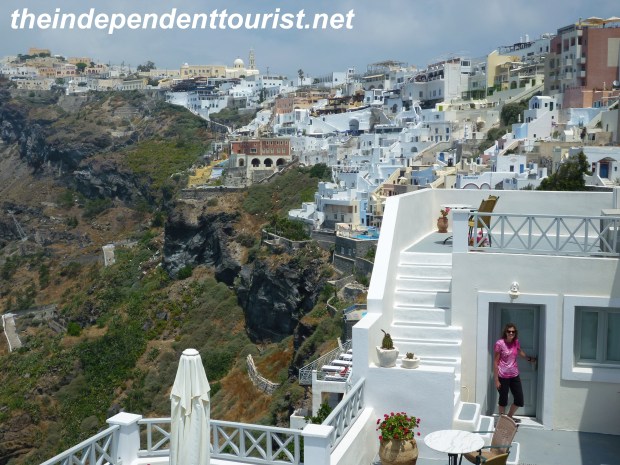
Our hotel, Hotel Keti, was at the south end of Fira, directly below the cathedral and literally on the edge of the caldera. The only thing we didn’t like about the hotel was the hard beds (a Greek mainstay). The view from our hotel, as shown in the pictures in this post, was absolutely stunning.

Views of Santorini_Greece (9)

View of the Caldera – Santorini.

From our hotel we could see most of Fira, the old harbor and the cruise ships in the caldera. (The caldera is what’s left from the island’s volcanic explosion in 1600 B.C. – more to come on that in another post: “Into the Caldera”). I recommend staying in a hotel that offers views of the caldera. It is definitely worth the splurge. Our room was large and had a separate sitting area, with a window view of the caldera in addition to a private patio. We paid €105 per night (double) in late May, right before high season. The hotel staff was great, and very helpful. Due to the great setting, we felt like we could have spent our three days right there on the hotel’s patio!

Be forewarned—Fira is all stairs….if stairs are a problem, it will be difficult to get around the town.  So, best to think ahead of anything you need before heading back to your hotel room.

Views of Santorini_Greece (5)

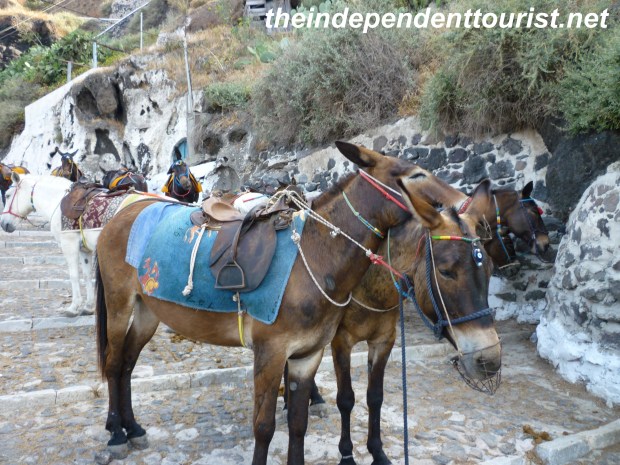
Mules resting while waiting for passengers.

The main thing to do in Fira itself is to wander through the town, along the cliffside, from one end of the town to the other–afternoon is best when the sunlight dances off the white buildings. We also walked the 600 steps down to the old port right below Fira (where we took a boat ride).  The locals bring down about 100 mules for the cruise day-trippers to ride up the steps. There also is a tram running from the port to the top of the cliff in town that is €4 each way.  Being lazy, we took the tram back up from the port!!

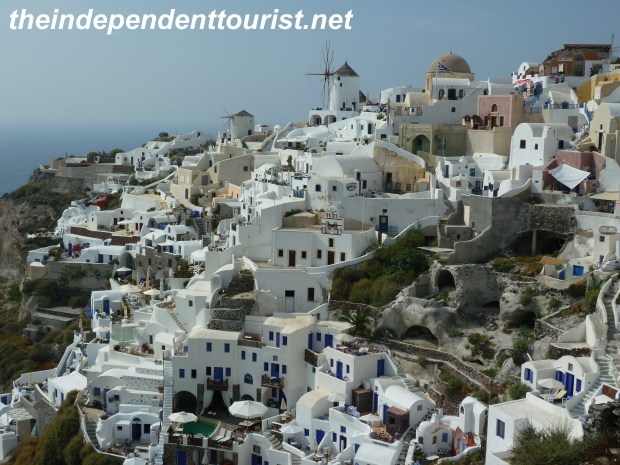
Oia_Santorini_Greece (18)

Oia, Santorini.

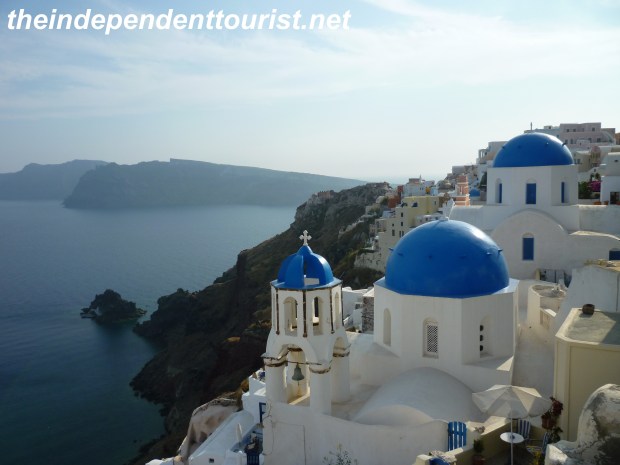
We visited Oia in the afternoon, debating whether to stay for the famous sunset views. We ended up going back to our hotel and watching the sunset from there, which was beautiful and relaxing. Oia is a small village, and one of the most the picture-perfect towns in Greece. From the bus stop, walk a block to the main pedestrian route, and turn right (north) and head out to the point, to “Oia Castle.” You are literally at the end of Santorini, and are rewarded with a wonderful 360 view of the town, a windmill, the little harbor, the caldera, Fira in the distance and other little islands. It would be easy to spend the day right here. When ready, walk south along the little alleys, and wherever possible, turn right out to the caldera and to take in the views of the little churches and homes set along the cliff.

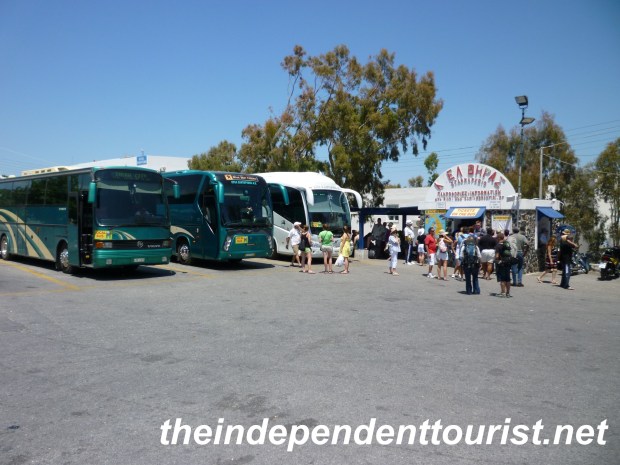
Bus Station_Santorini_Greece

Fira Bus Station.

We did not rent a car in Santorini. The island is small, and the bus goes about everywhere you want.  The “bus station” was just a couple blocks from our hotel. The fare to most destinations on the island was €1.60, including from the airport to Fira. The fare to the ferry terminal was a little more, €2.20 per person. I would suggest getting to the bus station earlier than the posted departure time, because when the bus fills, it takes off, regardless of the exact time! If I was to rent anything, it would be an ATV, which are available everywhere, it would be a fun way to get around the island. In May, we saw about 3 cruise ships a day entering the harbor, so it’s a busy island, but a must-do sight when you visit Greece.

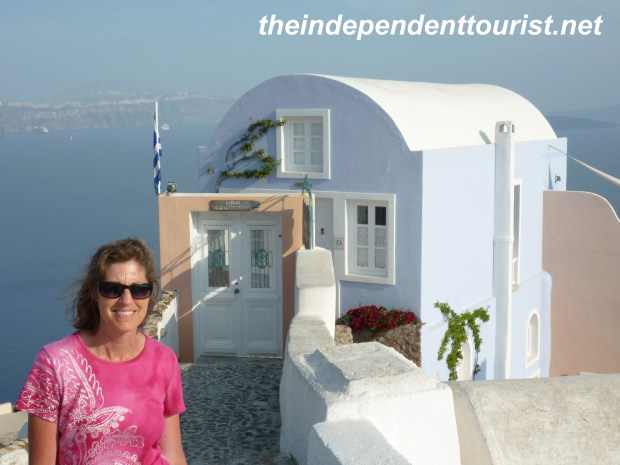
Oia_Santorini_Greece (21)

House with a view – Oia.

Oia_Santorini_Greece (6)

Another view of Oia.

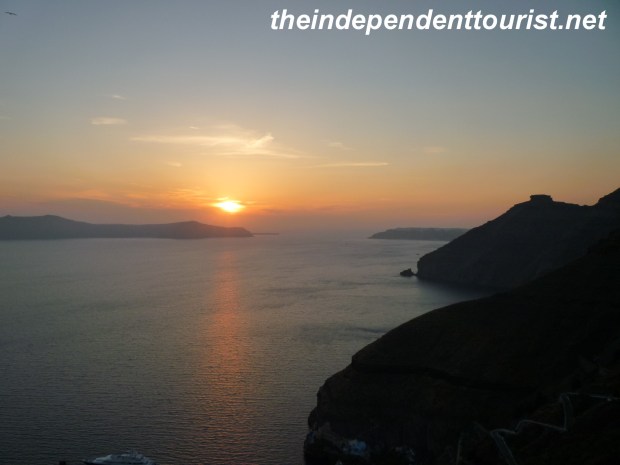
Views of Santorini_Greece (17)

Another glorious sunset over Santorini.