Częstochowa – Poland’s Spiritual Center

Between 4 and 5 million visitors from 80 countries visit this town each year. They come to visit the Monastery of Jasna Góra, and specifically to see the 14th century Black Madonna painting which according to legend was painted by St. Luke the Evangelist (author of the Gospel of Luke in the New Testament). It is credited with many miracles, such as the story of a looter who in 1430 attacked the painting with his sword two times but fell in pain and died before he could strike it a third time (the marks from his attack are visible).

Entrance to the Jasna Góra Monastery, on the south side of the complex.

Entrance to the Jasna Góra Monastery, on the south side of the complex.

The Black Madonna painting. It's apparently black from centuries of soot. No one really knows for sure of its origin, but it is credited with saving the town during the Swedish aggression in the 1600's.

The Black Madonna painting. It’s apparently black from centuries of soot. No one really knows for sure of its origin, but it is credited with saving the town during the Swedish aggression in the 1600’s.

This shrine is one of the great pilgrimage spots in the world, and famous visitors have included Pope John Paul II and Pope Benedict XVI. Many pilgrims arrive on foot after journeys of as long as 20 days. The painting is in the 14th century Chapel of Our Lady and may be viewed during the day except from 12:00 – 1:30 pm and after 9:20 pm when it is covered.

The 14th century Chapel of Our Lady at Jasna  Góra Monastery (the Black Madonna is at the lower center of the image, behind the gate).

The 14th century Chapel of Our Lady at Jasna Góra Monastery (the Black Madonna is at the lower center of the image, behind the gate).

In addition to the Chapel of Our Lady, be sure to visit the Basilica which dates from the 17th century and has many Baroque features—it reminded me of monasteries in Germany and Austria (such as Melk Abbey).

The Baroque Basilica at the Jasna  Góra Monastery.

The Baroque Basilica at the Jasna Góra Monastery.

The organ pipes in the Basilica of Jasna  Góra.

The organ pipes in the Basilica of Jasna Góra.

Other attractions include several museums, a treasury and the Bell Tower, Poland’s tallest historic church tower at 106 meters (348 feet), which can be climbed.

The asymmetrical architecture inside the Monastery, a bit like Wawel Cathedral in Kraków.

The asymmetrical architecture inside the Monastery, a bit like Wawel Cathedral in Kraków.

Częstochowa makes a great overnight stop from Toruń to Krakow. The main street (a long Polish name which is abbreviated to NMP) running directly east from the Monastery and adjacent Park Staszica has a number of good restaurants and hotels.

The Jasna Góra Monastery at sunset - it sits on a hill overlooking the town of Częstochowa. The Bell Tower is 106 m high.

The Jasna Góra Monastery at sunset – it sits on a hill overlooking the town of Częstochowa. The Bell Tower is 106 m high.

We arrived in the late afternoon and visited the Monastery at sunset, which was perfect. There was an outdoor service going on during our visit, which added to the atmosphere of the setting.

Climbing Mt. Sinai – An Unforgettable Experience

One of our most memorable experiences in Egypt was visiting St. Katherine’s Monastery and climbing to the summit of Mt. Sinai. It’s about a two and a half-hour drive through the unforgiving interior desert landscape from the resort of Na’ama Bay to St. Katherine’s Monastery, where the hike begins to Mt. Sinai.

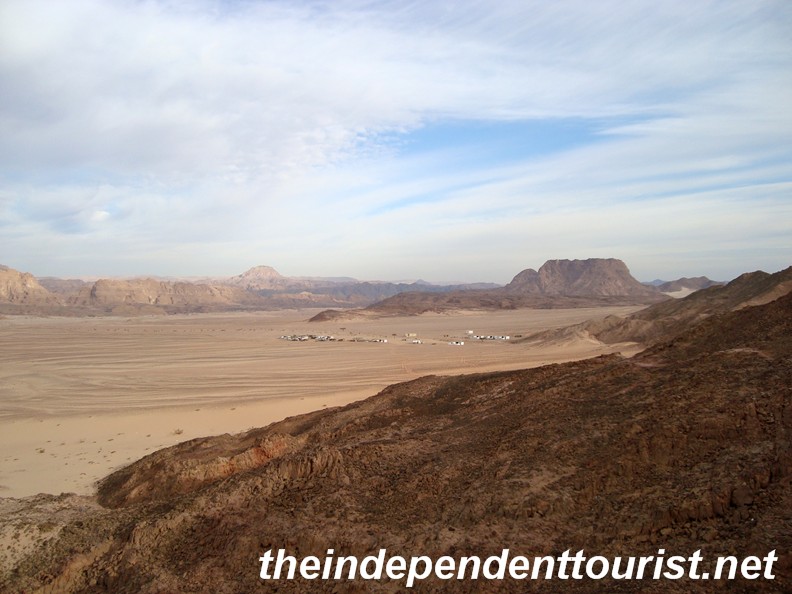
A view of the Sinai peninsula landscape on the way to Mt. Sinai.

A view of the Sinai peninsula landscape on the way to Mt. Sinai.

St. Katherine’s Monastery

This area has been a pilgrimage site for centuries and is holy ground to three religions: Christians, Muslims, and Jews. According to the Old Testament, this is the place of numerous revelations by God (including the Ten Commandments) to the prophet Moses. The Israelites camped in this area for some time after miraculously escaping from the Egyptian armies by crossing the Red Sea on dry land.

The Bell Tower at St. Katherine's Monastery. It houses 9 bells donated by Tsar Alexander II from Russia.

The Bell Tower at St. Katherine’s Monastery. It houses 9 bells donated by Tsar Alexander II from Russia.

Considered one of the oldest continually functioning monastic communities in the world, much of the compact monastery is off limits to tourists, but it is still worth a visit and is the spot where all tourists begin their hike up Mt. Sinai.

A view of the Monastery walls and some local camels.

A view of the Monastery walls and some local camels.

The 20 or so monks living here are Greek Orthodox and the first church was built here in about 337 AD, commemorating the spot where God spoke to Moses in the form of a burning bush. Interestingly, a descendant of an evergreen bush which grows nowhere else in the Sinai is found here.

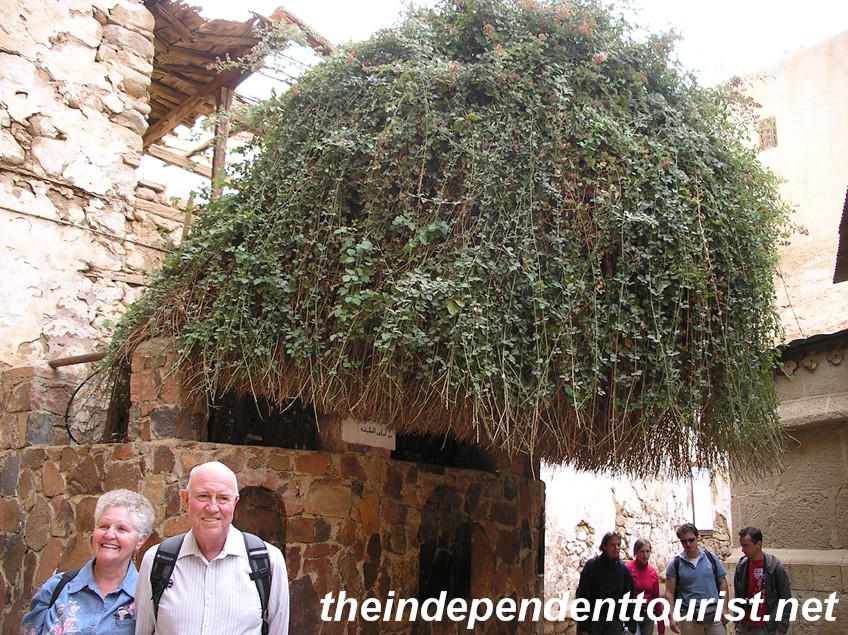
This evergreen is believed to be a descendant of the burning bush. Transplanted here in the 10th century from the nearby chapel of the same name.

This evergreen is believed to be a descendant of the burning bush. Transplanted here in the 10th century from the nearby chapel of the same name.

The Byzantine Emperor Justinian fortified the location and built the main Basilica of the Transfiguration in 527 AD on the grounds of the original church which became the origin of the monastery.

Mt. Sinai

There are two ways to climb the Mount (altitude: 2,285 meters or 7,500 ft). There is the “camel path” which is wider and more “gently” sloping, or taking what is called the “Steps of Repentance” route– a very steep climb of 3,750 steps (hard on the knees) which was built by a monk doing penance—what a price to pay! We took the camel path, and it joins the “Steps of Repentance” path 750 steps below the summit.

On the trail with Mount Sinai behind me - about halfway up.

On the trail with Mount Sinai behind me – about halfway up.

Going through a narrow gorge. Getting ready for the final ascent.

Going through a narrow gorge. Getting ready for the final ascent.

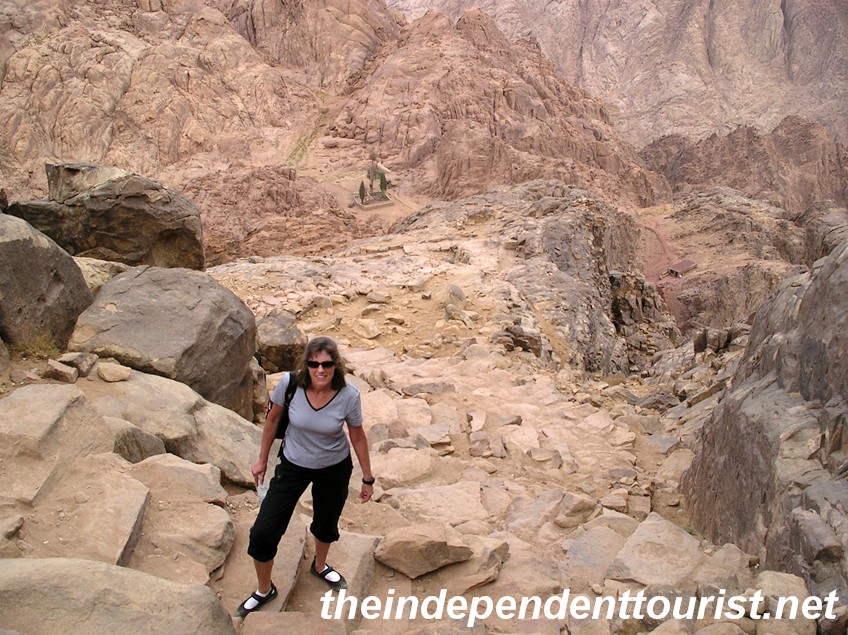
Hiking up the last 750 steps to the summit. In the distance below is Elijah's basin. The cypress tree is thought to be 1,000 years old. Those who traveled with Moses up the mountain waited here while he ascended to the summit to speak with God.

Hiking up the last 750 steps to the summit. In the distance below is Elijah’s basin. The cypress tree is thought to be 1,000 years old. Those who traveled with Moses up the mountain waited here while he ascended to the summit to speak with God.

You can take a camel up the path but we decided to hike it, and even at a good pace it took us about 2 hours to reach the summit from the Monastery. This is not an easy hike, and several members of our group ended up not making it to the top.

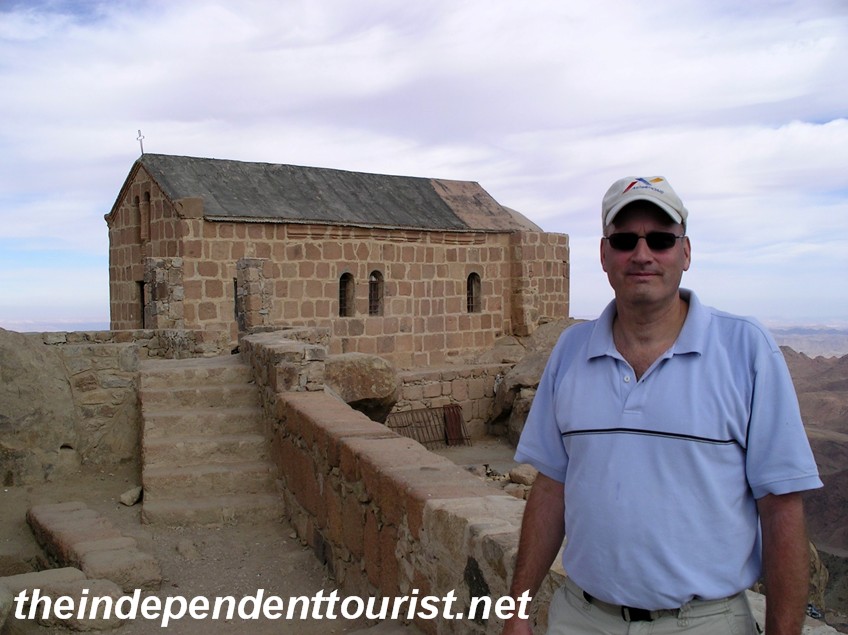
The Chapel of the Holy Trinity at the summit of Mt. Sinai.

The Chapel of the Holy Trinity at the summit of Mt. Sinai.

A magnificent view from the top of Mt. Sinai.

A magnificent view from the top of Mt. Sinai.

A lot of tourists leave at around 3 am to reach the summit for the sunrise. We were not that ambitious and arrived at the summit around noon. My wife and I had the top of this sacred mountain to ourselves at that time of day. The views are incredible and although the landscape is harsh (reminding me a bit of Death Valley), it was thrilling to be on the Mount which holds so much historical and religious significance to many people.

References: Lonely Planet Egypt, DK Eyewitness Travel Egypt.

Toruń – Poland’s Best Preserved Medieval City

About 106 miles (or 170 km) south of Gdansk is the medieval city of Toruń. It has been well preserved over the centuries and fortunately was not damaged in World War II. Toruń is the birthplace of Nicolaus Copernicus (1473 – 1543), the great mathematician and astronomer who placed the sun (rather than the earth) at the center of our solar system. His home is here along with his statue in the main square.

Nicolaus Copernicus' house in the center of Toruń.

Nicolaus Copernicus’ house in the center of Toruń.

Statue of Copernicus and the Town Hall tower, which you can climb for great views.

Statue of Copernicus and the Town Hall tower, which you can climb for great views.

There is a lot to see in Toruń, including some lovely medieval churches, the town square, the city walls and other historic buildings. The Town Hall is now a Regional Museum that includes other sites around Toruń. Be sure to climb the tower of the Town Hall to get a great view of the old town and surrounding countryside.

A view of Toruń, looking northeast along the Vistula river, from the Town Hall Tower.

A view of Toruń, looking northeast along the Vistula river, from the Town Hall Tower.

A view from the Toruń Town Hall Tower - The huge, late 13th century St. Mary's Church is on the right.

A view from the Toruń Town Hall Tower – The huge, late 13th century St. Mary’s Church is on the right.

The interior of St. Mary's Church. There are some well-preserved frescoes on some of the walls.

The interior of St. Mary’s Church. There are some well-preserved frescoes on some of the walls.

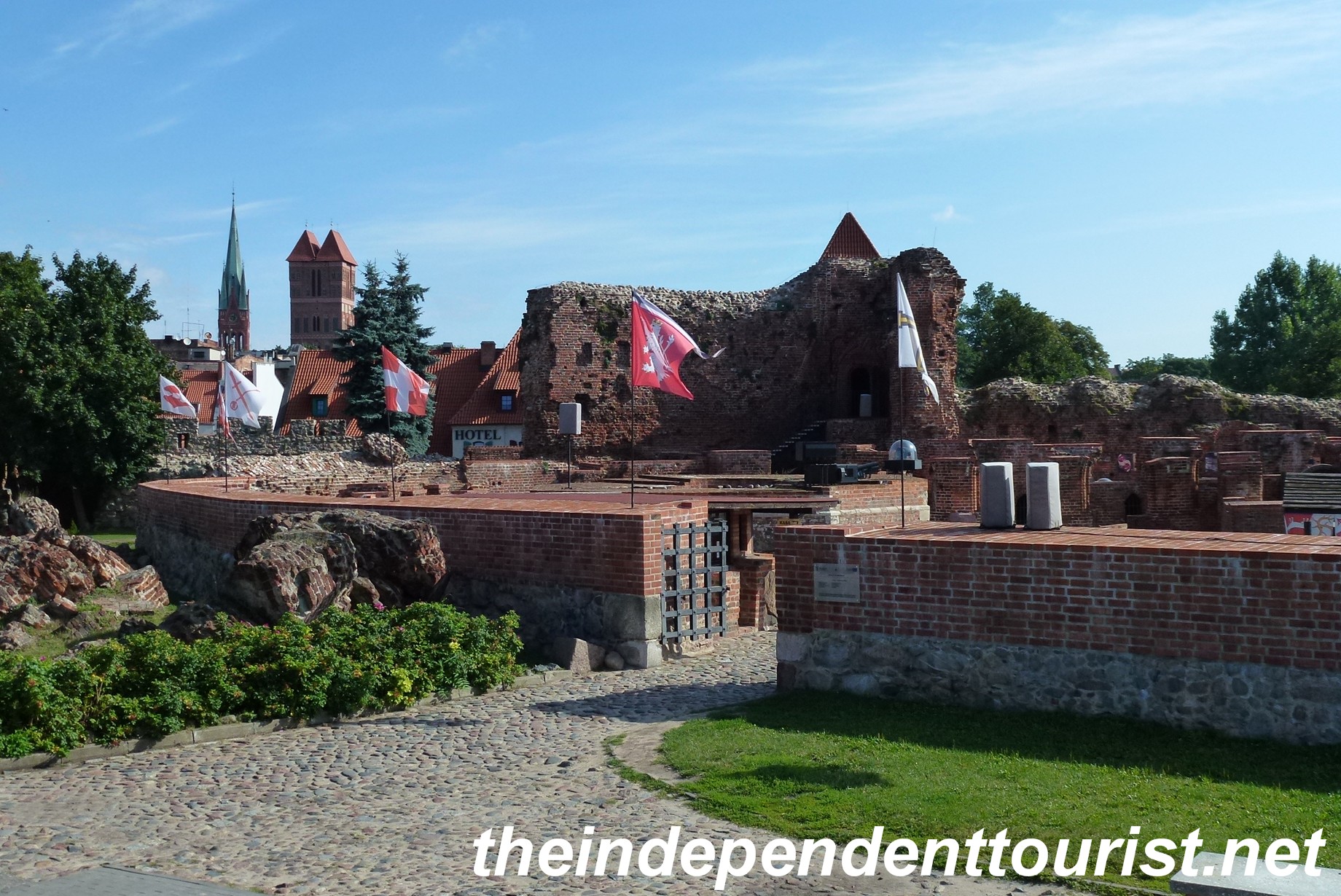
The ruins of the Teutonic Castle (from the early 1200’s) are limited; it was destroyed by the townsfolk in 1454 as part of a rebellion of the Teutonic rule—they did a good job!

The ruins of the Teutonic Knights' castle in Toruń.

The ruins of the Teutonic Knights’ castle in Toruń.

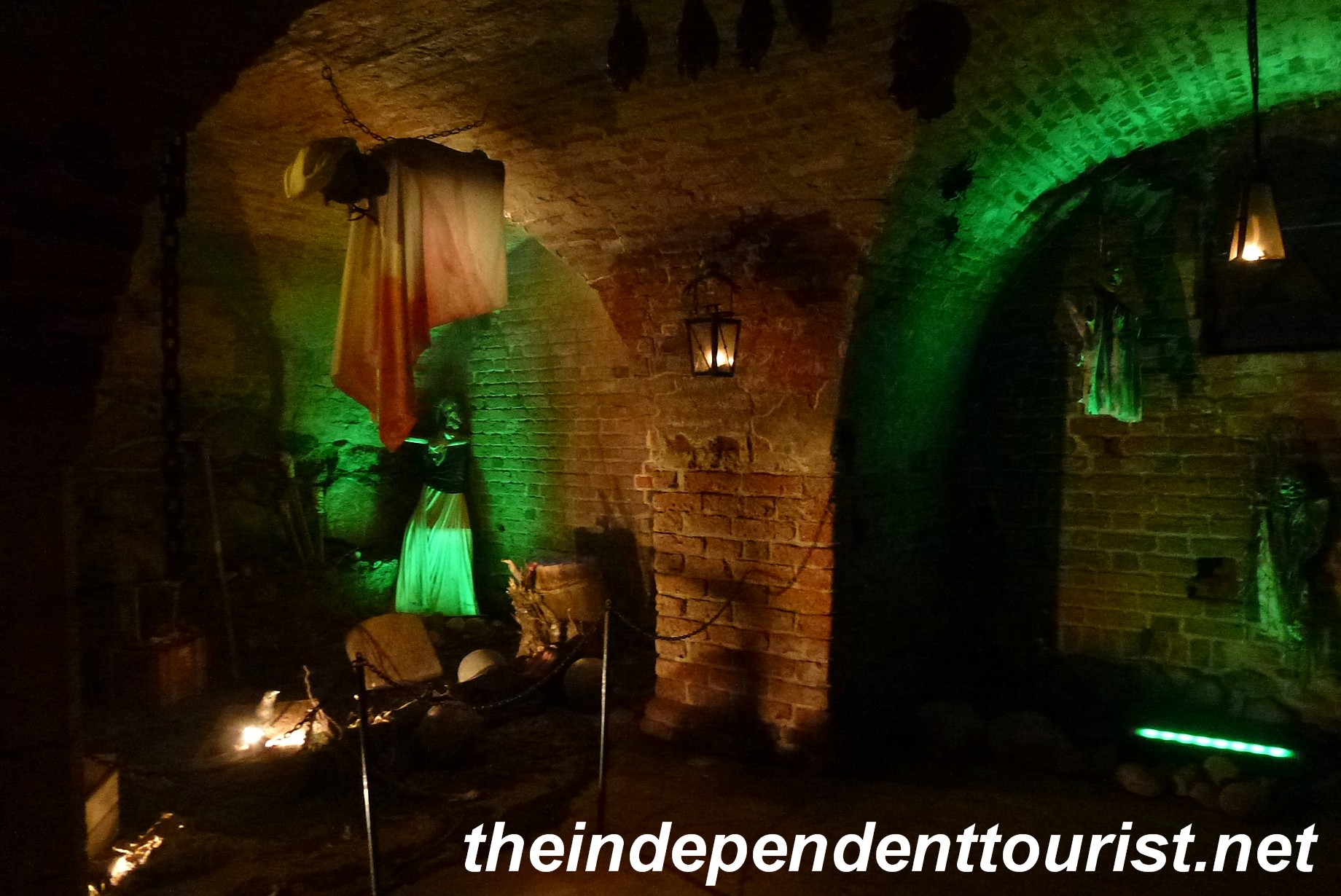
Some scary displays in the dungeon of the Knights' castle in Toruń.

Some scary displays in the dungeon of the Knights’ castle in Toruń.

However, there is a good display in the cellar/dungeon of the castle and a number of signs around the castle grounds explaining its history and features. The Latrine Tower and connecting bridge are well preserved.

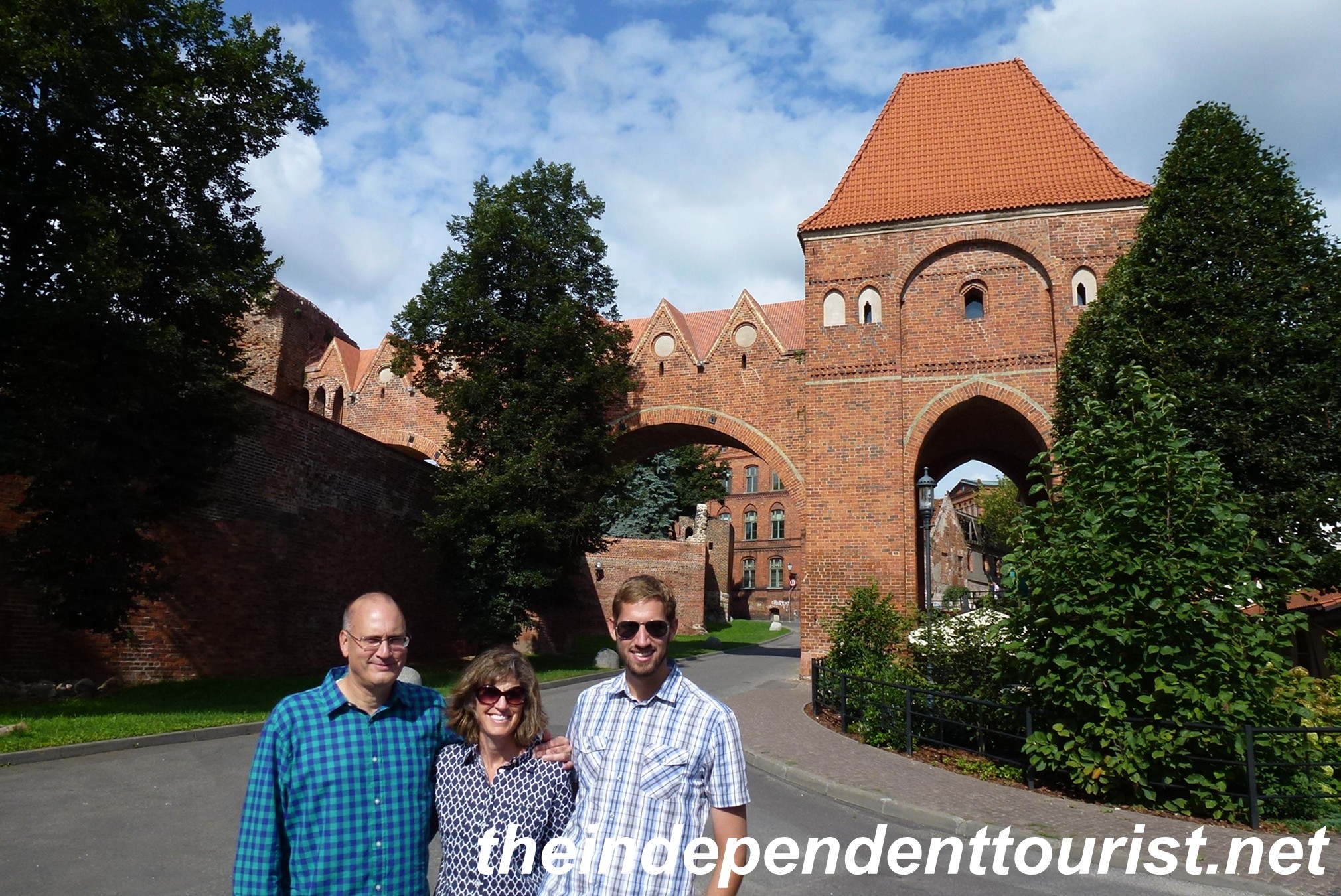
The Latrine Tower of the Teutonic Castle in Toruń.

The Latrine Tower of the Teutonic Castle in Toruń.

We found that parking a car is nearly impossible in the old town, so we found a great car park right outside the city walls near a bridge over the Vistula River that was within walking distance of our apartment.

Toruń's city walls and the 15th century Burghers Hall, which was the home of the Brotherhood of St. George, whose membership comprised the elite of Toruń.

Toruń’s city walls and the 15th century Burghers Hall, which was the home of the Brotherhood of St. George, whose membership comprised the elite of Toruń.

We had a lovely stay in the old town at a place called Apartamenty Anielskie. Toruń is definitely worth an overnight stop. Take a walk along the east (river) side of the town to get some great views of the old city walls and gates.

The Leaning Tower, an interesting part of the city walls of Toruń. It started to lean because of the soft ground - about 5 degrees so far, but still standing!

The Leaning Tower, an interesting part of the city walls of Toruń. It started to lean because of the soft ground – about 5 degrees so far, but still standing!

The Sinai Peninsula – A Totally Different Egypt and Gateway to the Red Sea

After two weeks touring the dusty ancient ruins of Egypt, we felt like we had traveled to a different planet when we arrived at the Sharm el-Sheikh Airport from Luxor. While both airports are modern, the minute you step outside in Sharm el-Sheikh you notice the difference – the more humid air, and the end of bargains. The taxi drivers wanted E£ 200 (at the time about $40 USD) for a 2-3 mile ride to our hotel that would have cost E£ 15-20 in other parts of the country, and they would rather walk away than bargain.

My sister on Na'ama Bay beach.

My sister on Na’ama Bay beach.

Lots of water toys available for rent in Na'ama Bay.

Lots of water toys available for rent in Na’ama Bay.

We stayed at the Hilton Hotel in Na’ama Bay (a bit more resort-like and next door to the larger town of Sharm el Sheikh) which felt more like Cancun than Egypt – a promenade with lots of restaurants, posh hotels and tourists—especially from Russia.

The promenade at Na'ama Bay - lined with restuarants and shops.

The promenade at Na’ama Bay – lined with restuarants and shops.

Even though it’s more of a cushy resort area, nice hotels can be had for about $50 US per night.

One of the nine pools at the Hilton Sharm Dreams Resort. Great hotel.

One of the nine pools at the Hilton Sharm Dreams Resort. Great hotel.

This is a divers’ paradise. The Red Sea has some of the best diving in the world. Lots of tour companies will take you out for day trips to the reefs and shipwrecks. Unfortunately we’re not divers, but we did enjoy snorkeling. My sister and her husband took a glass-bottom boat tour.

One of the glass bottom boat tours available in Na'ama Bay.

One of the glass bottom boat tours available in Na’ama Bay.

The water is incredibly clear and full of life, with unique coral formations and marine species not found elsewhere on the planet. We took a taxi out to Ras Mohammed National Park and did some snorkeling from the beach. Lots of dive boats were just off shore; this is one of the best spots in the Red Sea.

The imposing entrance to Ras Mohammed National Park.

The imposing entrance to Ras Mohammed National Park.

An incredible beach at Ras Mohammed National Park.

An incredible beach at Ras Mohammed National Park.

One of the coral walls that goes straight down into the depths at Ras Mohammed National Park.

One of the coral walls that goes straight down into the depths at Ras Mohammed National Park.

Sharm el-Sheikh was claimed by Israel after the 1967 war (it was returned to Egypt in 1982 and that is when development took off), and it experienced some terrorist activity about 10 years ago. However, it is probably one of the safest tourist spots in Egypt now. There are security barriers and guards at the entrance to the town. Your car may be checked, but this is for your protection as a tourist.

A view of the shore heading back to Na'ama Bay from Ras Mohammed National Park.

A view of the shore heading back to Na’ama Bay from Ras Mohammed National Park.

It would be a huge mistake to visit Egypt and not go to the Sinai. We also climbed Mt. Sinai (think Moses and the 10 Commandments) and I will discuss that day trip in a separate post.

Salamanca – Home of One of the Oldest Universities in Europe

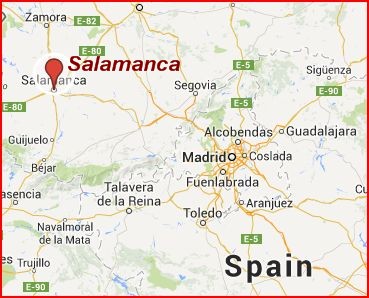
Along with Toledo, Salamanca is one of my favorite cities in Spain. It has so much to offer in a compact area: an ancient university, two old cathedrals, a beautiful Plaza de Mayor, an old Roman bridge, and other remarkable sights. Salamanca is 132 miles (212 km) northwest of Madrid.

Salamanca is northwest of Madrid.

Salamanca is northwest of Madrid.

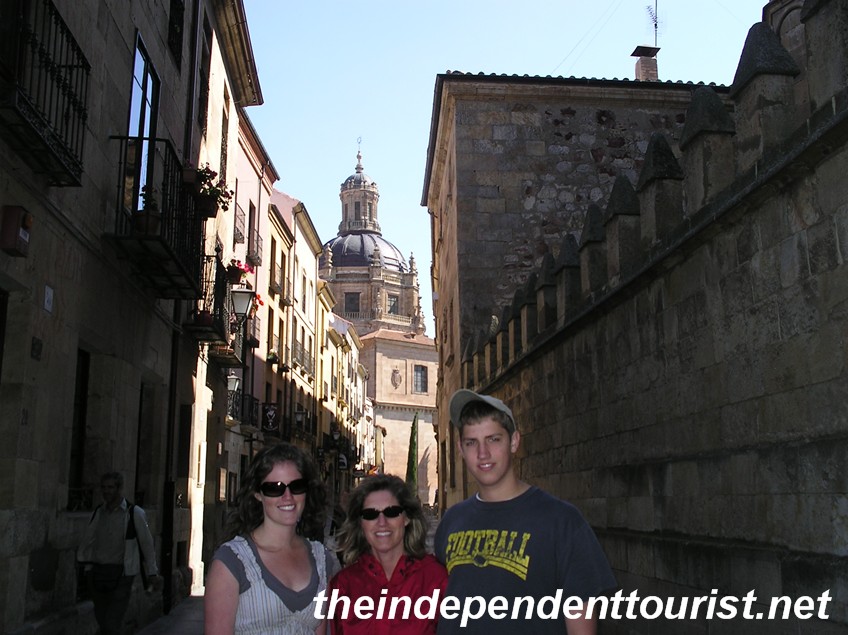
The founding of the city goes back to pre-Roman times. The stately architecture of the old town gives it an aura of distinction, which has been earned–Salamanca has been an important center of learning for a thousand years .

The narrow streets of Salamanca.

The narrow streets of Salamanca.

Plaza de Mayor

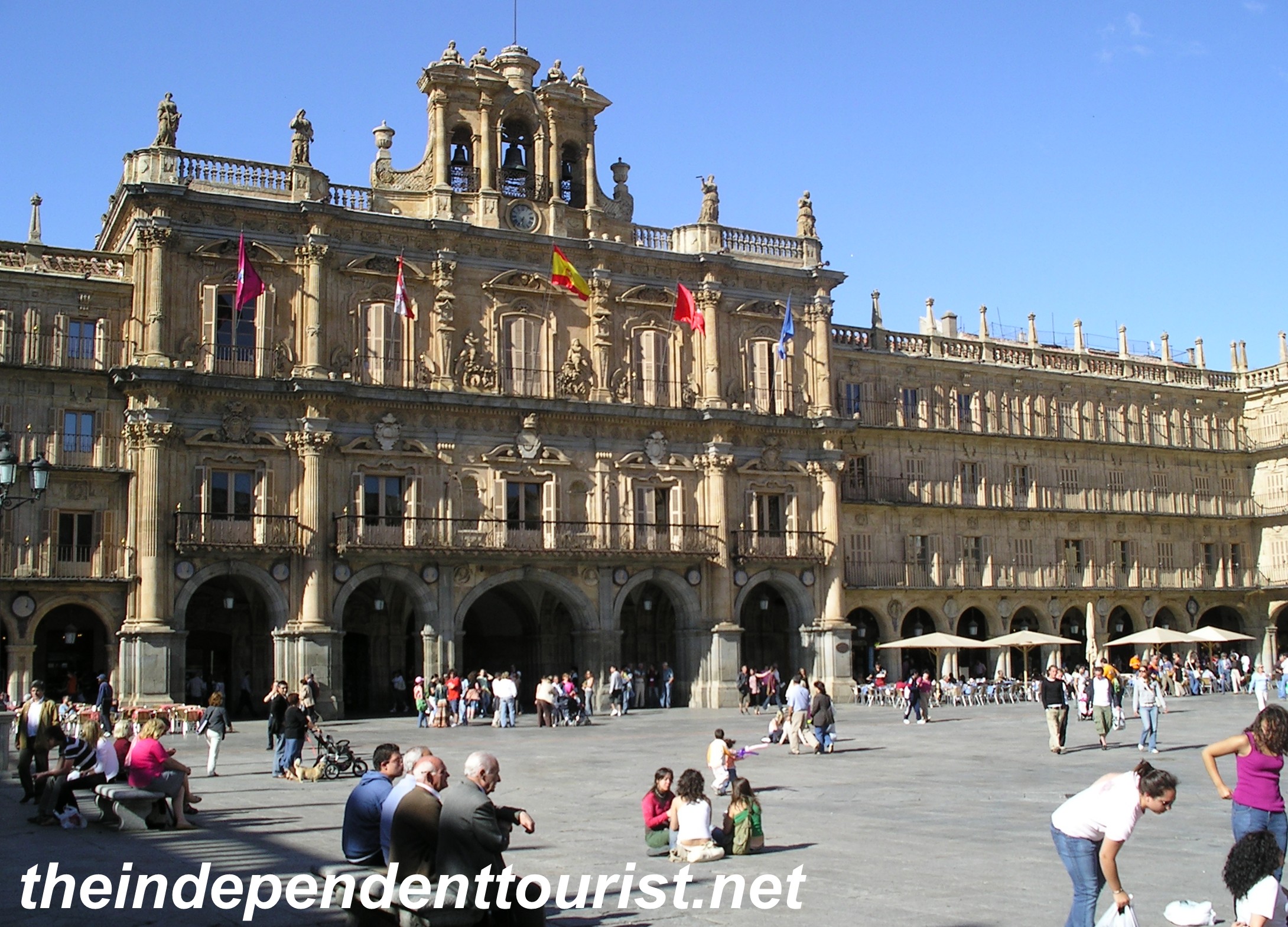
Although “Plazas de Mayor” are found throughout cities in Spain, one of the grandest is Salamanca’s. I had heard how great it was, but didn’t understand until I visited. This 18th century plaza is one of Spain’s largest, bordered by majestic architecture.

Salamanca's great Plaza de Mayor.

Salamanca’s great Plaza de Mayor.

The Plaza Mayor is a great place to rest and absorb the wonderful surroundings on a sunny afternoon.

Catedral Vieja and Catedral Nueva (Old and New Cathedrals)

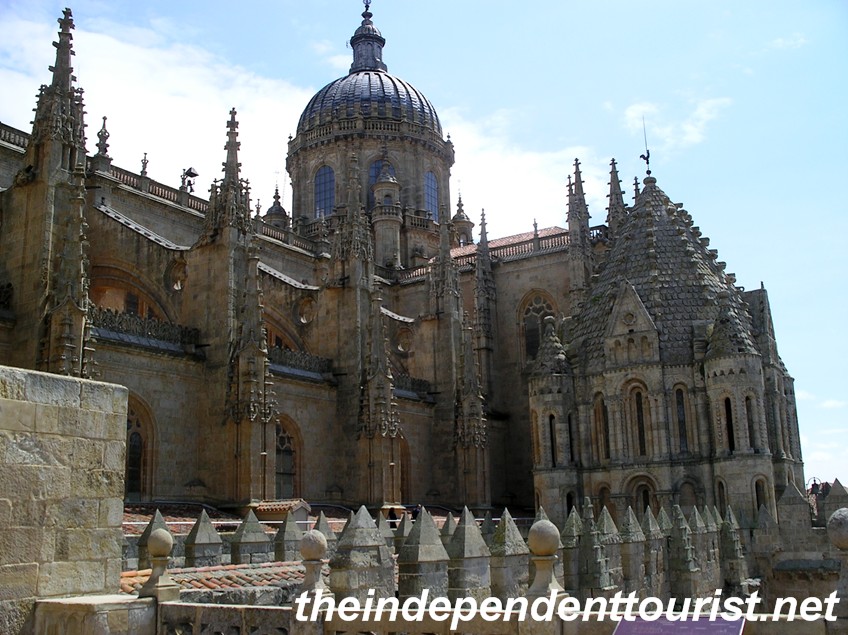
These two cathedrals adjoin one another. The old Romanesque cathedral is from the 12th and 13th centuries and the “new” 16th century cathedral is more Gothic and Baroque in its design. Luckily the old cathedral was preserved, rather than being torn down to make room for the new cathedral.

Although hard to tell, the old cathedral is on the right and the new cathedral towers over the old.

Although hard to tell, the old cathedral is on the right and the new cathedral towers over the old.

They both have beautiful frescoes, altarpieces and other precious art. Be sure to go up to the roof for a great view of old Salamanca.

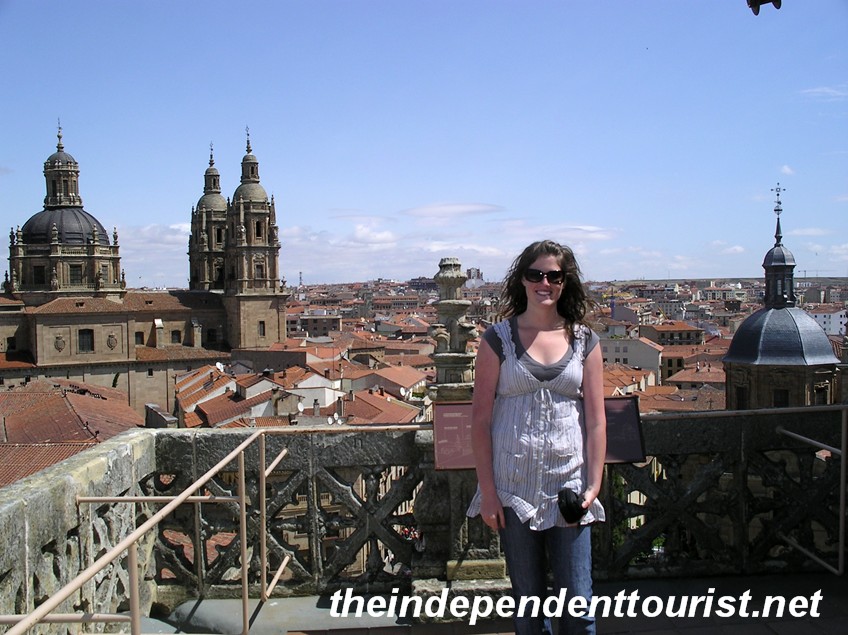
View of Salamanca from the roof top of the Cathedral.

View of Salamanca from the roof top of the Cathedral.

Salamanca University

Founded in 1218, Salamanca University is one of Europe’s oldest and still functions as a top university in Spain, attracting students from around the world. One of the lecture rooms still has its original furniture.

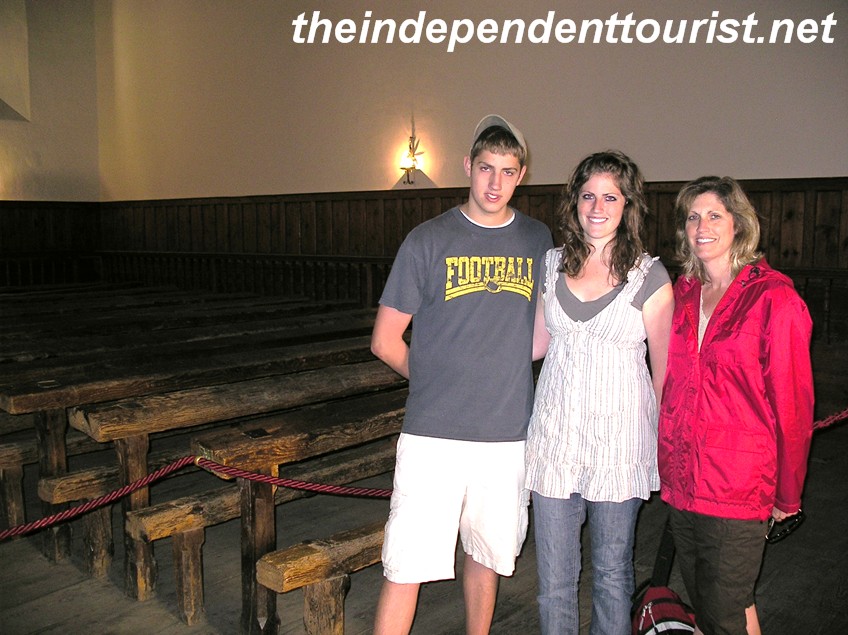
The 13th century student seating in this lecture hall is original.

The 13th century student seating in this lecture hall is original.

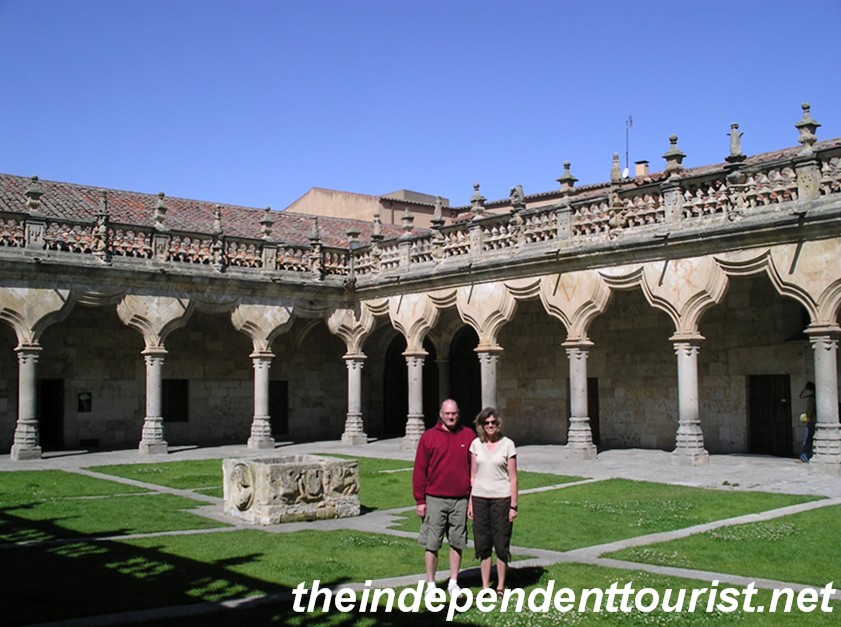
The elegant courtyard of Salamanca University.

The elegant courtyard of Salamanca University.

Columbus met with geographers here to make his case for his famous western voyage to the Indies (which of course turned out to be the Americas).

The Patio de las Escuelas of Salamanc University.

The Patio de las Escuelas of Salamanc University.

Other Sights

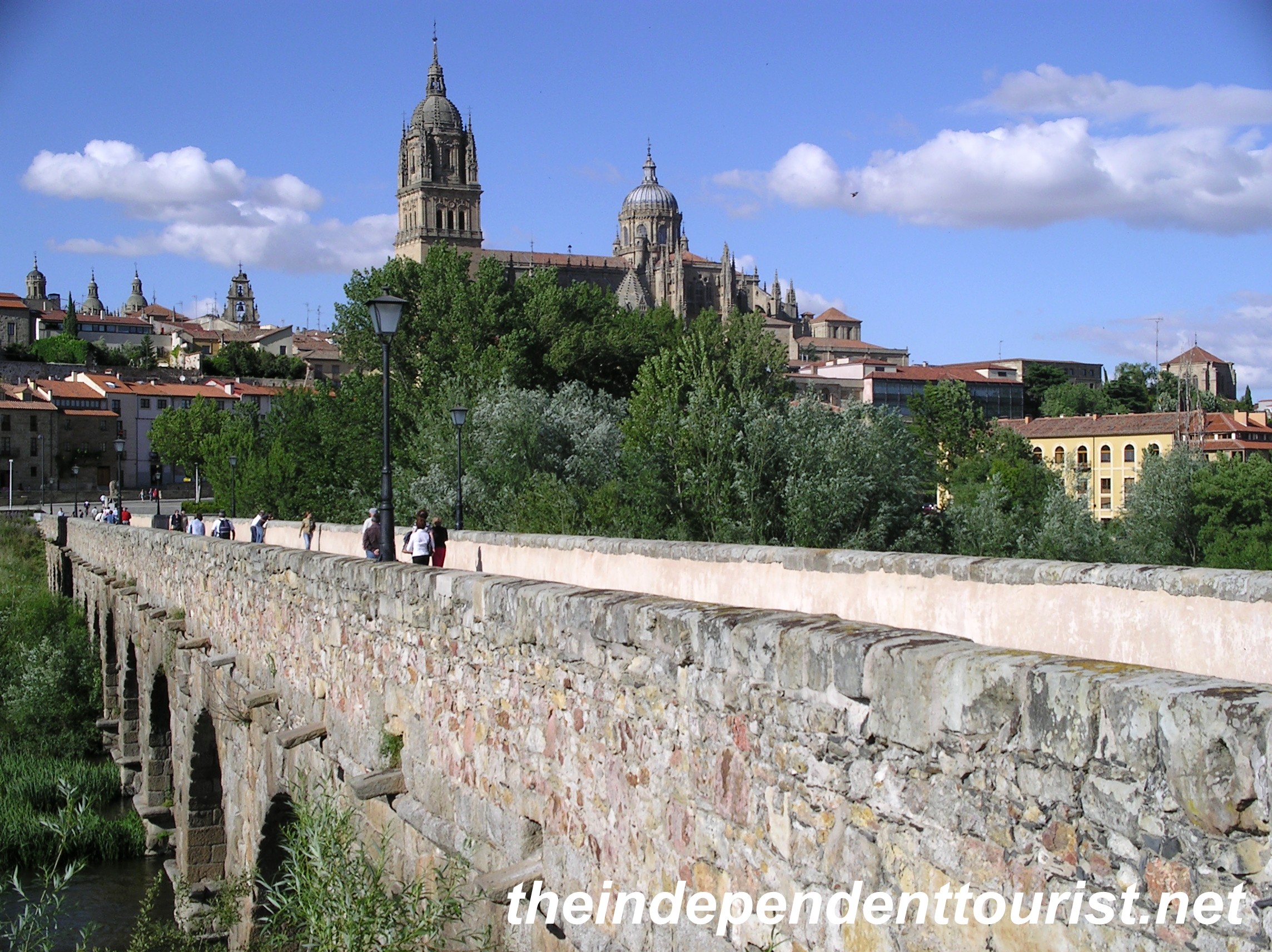
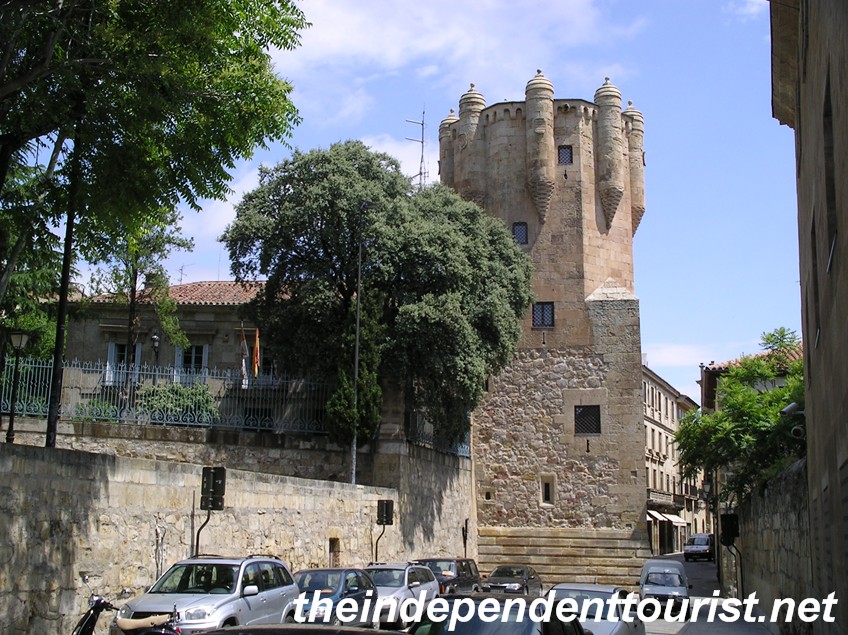
Venture south of the old town to take a look at the Puente Romano (Roman Bridge), built in the 1st century AD. The Torre del Clavero (a 15th century tower), other old churches, convents and museums also beckon.

The 1st century AD Roman Bridge in Salamanca.

The 1st century AD Roman Bridge in Salamanca.

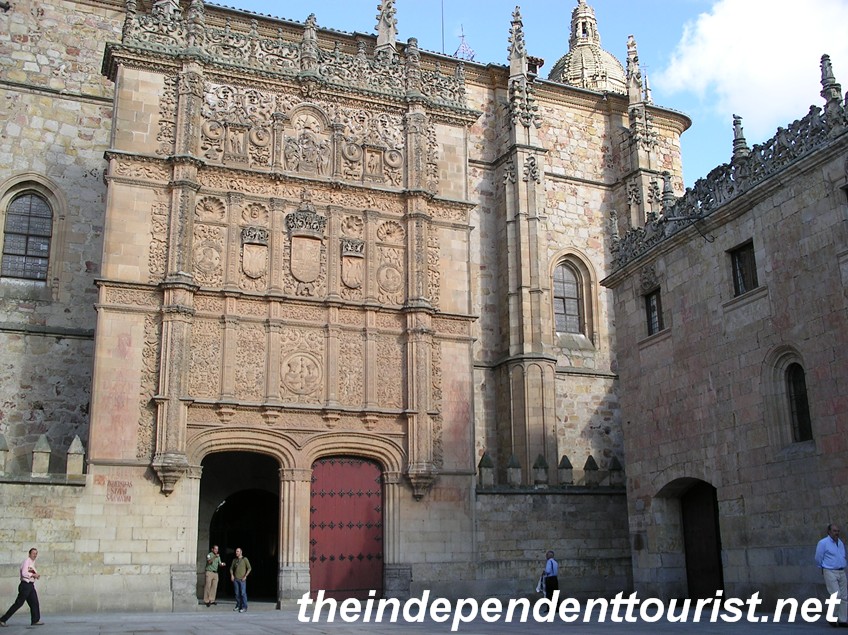
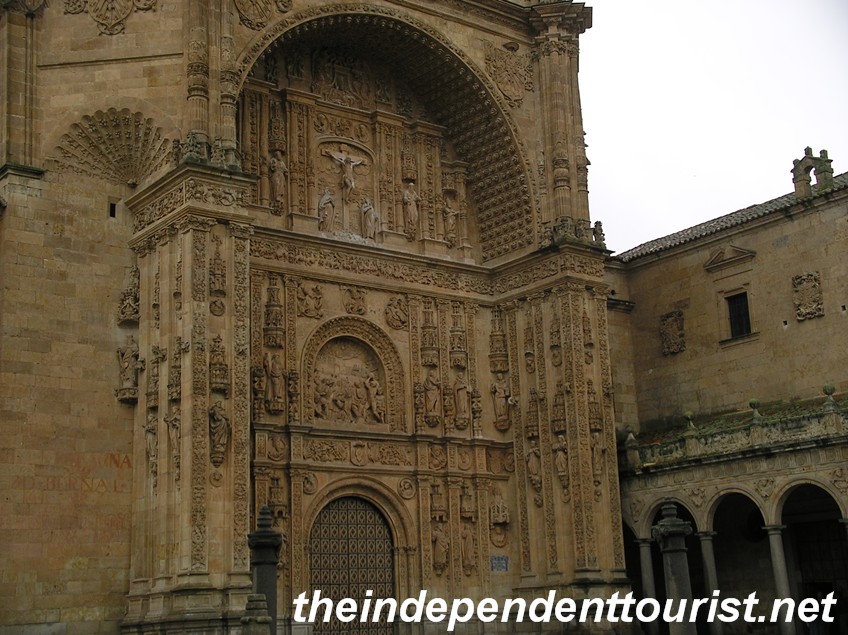
The intracately carved entrance to the Iglesia-Convento de San Esteban, a 16th century Dominican monastery.

The intracately carved entrance to the Iglesia-Convento de San Esteban, a 16th century Dominican monastery.

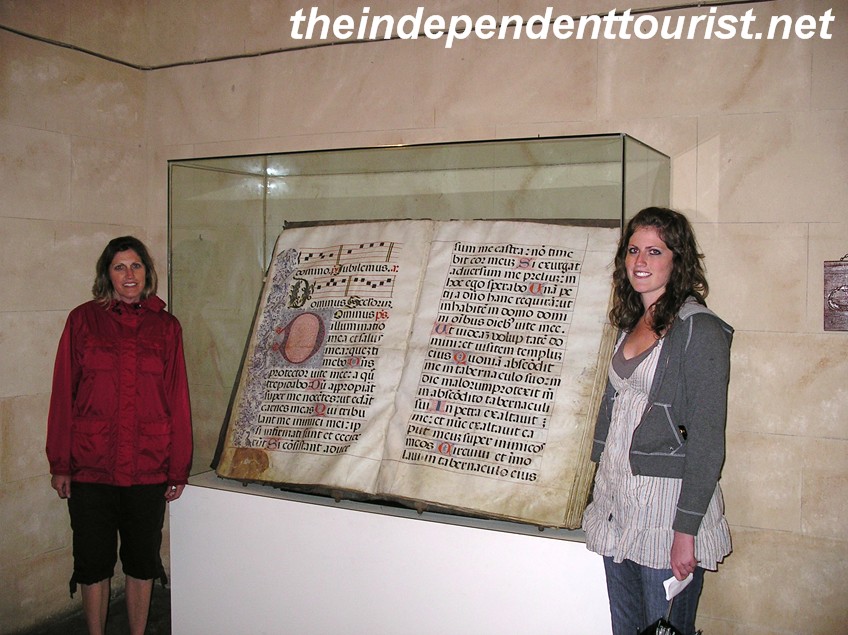
Huge ancient manuscript in the Iglesia-Convento de San Esteban.

Huge ancient manuscript in the Iglesia-Convento de San Esteban.

The Torre del Clavero (15th century) in old Salamanca.

The Torre del Clavero (15th century) in old Salamanca.

Just wandering through the old town is a joy. Be sure to visit Salamanca on your next trip to Spain!

Three Must-Do Sights on the West Bank of the Nile (Ancient Thebes)

As mentioned in my other post on Thebes (located on West Bank of the Nile), there is lots to see in this area just across the river from Luxor, Egypt. The three sights below are “must do’s”, two of which are major tourist sights (the third receives far fewer tourists). For a map of places visited in Egypt click here.

Valley of the Kings

The Valley of the Kings is the number one tourist spot in ancient Thebes. It’s the location of the tomb of the world famous King Tut and many other pharaohs from the 18th – 20th Dynasties (1550-1069 BC).

At the entrance to the Valley of the Kings.

At the entrance to the Valley of the Kings.

Some of the tombs were known and open as far back as Greek and Roman times and others were discovered more recently (such as King Tut’s, which was just discovered in 1922). Many of the artifacts from King Tut’s tomb are found in the Egyptian Museum in Cairo (a new Grand Egyptian Museum is set to open in March 2015 near the Giza Pyramids). Your ticket will allow you to see three tombs in one day and the number of visitors to each tomb is limited (King Tut’s requires a separate ticket).

In one of the plain chambers of the tombs I quickly took this picture.

In one of the plain chambers of the tombs I quickly took this picture.

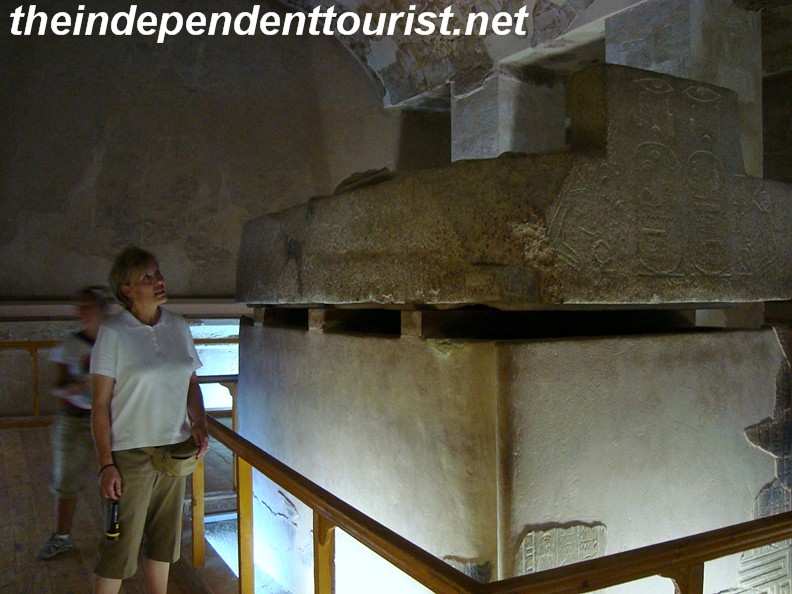
It is just about impossible to get meaningful pictures in the Valley of the Kings since photos aren’t allowed in the tombs and the exteriors are just dark entrance ways with signage. However, the tombs themselves are incredible. Many of the tombs are accessed via long corridors going deep into the hillsides, some have chambers in addition to the main tombs. These tombs are carved out of solid rock and the walls and ceilings of most corridors and rooms are highly decorated with beautiful paintings.

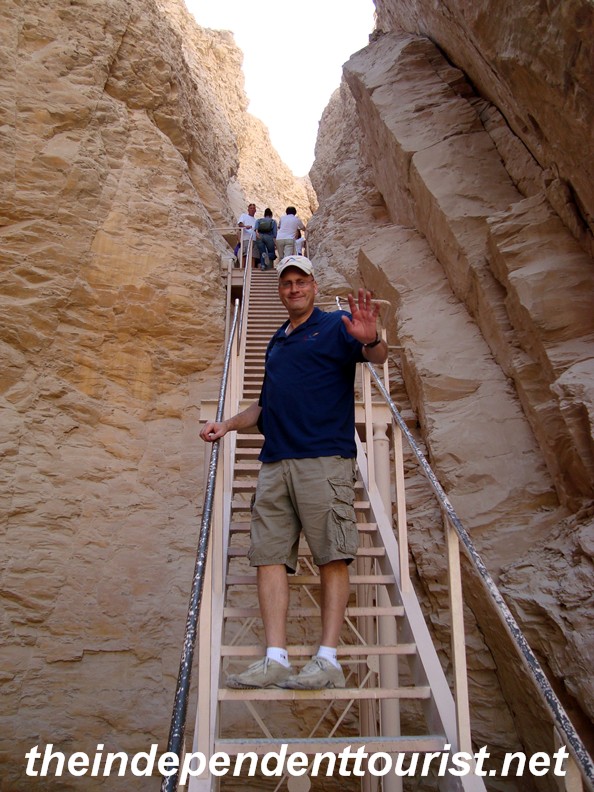
Climbing up to the Tomb of Tuthmosis III - the tomb was dug 100 feet above the valley floor in an attempt to keep thieves out (didn't work!).

Climbing up to the Tomb of Tuthmosis III – the tomb was dug 100 feet above the valley floor in an attempt to keep thieves out (didn’t work!).

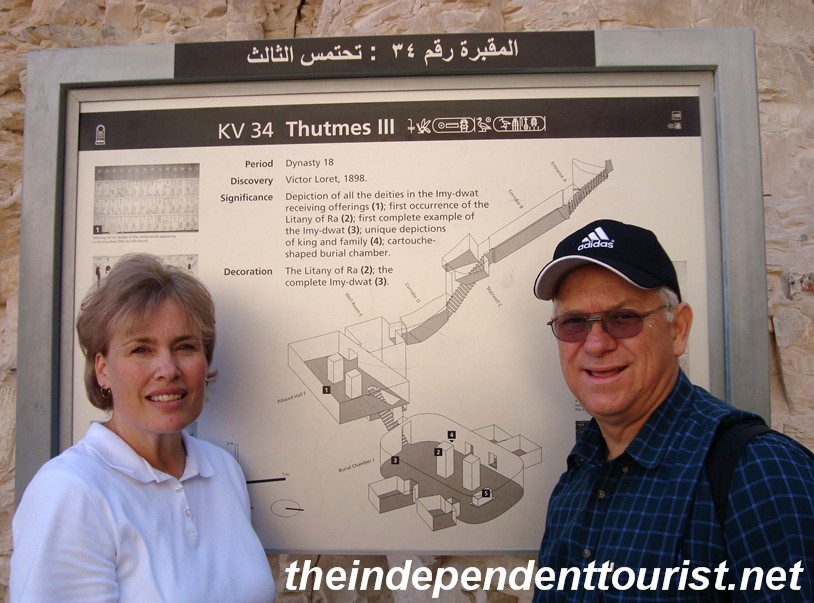
The sign at the entrance of the tomb of Tuthmosis III (1479 - 1425 BC). The "KV 34" means it was the 34th tomb discovered in the "Kings Valley."

The sign at the entrance of the tomb of Tuthmosis III (1479 – 1425 BC). The “KV 34” means it was the 34th tomb discovered in the “Kings Valley.”

Sixty-two tombs have been excavated to-date, and there are probably more to be discovered. This remote location was chosen to thwart grave robbers, but even though many tombs were hard to reach, robbers found a way into almost all of the tombs.

Temple of Hatshepsut (Deir al-Bahri)

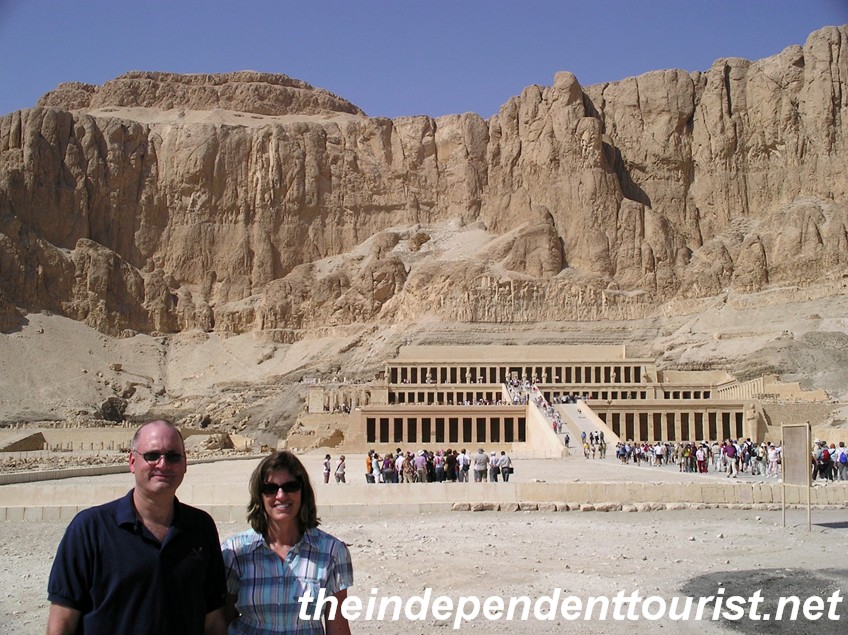
The Temple of Hatshepsut at the base of a dramtic limestone cliff.

The Temple of Hatshepsut at the base of a dramtic limestone cliff.

This temple was constructed by Queen Hatshepsut in the 18th Dynasty (she reigned from 1473-1458 BC). The setting is dramatic and the temple is in good condition and from a distance is almost looks new—hard to believe it’s 3,500 years old.

The decorated rooms of the Temple of Hatshepsut.

The decorated rooms of the Temple of Hatshepsut.

A carved pillar in the courtyard of the Temple of Tuthmosis III next to the Temple of Hatshepsut.

A carved pillar in the courtyard of the Temple of Tuthmosis III next to the Temple of Hatshepsut.

There are many carved and painted reliefs still in good condition even after thousands of years. There are also some older temple ruins on the site. Be prepared for the crowds here.

Medinat Habu Temple

This temple is huge, and 2nd to only Karnak in size (Karnak is located on the East Bank north of Luxor). However, it receives fewer visitors since it is a little off the beaten track from the Valley of the Kings and the Temple of Hatshepsut.

My mother-in-law, wife and sister in front of the Medinat Habu Temple.

My mother-in-law, wife and sister in front of the Medinat Habu Temple.

The carved pillars in the Second Court of Medinat Habu Temple.

The carved pillars in the Second Court of Medinat Habu Temple.

It is the mortuary temple of Ramses III (reigned 1184 – 1153 BC) and was patterned after the mortuary temple of Ramses II (the Ramesseum, nearby). Medinat Habu has survived in much better condition than the Ramesseum.

Another view of the Second Court of Medinat Habu Temple.

Another view of the Second Court of Medinat Habu Temple.

The temple area was inhabited until the 9th century and was the center of economic life in Thebes for centuries. Allow a couple hours to wander the extensive ruins.

The Chateaux of the Loire Valley, France

One of my favorite areas of France is the Loire Valley, located in the central part of the country, about 115 miles (185 km) southwest of Paris. There are over 300 chateaux in this region, all harken back to the days of the French aristocracy. The ostentatious display of wealth as evidenced by the chateaux and their extensive lands and gardens helped lay the groundwork for the French Revolution in 1789. Many of the chateaux were built in the 1500’s, and a number of them are open to tourists. I love visiting historical sights and these elegant chateaux are fun to explore, each is unique in its architecture and many have beautiful gardens also.

Blois Chateau, in the heart of the city of Blois.

Blois Chateau, in the heart of the city of Blois.

I highly recommend spending at least a couple days in the Loire Valley to see several of these beautiful structures. Good bases for exploring the area include Blois, Amboise or Tours. I have a hard time picking a favorite. Some are very large (Chambord is huge) and others are smaller but have more elaborate interiors and decorations. Although it’s called the Loire “Valley” the area is quite flat, agricultural, and a popular bike route.

Chenonceau

Chenonceau (along with Chambord–below) is considered the Renaissance masterpiece of the Loire Valley. The main castle was built from 1513-1521. It was the home of the mistress of King Henri II (Diane de Poitiers) in the mid 1500’s.

A view of the Chenonceau gardens and castle.

A view of the Chenonceau gardens and castle.

There are a number of beautiful tapestries here, but it was hard to get interior pictures as they weren’t allowed.

The gallery of Chenonceau spanning over the River Cher.

The gallery of Chenonceau spanning over the River Cher.

The long two-story gallery spanning across the Cher River was built in 1570 by Catherine de’ Medici (wife of King Henri II) and was used as a hospital ward in World War I. In World War II, the far bank of the river was the border of the free zone of France and passing through the gallery meant escaping from Nazi occupied France.

Chambord  

The largest of the Loire Valley chateaux, Chambord was begun by King Francios I in 1519, and later finished by Louis XIV in 1685.

A view of the keep (central towers) of Chambord Chateau.

A view of the keep (central towers) of Chambord Chateau.

It has 440 rooms and was a “hunting lodge.” One of the most unusual features is the roof, with highly decorated towers and chimneys.

The roof towers and chimneys at Chambord Chateau.

The roof towers and chimneys at Chambord Chateau.

The interior is largely bare and open.

The double-helix Grand Staircase - note the two stairways.

The double-helix Grand Staircase – note the two stairways.

The Grand Staircase, with the “double helix” construction, was supposedly designed by Leonardo da Vinci. The design means that someone going up the staircase and a person going down would not meet!

Chaumont

Chaumont was built in 1445 on the grounds of an earlier castle from the 10th century. The rebuilt chateau was designed less for defensive reasons but still has the feel of a medieval castle with a drawbridge, turrets and crenellated walls.

Chaumont Chateau has the look of a medieval castle.

Chaumont Chateau has the look of a medieval castle.

Another view of Chaumont Chateau.

Another view of Chaumont Chateau.

When Diane de Poitiers was kicked out of Chenonceau by Catherine de’ Medici after King Henri II’s death, she was moved here. While not as elegant as Chenonceau, it’s still not too bad of a place to live!

Amboise

Amboise is a great medieval town, in addition to having a 15th century chateau and the nearby Gothic Chapelle St-Hubert, Leonardo da Vinci’s burial spot.

The Chapelle St-Hubert sits on top of the walls of Amboise. It's the final resting place of Leonardo da Vinci.

The Chapelle St-Hubert sits on top of the walls of Amboise. It’s the final resting place of Leonardo da Vinci.

A view of Amboise Chateau from the courtyard.

A view of Amboise Chateau from the courtyard.

The chateau has quite a place in French royal history with several kings either having been born or raised here, or living and dying here. Catherine de’ Medici’s 10 children also were raised here.

Another view of the walls of Amboise with the Chateau overlooking the edge.

Another view of the walls of Amboise with the Chateau overlooking the edge.

Although the chateau itself is a bit smaller than some of the others, the setting, town and overall feel of Amboise makes it a must-see location in the Loire Valley.

Kwidzyn and Gniew – Other Great Teutonic Castles in Northern Poland
The German Teutonic Knights built numerous castles in Norther Poland in the 13th and 14th centuries. Here are two others in addition to Malbork worth visiting. (For a map of sites we visited in Poland, click here).

Kwidzyn Castle

Kwidzyn Castle doesn’t receive near the number of visitors that Malbork Castle does, and yet it’s one of the more interesting castles I’ve visited from an architectural standpoint. It has two towers extending from the main structure by long arcaded bridges, one of which is a latrine tower and the other is over a well.

Kwidzyn Castle with the Latrine Tower in the foreground. A long way down from your toilet seat!

Kwidzyn Castle with the Latrine Tower in the foreground. A long way down from your toilet seat!

The elevated hall leading to the Latrine Tower, with many displays of old farm tools and home furnishings.

The elevated hall leading to the Latrine Tower, with many displays of old farm tools and home furnishings.

Kwidzyn Castle with the Well Tower extending from the main structure.

Kwidzyn Castle with the Well Tower extending from the main structure.

If you like medieval churches too, Kwidzyn is a great stop because it has a cathedral and castle connected right together!

The Kwidzyn Cathedral, conveniently connected directly to the castle.

The Kwidzyn Cathedral, conveniently connected directly to the castle.

Interior of the 14th century Kwidzyn Cathedral. There are many well preserved frescoes (note opposite wall).

Interior of the 14th century Kwidzyn Cathedral. There are many well preserved frescoes (note opposite wall).

The castle and the adjoining cathedral were built in the early 14th century and somehow they survived World War II without a scratch; however the castle did suffer under the Prussians in the 18th century, who pulled down a couple of sections. But thankfully most of it remains intact. The main castle is a museum, containing a variety of natural history displays, medieval art and farming implements in the hallways and towers and some torture devices in the dungeon.

The dungeon of Kwidzyn Catstle.

The dungeon of Kwidzyn Catstle.

One torture device in the dungeon of Kwidzyn Castle. You would have to sit in one position and couldn't move. Also note shackles on wall to the right.

One torture device in the dungeon of Kwidzyn Castle. You would have to sit in one position and couldn’t move. Also note shackles on wall to the right.

Gniew Castle

We also made a quick stop at one other castle near Kwidzyn that is now a business convention center. Gniew Castle was started in the late 13th century.

Exterior of Gniew Castle.

Exterior of Gniew Castle.

It was a famous location, known for hosting lavish banquets and many guests. In the early 1600’s Gniew Castle was the site of a year-long siege by the Swedish who carried off many of the castle’s treasures.

Interior courtyard of Gniew Castle, it could accomodate 500 guests for banquets.

Interior courtyard of Gniew Castle, it could accomodate 500 guests for banquets.

Less Visited Sights of the West Bank (Ancient Thebes) near Luxor, Egypt

The West Bank of the Nile (across from Luxor) has a number of interesting sights, some of which very few tourists visit. Lots of boats will take you across the Nile for a small fee. Once you cross the Nile, there are plenty of taxis and bicycles for rent to get you around the sights. For a map of places we visited in Egypt, click here.

Our boat, the "Omar Sharrif" getting ready for the short journey across the Nile.

Our boat, the “Omar Sharrif” getting ready for the short journey across the Nile.

Colossi of Memnon

I admit these aren’t “less visited,” but since these huge statues mark the gateway to the sights of the West Bank, I am including them here. This is a popular spot since the Colossi are right off the road. They were part of a huge temple complex dating to the time of Amenhotep III (1390-1352 BC). The temple has long since disappeared, mainly due to the site being in the flood plain of the Nile and pilfering of the building materials by subsequent pharaohs.

These 60 ft. statues have been standing watch over the West Bank of the Nile for almost 2,400 years.

These 60 ft. statues have been standing watch over the West Bank of the Nile for almost 2,400 years.

The Colossi were already a tourist site in Roman times 2,000 years ago!

Deir al-Medina

These ruins are also known as the Worker’s Village. The workers who created the nearby Valley of the Kings and other monuments in Thebes lived in this village, which was founded about 1500 BC. During our visit we had the place to ourselves. The site includes a temple, ruins of the village houses, and several decorated tombs (no pictures inside allowed).

My sister in a view of the Worker's Village ruins (Deir al-Medina).

My sister in a view of the Worker’s Village ruins (Deir al-Medina).

A small temple in the Worker's Village.

A small temple in the Worker’s Village.

Walls surrounding the temple in the Worker's Village.

Walls surrounding the temple in the Worker’s Village.

Another view of the Worker's Village (Deir al-Medina).

Another view of the Worker’s Village (Deir al-Medina).

Tombs of the Nobles

These tombs are less refined and more rough-hewn than the tombs in the Valley of the Kings, but are considered some of the best in Thebes. There are 100 tombs, not all of which are open and you probably couldn’t find them if they were. It is impossible to get pictures inside the tombs, and I understand the need for ensuring the paintings will endure for future generations. We were the only group visiting this spot.

Looking up at the hillside containing many of the Tombs of the Nobles.

Looking up at the hillside containing many of the Tombs of the Nobles.

The entrance to the Tomb of Sennofer (considered one of the best in the Tombs of the Nobles), 18th Dynasty (about 1500 BC).

The entrance to the Tomb of Sennofer (considered one of the best in the Tombs of the Nobles), 18th Dynasty (about 1500 BC).

The village that intermingles with the tombs is called Old Gurna and the government is trying to relocate the population away from the tombs. We had some friendly local residents show us around some of the tombs for a small fee.

The village of Old Gurna near the Tombs of the Nobles.

The village of Old Gurna near the Tombs of the Nobles.

The Ramesseum

This very ruined structure was built for Ramses II (around 1250 BC) as his mortuary temple so he could live eternally in the minds of his subjects. Ramses II ruled Egypt for 67 years. With almost no tourists in sight, it was fun exploring the ruins of this huge temple.

In the Hypostyle Hall of the Ramesseum.

In the Hypostyle Hall of the Ramesseum.

The head and shoulders of a 60 ft. statue of Ramses II - how did they move and hoist such a huge block of granite?

The head and shoulders of a 60 ft. statue of Ramses II – how did they move and hoist such a huge block of granite?

Another view of the Ramesseum. In the background are statues of Ramses II as Osiris, god of the underworld.

Another view of the Ramesseum. In the background are statues of Ramses II as Osiris, god of the underworld.

We spent two days exploring the sights of the West Bank and it would be easy to have spent more exploring this vast culturally rich area.

Malbork – Europe’s Largest Gothic Castle

Malbork Castle sits on the east bank of the Nogat River, a tributary of the mighty Vistula River.

Malbork Castle sits on the east bank of the Nogat River, a tributary of the mighty Vistula River.

My first general awareness of Malbork Castle came from a Lufthansa flight magazine on a trip to Europe. Immediately I though “this is a place I need to visit” and in August 2013 I was able to do so with my family. Malbork is about 30 km (18 miles) southeast of Gdansk, Poland and can be visited by car or train from Gdansk.

Places we visited in Poland in 2013.
Places we visited in Poland in 2013.

This huge castle is one of Poland’s greatest tourist attractions. We were astounded at its size. We were “running” and it took us close to three hours to visit.

The massive gate entrance to the Middle Castle - Malbork.

The massive gate entrance to the Middle Castle – Malbork.

Malbork was built by the Teutonic Knights (a German religious order of monk-warriors founded during the Third Crusade to Jerusalem) and Malbork was their headquarters and seat of the Grand Masters for 150 years starting in 1309 (construction on the castle started in the 1370’s). World War II inflicted significant damage to parts of the castle, but it is largely intact and restored.
A view taken from the Main Tower of the High Castle, overlooking the Palace of the Grand Masters, Middle Castle and the Nogat River.

A view taken from the Main Tower of the High Castle, overlooking the Palace of the Grand Masters, Middle Castle and the Nogat River.

A view of the eastern side of the Middle Castle at Malbork.

A view of the eastern side of the Middle Castle at Malbork.

The primary structures include the High Castle (the stronghold), the Middle Castle (kitchens, rooms for entertaining guests and the Palace of the Grand Masters), and outer walls and buildings. Main sights include the Grand Master’s Palace, the Great Refectory, the High Castle Courtyard and St. Mary’s Church, including St. Anne’s Chapel underneath the church.

Exterior of the Grand Master's Palace.

Exterior of the Grand Master’s Palace.

The Great Refectory, Middle Castle - Malbork. Largest Gothic interior of its kind in Central Europe. Used for banquets and entertaining.

The Great Refectory, Middle Castle – Malbork. Largest Gothic interior of its kind in Central Europe. Used for banquets and entertaining.

The Chapter Room (where business would be conducted) in the High Castle - Malbork.

The Chapter Room (where business would be conducted) in the High Castle – Malbork.

St. Mary's Church, not completely restored from WW II damage.

St. Mary’s Church, not completely restored from WW II damage.

The Last Supper frescoe in St. Mary's Church.

The Last Supper frescoe in St. Mary’s Church.

Tombs of the Grand Masters in St. Anne's Chapel.

Tombs of the Grand Masters in St. Anne’s Chapel.

Courtyard and well in the High Castle - Malbork.

Courtyard and well in the High Castle – Malbork.

Be sure to visit the walls on the south side of the castle. There are interesting displays of medieval machinery and excellent views of the castle buildings and towers from here.

The Latrine Tower on the southwestern corner of the castle grounds. Used for exactly what it sounds like! There was originally water below the tower for "flushing."

The Latrine Tower on the southwestern corner of the castle grounds. Used for exactly what it sounds like! There was originally water below the tower for “flushing.”

There are other Teutonic castles in northern Poland and in another post I will share images of two more, but Malbork is the grandest by far.

Sources: Plaques at Malbork Castle, Top Spot Guide: Malbork Castle –  The World of the Teutonic Order, by Marek Stokowski.