Author: Paul Terry

I love to travel. I've been fortunate to visit about 75 countries so far. I prefer to travel independently to get off the beaten path a bit. I also try to find good deals to make my travels more affordable.

Snagov Monastery – The Final Resting Place of “Dracula” (or is it?)

A view of Lake Snagov from the monastery.

A view of Lake Snagov from the monastery.

Snagov Monastery Church - Vlad Tepes grave is located here.

Snagov Monastery Church – Vlad Tepes grave is located here.

North of Bucharest is Snagov Monastery on Lake Snagov (for a map of Romania and sites visited click here). This is where Vlad Ţepeş is believed to be buried. Vlad “The Impaler” Ţepeş, (the man who inspired the legend of “Dracula”) lived from 1431 to 1476. The name Dracula comes from his father who was known as “Vlad Dracul,”a member of the “Order of the Dragon.” In 1476, Vlad Ţepeş was killed by the Turks in a battle near Bucharest and his head was taken as a prize to Istanbul. It’s believed that his body was buried at this monastery, which has existed on this spot since the 14th century. The remains were exhumed in the 1930’s and it was clear that the corpse had been decapitated, consistent with Vlad Ţepeş’ death.

The simple grave of Vlad Tepes - A plaque and a candle mark the spot.

The simple grave of Vlad Tepes – A plaque and a candle mark the spot.

My wife and son standing over "Dracula's" grave.

My wife and son standing over “Dracula’s” grave.

Another view of the interior of the church at Snagov.

Another view of the interior of the church at Snagov.

Practicalities:

The monastery is located on a small island in Snagov Lake, at the northern end near the small village of Silestru. Let me say it here: you don’t need a boat to get to the monastery. Although both Lonely Planet and Rough Guide say you have to get a row boat, you can get to the monastery by foot, by crossing a small bridge. The road to the footbridge (located at the end of Vlad Ţepeş street) is not well marked (Silestru is just a little village), but wander around a bit or ask a local and I’m sure they’ll point you in the right direction. Park your car near the footbridge and if a man asks for a payment for leaving your car there, pay him and don’t quibble.

The footbridge from Silestru to Snagov Monastery.

The footbridge from Silestru to Snagov Monastery.

The street that leads to the footbridge to Snagov Monastery.

The street that leads to the footbridge to Snagov Monastery.

There isn’t too much to see here other than the small chapel and the grave marking Vlad Ţepeş resting spot. But, given the Dracula lore, we had to make the stop. There are a few tour buses who also visit here as part of a day trip from Bucharest (about 35 km south of Snagov), so I would suggest getting here first thing when the monastery opens.  We were leaving just as a crowd was arriving. Relative to other sights in Romania, the monastery was rather expensive, 15 lei per person (about 3 lei per USD).

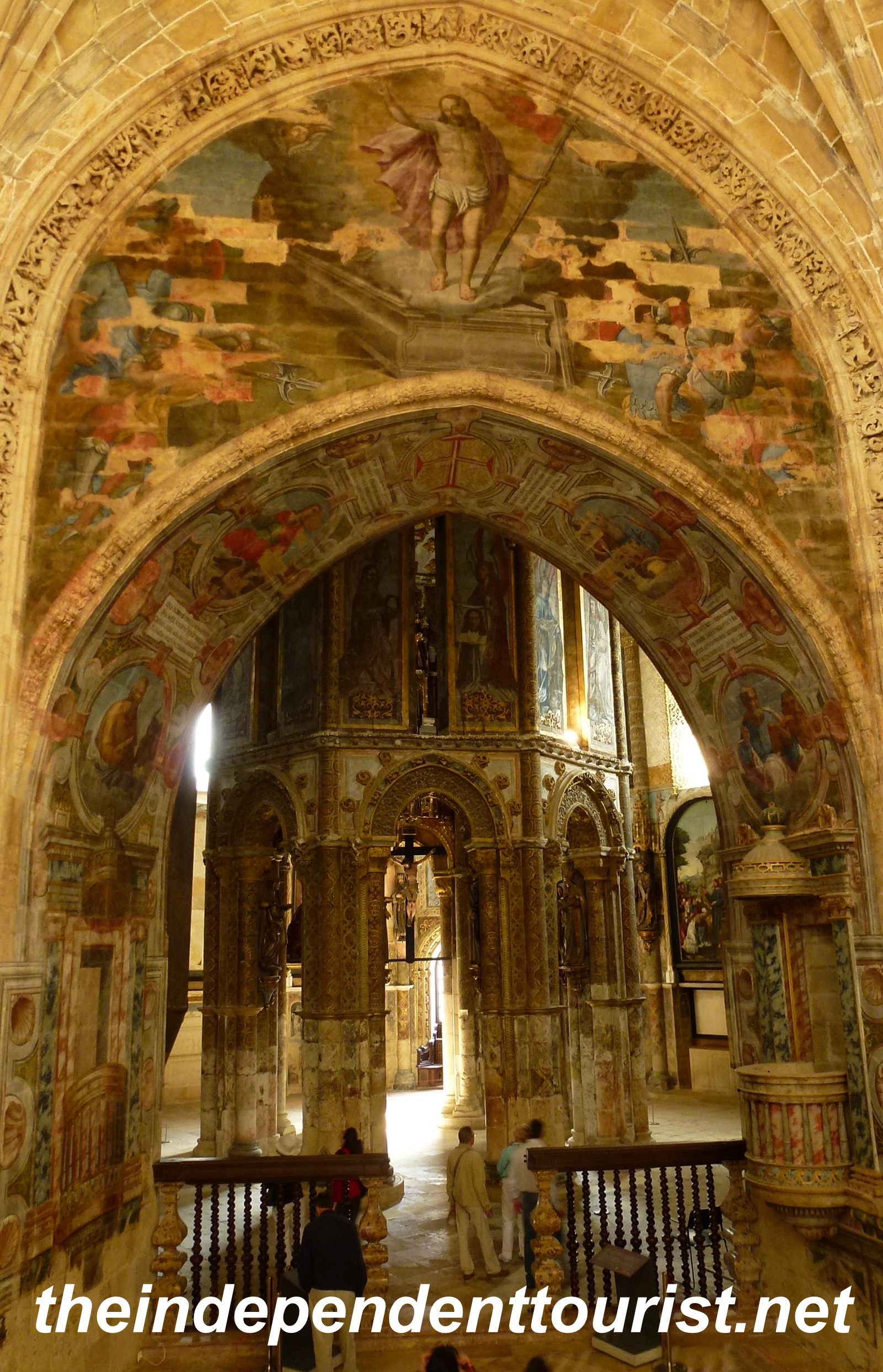
Convento de Cristo, Tomar, Portugal

The Templar church (Oratory) was also a defensive tower, it has 16 sides, and was next to an exterior wall. The interior (see pictures below) is amazing.

The Templar church (Oratory) was also a defensive tower, it has 16 sides, and was next to an exterior wall. The interior (see pictures below) is amazing.

Huge fortress walls, a Templar castle-like church and a huge late-Gothic monastery all in one.  What more could you ask for? That’s what you get with the Convento de Cristo, in the town of Tomar, Portugal.

The entrace to the 12th century circular church from the 16th century chapter house.

The entrace to the 12th century circular church from the 16th century chapter house.

The circular ambulatory in the 12th century church.

The circular ambulatory in the 12th century church.

The 8 sided center column fans out to the 16 sided walls.

The 8 sided center column fans out to the 16 sided walls.

The fortress grounds and convent sit on a hill overlooking the town of Tomar—the walls are visible from the train station.  Ever since I got a book about the Great Monasteries of Europe (by Bernard Schütz) many years ago, I’ve wanted to visit Tomar. With my love of medieval history and interest in the Knights Templar, Tomar is a must do, and I finally had the chance to visit in 2012.

Tomar is 2 hours by train (137km) northeast of Lisbon.

Tomar is 2 hours by train (137km) northeast of Lisbon.

The fortified walls and entrance to the monastery.

The fortified walls and entrance to the monastery.

The original fortress was a Moorish settlement (9th to 12th centuries), and the Knights Templar made Tomar their headquarters in 1160. The Templars were heroes at the time due to their role in the Reconquista, helping push the Moors out of the Iberian Peninsula. The Knights brought with them architectural refinements from the Middle East (from their time defending the Holy Land) and the fortress structural design was considered ahead of its time for western Europe.

The intricate carvings of the main entry way into the church and chapter house.

The intricate carvings of the main entry way into the church and chapter house.

The highly decorated exterior of the 16th century chapter house addition.

The highly decorated exterior of the 16th century chapter house addition.

The famous chapter house west facade window, 1510-1513, late Gothic “Manueline” style (after King Manuel), symbolizes the Tree of Life or Tree of Jesse from the Bible.

The famous chpater house west facade window, 1510-1513, late Gothic “Manueline” style (after King Manuel), symbolizes the Tree of Life or Tree of Jesse from the Bible.

When the Order of the Knights Templar (or Order of the Temple) was disbanded in 1319, the fortress of Tomar was turned over to the Portuguese Order of Christ, becoming its headquarters in 1357. King Manuel and King João III in the 16th century added extensively to the site making this a very large monastery—the artistic work speaks to the wealth of Portugal as a world power at that time.

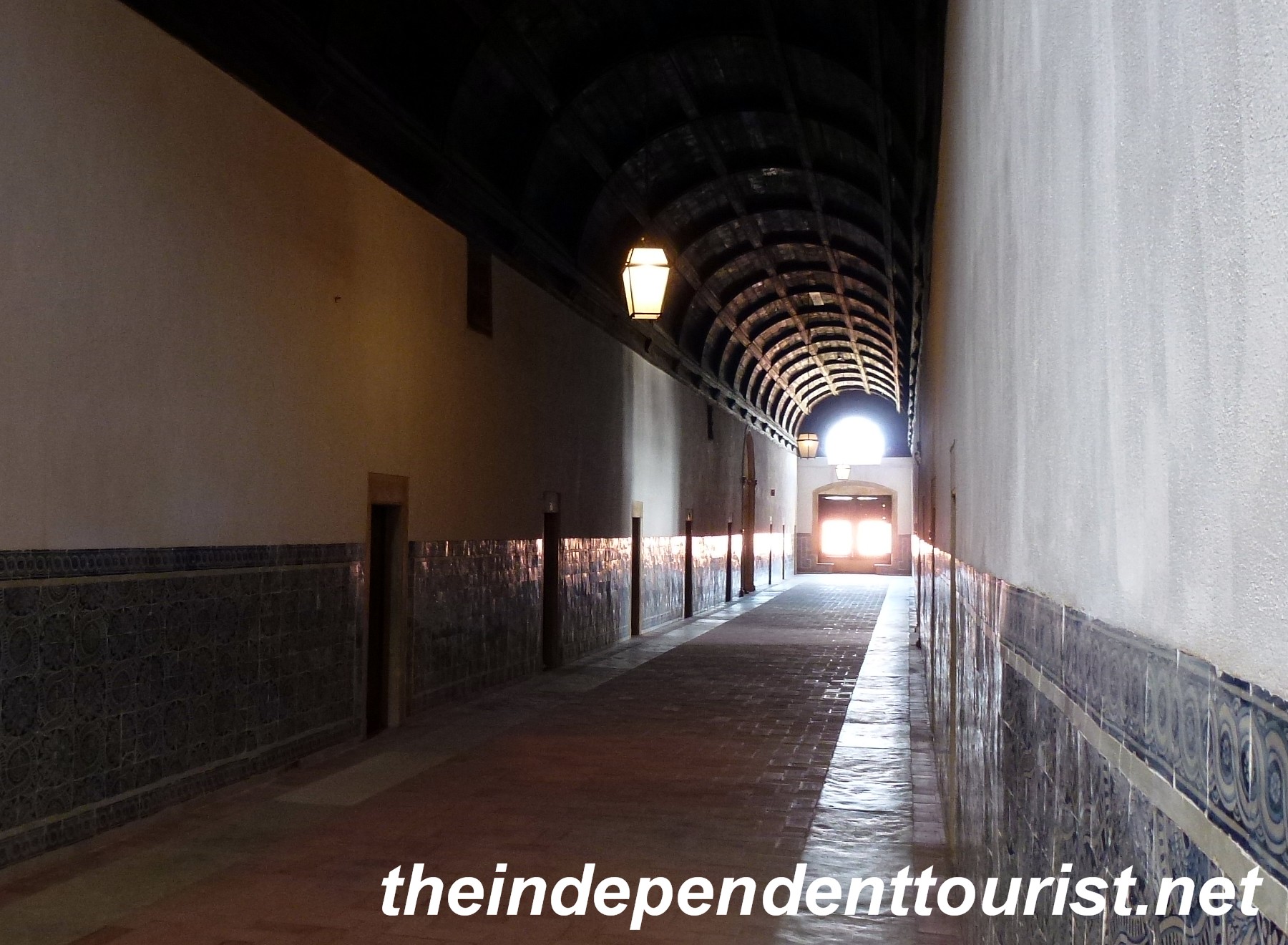
The monk's cells were finished around 1543 – 1545, the tiles are from the 17th century.

The monk’s cells were finished around 1543 – 1545, the tiles are from the 17th century.

The refectory was finished between 1535 – 1536 by King João III,  reserved for reading during meal times.

The refectory was finished between 1535 – 1536 by King João III, reserved for reading during meal times.

The kitchen of the monastery (16th century).

The kitchen of the monastery (16th century).

Tiles in the Portocarreiros Chapel, built 1626.

Tiles in the Portocarreiros Chapel, built 1626.

Practicalities:  Tomar is an easy day trip from Lisbon. It’s about a 2 hour train ride (€9.75 each way), and the train leaves from Station Apolónia (eastern side of Lisbon). It’s about a 15 minute hike from the Tomar train station up the hill to the Convento de Cristo. The entry fee was €6. There’s a lot to see, so allow at least a couple hours. I kept finding new cloisters (courtyards), rooms, and unique views and architectural features of the buildings at every turn.  The signage is comprehensive and in English. If you get hungry, there is a café on the site as well. Be sure to stroll out and see the terraces, gardens, walls and an aqueduct that was built in the 17th century and finally gave the monastery a consistent water supply.

Main cloister—started in 1530-1533, under King Joao III (1521-1557), considered a masterpiece of the European Renaissance.

Main cloister—started in 1530-1533, under King Joao III (1521-1557), considered a masterpiece of the European Renaissance.

References: Signposts throughout Convento de Cristo.

A Tale of Two Churches in Curtea de Argeş, Romania

Just about 2 ½ hours by car (155 km) from Bucharest are two very interesting churches, located in the town of Curtea de Argeş. Curtea de Argeş is the gateway to Poienari Castle (about 25 km north) and the Făgăraş Mountains (the Transylvanian Alps). One church, called the St. Nicholas Princely Court Church is the “oldest monument preserved in its original form in Wallachia” (this region of Romania) and the other is the Curtea de Argeş Monastery, a small “Taj – Mahal” like church (ok, not quite the Taj Mahal, but its exterior is still an example of amazing marble work) where the kings of modern Romania are buried.

The beautiful marble exterior of the Curtea de Arges Monastery.

The beautiful marble exterior of the Curtea de Arges Monastery.

Exterior view of St. Nicholas Princely Church.

Exterior view of St. Nicholas Princely Church.

St. Nicholas Princely Church

Curtea de Argeş was the seat of Romanian princes of Wallachia, and hence the name of this church. If you are a student of Byzantine religious history and artwork, St. Nicholas Princely Church is on your must-do list, it is one of the most important ecclesiastical buildings of its time. Completed in the 14th century (1340-1352), it has intact Byzantine frescoes from 1364-1369. A very nice gentleman gave us an impromptu tour—the church had just closed and he reopened it for us, he was a wealth of knowledge. The style of frescoes in this church is a mix of Italian and Byzantine influences, and many important priceless artifacts were found in the 14 tombs (buried on the church grounds) of the local ruling class, which are now in museums in Bucharest. The church is in the shape of Greek cross. There was a fee of 6 lei per person (about $2 USD).

A view of the highly decorated interior of St. Nicholas Church.

A view of the highly decorated interior of St. Nicholas Church.

The frescoed wall above the church entrance.

The frescoed wall above the church entrance.

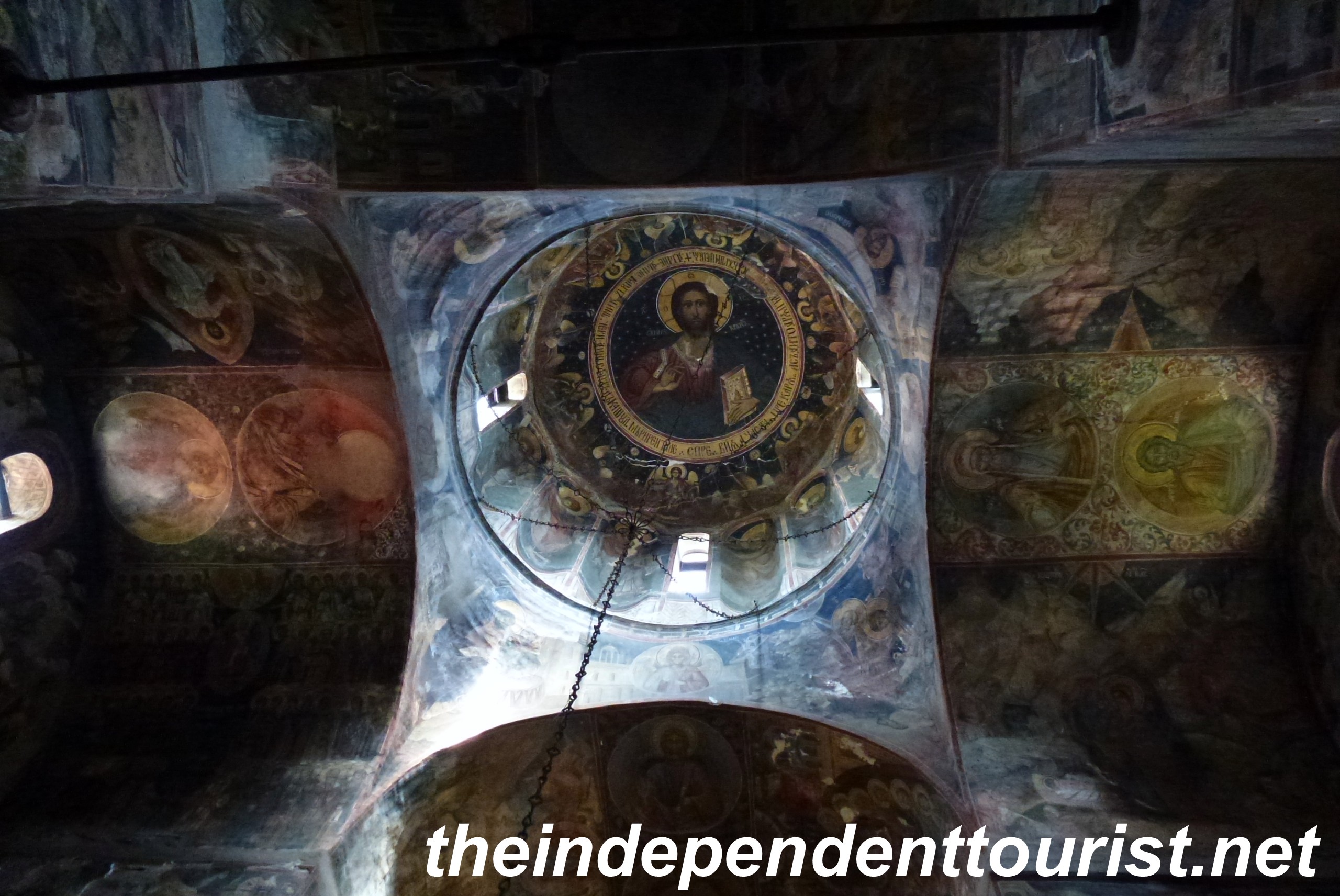
It may be hard to tell, but this is looking straight up at the cupola of the church.

It may be hard to tell, but this is looking straight up at the cupola of the church.

Curtea de Argeş Monastery

This monastery was originally built 1512 – 1521, with marble from Constantinople (Istanbul). Legend has it that the master stonemason’s wife is buried within the walls; it was a local custom that the mason had to bury a loved one alive in the church to ensure the success of his work, since ghosts were believed to keep buildings from collapsing. If you built many structures, you might run out of loved ones to bury—what a sad tale. The monastery had to be largely rebuilt in 1875, after years of neglect.

A view of the exterior of the Curtea de Arges Monastery.

A view of the exterior of the Curtea de Arges Monastery.

An interior view of the monastery.

An interior view of the monastery.

Another view of the interior of the monastery.

Another view of the interior of the monastery.

The church contains royal tombs–two kings and queens tombs lie here, King Carol (the first king of Romania) and his wife Elizabeth (the builders of the incredible Peleş Castle), and King Ferdinand and Queen Marie (granddaughter of Queen Victoria of England).  It was difficult to get photos in this church due to restrictions. The monastery is free.

References: Lonely Planet Romania Guide, 2010; Rough Guide Romania, 2008.

The Gate to Hell: The Ancient City of Hierapolis and Travertine Terrace Pools of Pamukkale

The theater at Hierapolis could seat 20,000.

The theater at Hierapolis could seat 20,000.

Put these sights on your “don’t miss” list in Turkey. The combination of the ruins of Hierapolis and the terraces of Pamukkale, famous for the brilliant white travertine pools make this an unforgettable destination. Hierapolis was founded in 190 BC and became part of the Roman Empire in 133 BC. Later on it was part of the Byzantine Empire and eventually faded into obscurity in the 6th century. Among other things, it was a spa town known for its thermal baths, and the warm water still runs here.

The northern gate to Hierapolis.

The northern gate to Hierapolis.

An elevated tomb at the extensive necropolis of Hierapolis.

An elevated tomb at the extensive necropolis of Hierapolis.

The Nymphaeum - in ancient times there would have been fountains everywhere on this structure. This is near Pluto's Gate.

The Nymphaeum – in ancient times there would have been fountains everywhere on this structure. This is near Pluto’s Gate.

The “Gate to Hell” reference applies to a spot on the site known as Pluto’s Gate (Pluto was a deity of the underworld), and the lethal vapors bubbling up from the waters running underneath the city were used to sacrifice animals as part of sacred pagan rites, with hallucinating priests performing the ceremonies (not unlike Delphi in Greece). This spot was undergoing excavation during our visit in 2012, and a recent article confirms this historical reference. Also, it’s believed that the apostle Philip met his death here (by stoning and crucifixion) in AD 80.

Frontinus Street - the main thoroughfare in Hierapolis.

Frontinus Street – a main thoroughfare in Hierapolis.

Swim in the warm waters among the ruins.

Swim in the warm waters among the ruins.

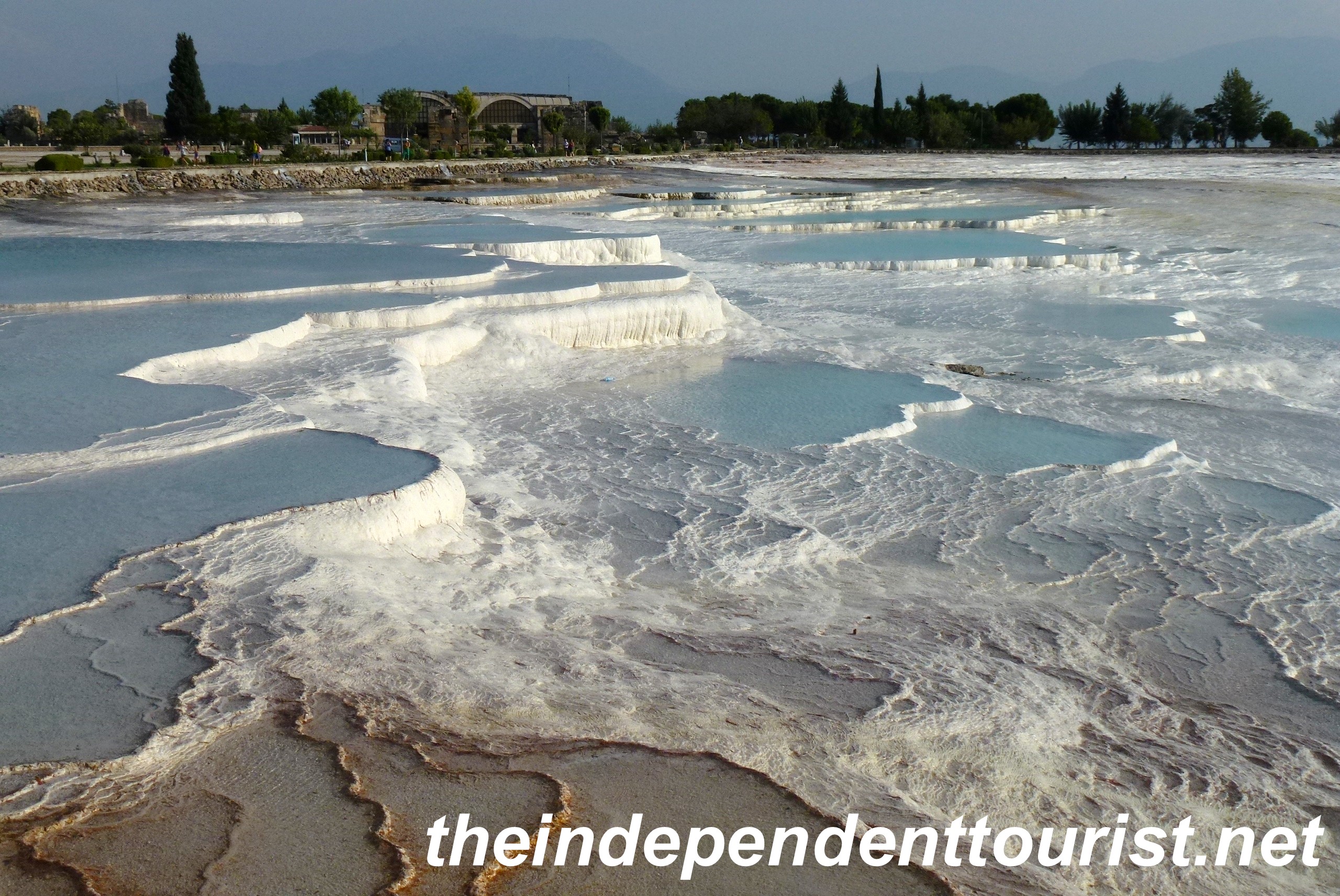
You can swim among the ruins, and this water is the basis for the white travertine terraces, which are just at the edge of the ancient city on a ridge overlooking the town. Pamukkale means “cotton castle” which is an apt description as you gaze at the terraces from below. The travertine terraces are formed from white limestone residue as the carbon dioxide escapes the water.

Where the ruins and travertine meet - this tomb is half-buried by the travertine residue.

Where the ruins and travertine meet – this tomb is half-buried by the travertine residue.

Some of the travertine terraces at Pamukkale.

Some of the travertine terraces at Pamukkale.

The setting sun reflecting on the travertine pools.

The setting sun reflecting on the travertine pools.

A few practical tips:

  • Visit the site in the afternoon (there is a parking fee of 5 TL and an entry fee of 20 TL per person (1.8 TL per USD) for both the ruins and travertine pools). By late afternoon the mobs and tour buses are leaving. We arrived about 3:30 pm (in September) and this was perfect timing to see everything and to watch the setting sun reflecting in the travertine pools.
  • Keep in mind the ruins of Hierapolis are significant and spread out. Depending on your interest in ruins, you can easily spend 2-3 hours exploring.
  • An ‘artificial’ section of the travertine pools are open for visitors to walk on.  Plan to take your shoes off and roll up your pants. The water is warm and the surface is a bit slippery.

    Walking and wading in the pools.

    Walking and wading in the pools.

  • The thermal pool with the marble column ruins is expensive and requires a separate entry fee which is about $30 US per person. We skipped the swimming but enjoyed the ambience. There is a snack shop right there and you can enjoy the picturesque setting for the price of a soft drink.
  • We stayed at the Hotel Venus in Pamukkale. It was an excellent small hotel, with a pool, nice large rooms, a very good restaurant and great breakfast buffet. It is just 5 minutes or so by car to the ruins. The room was €35 per night.

    Another excellent Turkish meal at the Hotel Venus, where we stayed.

    Another excellent Turkish meal at the Hotel Venus, where we stayed.

  • Pamukkale (which is about 15 km from the large city of Denizli), is a quiet little village and a great place to stay. The drive from Fethiye (on the south coast) took approximately 4 hours (about 200 km, on country roads).

Also fairly close to these sights are the ruins of Aphrodisias, which I will cover in a separate post.

References: DK Eyewitness Travel Turkey, 2008. Lonely Planet – Turkey, 2010.

Ölü Deniz Beach – One of Turkey’s Best (and everyone knows it)

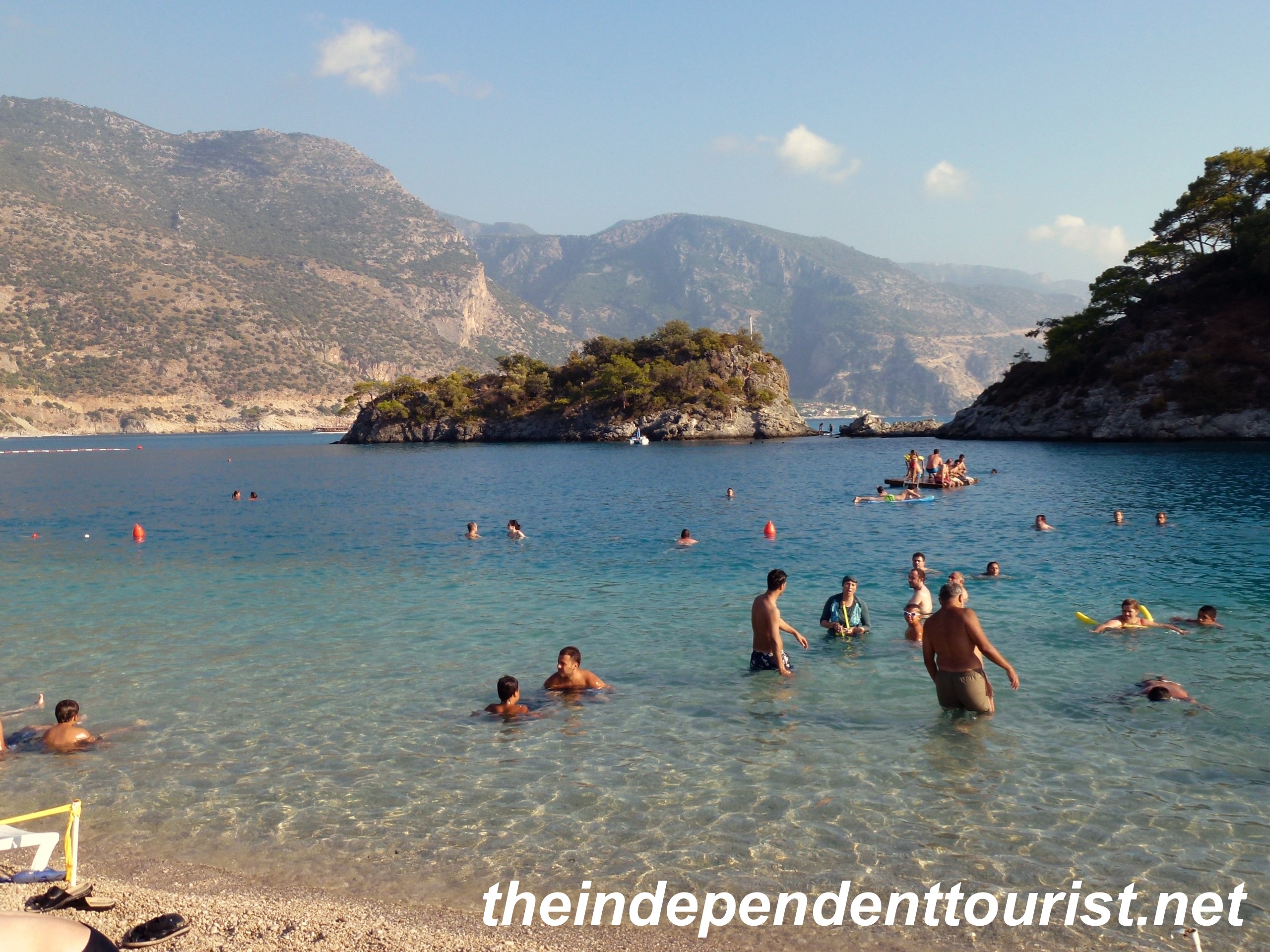
The little islands protect most of the beach, making the water very calm.

The little islands protect most of the beach, making the water very calm.

Ölü Deniz beach is about 15 km from Fethiye, and one of the most famous beaches in Turkey. This beach is well known for a number of reasons – its image is on many posters promoting Turkish tourism, it’s a paragliders paradise, calm water, its beautiful setting, a long stretch of lengthy, clean white pebbly “sand,” and a shallow lagoon behind the main beach that’s perfect for toddlers. (Ölü Deniz means ‘dead sea,’ an apt description since the water is so calm).

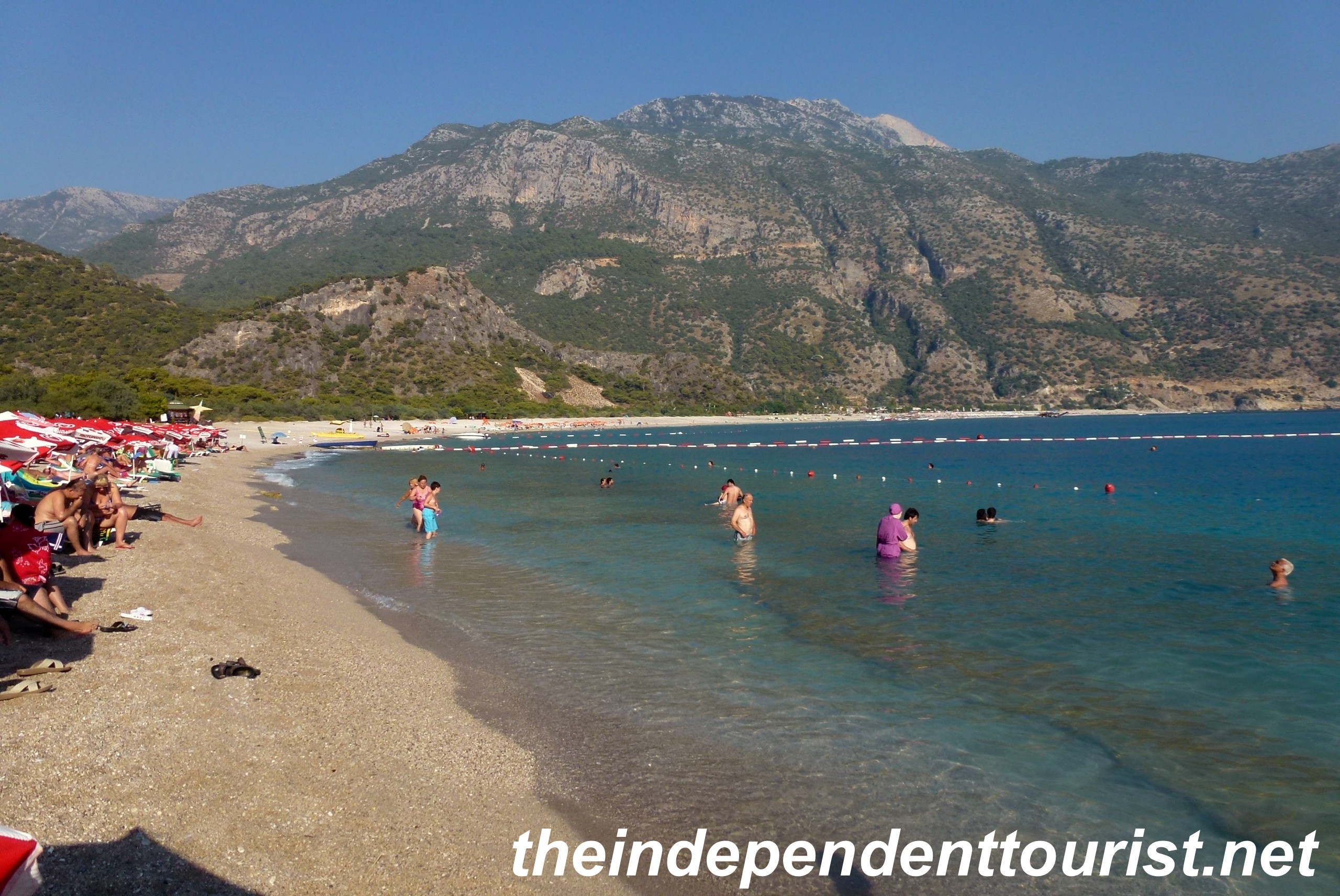
The long beach at Ölü Deniz.

The long beach at Ölü Deniz.

There is a roped-off safe swim area at this beach.

There is a roped-off safe swim area.

The beach is well-developed, with bathroom facilities, lounge chairs for rent and several snack bars. The entry fee was 7 TL (1.8 TL to 1 USD) per car.  The nearby little village of Ölü Deniz is a hangout for tourists and backpackers, since this is the start of the Lycian Way, which winds its way eastward, ending near Antalya.

This end (near the lagoon) of the beach is quite crowded in the afternoon. Oh well, still a good spot.

This end of the beach (near the lagoon) is quite crowded in the afternoon. Oh well, still a good spot (note the paragliders above the mountain ridge, known as Baba Daği).

Although crowded in late afternoon, we still loved it and I would go back in a hearbeat! We stayed in Fethiye at the Hotel Doruk, a great hotel with a view of Fethiye harbor, although parking a car was a challenge (just a narrow little side street for parking). The hotel was 75 Euros/night. There are some ruins in Fethiye also, but given our short stay and many other stops for ruins we didn’t take the time to visit the ones here.

The restaurant at the Hotel Doruk, overlooking the pool and harbor.

The restaurant at the Hotel Doruk, overlooking the pool and harbor.

The Village Museum in Bucharest – A Step Back in Time

Lake Herastrau in Bucharest. The Village Museum is on the western shore of this lake.

One of the most interesting sights in Bucharest is the Village Museum, located close to the Arc de Triumf (Bucharest’s answer to the Arc de Triomphe in Paris) and situated on the shores of Lake Herăstrău, adjacent to Herăstrău Park. The museum provides visitors with a look at how people lived in rural Romania for centuries. For more information on other sights in Bucharest click here.

Note the intracate fence design - a lot of work if you had a large farm!

Note the intracate fence design – a lot of work to build and maintain if you had a large farm!

The open air museum contains a number of homesteads with houses, barns, farm implements, churches, water mills, windmills and presses from around Romania.

This type of home was very practical - half buried, so it remained cool in the summer and warm in the winter. Also was easier to disguise during Ottoman raids. Plus less maintenance - few walls to paint!

This type of home was very practical – half buried, so it remained cool in the summer and warm in the winter. It was also easier to disguise during Ottoman raids. Plus, less maintenance – few exterior walls to paint!

I was impressed with the highly decorated wooden churches, with various biblical scenes on the interior walls.

A 18th century wooden church. High decorated interior.

A 18th century wooden church, with the brightly decorated interior.

Another view of a 18th century church.

Another view of the same 18th century church.

Many of the homes are open for touring, and local guides dressed in period costumes provide information on life in 17th and 18th century Romania.

Another example of a homestead with the living accomodations on the 2nd floor.

An example of a home with the living accomodations on the 2nd floor.

Interior of a typical rural home in Romania.

Interior of a typical rural home in Romania.

I found the barns and sheds interesting with examples of tools and farm implements used hundreds of years ago, and in some cases still in use!  Much of the farm work today in Romania continues to be done manually, with horses and carts also providing some families’ transportation.

Farm shed. Note the extensive use of thatched roofing.

Farm shed. There was extensive use of thatched roofing, not only on this shed but also on other buildings.

The museum was founded in 1936, and I think it was a smart idea–to save these buildings from the past as a way to preserve the heritage of the people of Romania, and to ensure future generations have the opportunity to see what life was like in an earlier day. Plan at least three hours to wander through this museum and park.

I didn't know that windmills were pretty common in southern Romania in medieval times.

Until I visited this museum, I didn’t know that windmills were pretty common in southern Romania in medieval times.

Other Views of Lima

Museo de la Inquisición (The Inquisition Museum)

This museum tells a bit about the history of the Spanish Inquisition in Peru, and shows some of the creative methods used for extracting information (usually confessions related to heresy) from the local population in colonial Lima (1600’s).

The Judgment Hall at the Inquisition Museum.

The Judgment Hall at the Inquisition Museum.

I wouldn't last long in this position.

I wouldn’t last long in this position.

Another means of extracting confessions.

Another means of extracting confessions.

What makes this museum more interesting is that it is the actual location where these forced confessions took place, and you can see some of the original dungeons and torture chambers.

One of the original dungeons at the Inquisition Museum.

One of the original dungeons at the Inquisition Museum.

Display at the Inquisition Museum

Display at the Inquisition Museum

The museum is located in El Centro, near the Plaza de Armas in the historic center of Lima.

Miraflores

Miraflores is a fashionable area of Lima (about 20 minutes by car from El Centro), part of which is located right on the coast, with big hotels, a new multi-level shopping mall and restaurants, parks and museums.

View of the coast in Miraflores.

View of the coast in Miraflores.

Enjoying the view from Tony Roma's in Miraflores.

Enjoying the view from Tony Roma’s in Miraflores.

Miraflores feels “other worldly” compared with the majority of Lima and provides a contrast of the very different economic realities of a small part of the population with the poverty affecting most Peruvians.

A more typical view of a residential area in Lima.

A more typical view of a residential area in Lima.

Sights around the Plaza de Armas, Lima

Lima is about at the midpoint of the coast of Peru, right on the Pacific Ocean.

Lima is about at the midpoint of the coast of Peru, right on the Pacific Ocean.

The Plaza de Armas is the historical center of Lima. It dates from the 16th century, the start of the colonial era of Peru and the beginnings of the city of Lima. Severe earthquakes in 1687, 1746 and 1940 took their toll on this historic area, many buildings were severely damaged or destroyed, but some have survived, and the government has been working to restore many of the historic buildings.

The governmental palace on the historical Plaza de Armas.

The governmental palace on the historical Plaza de Armas.

An example of the excellent restoration work around the Plaza de Armas.

An example of the excellent restoration work around the Plaza de Armas.

There are many old churches near the Plaza de Armas, I’ll share a bit about three below.

The facade of the Iglesia de San Francisco.

The facade of the Iglesia de San Francisco.

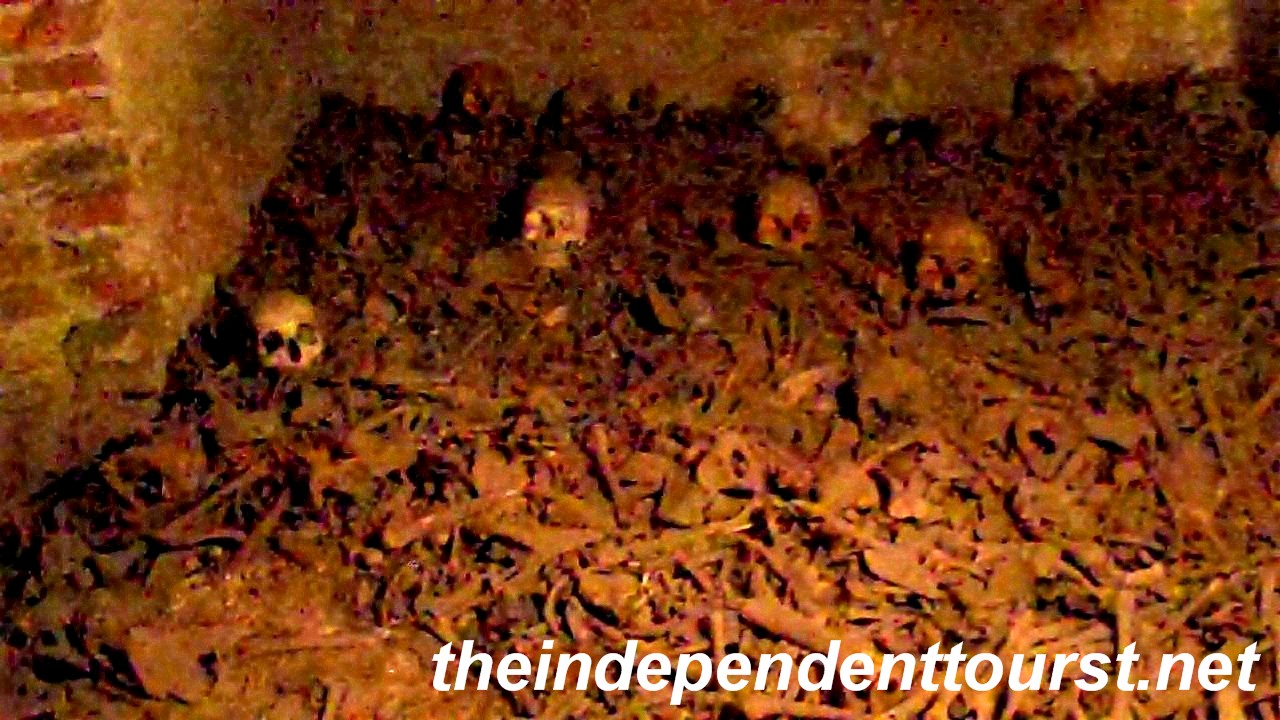
Iglesia de San Francisco. This church was built in the 17th century, and contains some fine artwork, including wood carvings in the choir, cloister ceilings, decorative tile and precious metals. I love catacombs and the ones below this church are extensive – the remains of 75,000 people are here. The catacombs are poorly lit and it was hard for me to get pictures (I took a few on my Flip video camera – please forgive the poor quality). The only way to visit the catacombs is via a tour (available in English). Next to the church is a beautiful monastery library with 400 year-old manuscripts but I was not allowed to take pictures there.

The main chapel in the Iglesia de San Francisco.

The main chapel in the Iglesia de San Francisco.

I'm guessing that much of the gold and silver decorating this altar came from Inca artifacts.

I’m guessing that much of the gold and silver decorating this altar came from Inca artifacts.

Note the bowed wall of this church - probably due to earthquakes over the centuries.

Note the bowed wall of this church – probably due to earthquakes over the centuries.

The tunnels of the catacombs are extensive.

The tunnels of the catacombs are extensive.

These bones aren't as neatly arranged as some...

These bones aren’t as neatly arranged as some…

Some of the neatly arranged bones in the catacombs.

Some of the neatly arranged bones in the catacombs.

Convento de Santo Domingo. This 16th century church stands out due to its pink exterior. From the convent’s bell tower, you get a pretty good view of Lima – one of the driest cities on earth. The cloister gardens are well manicured and this church also had an interesting library. The tombs of the first two Peruvian saints are buried here.

The pink Convento de Santo Domingo. (Climb to the top of the tower for a good view)

The pink Convento de Santo Domingo. (climb to the top of the tower for a good view.)

The library of the Convento de Santo Domingo.

The library of the Convento de Santo Domingo.

The cloisters of the Convento de Santo Domingo.

The cloisters of the Convento de Santo Domingo.

Decorative 17th century tiles imported from Spain.

Decorative 17th century tiles imported from Spain.

A view of the Lima Cathedral from the Convento de Santo Domingo.

A view of the Lima Cathedral from the Convento de Santo Domingo.

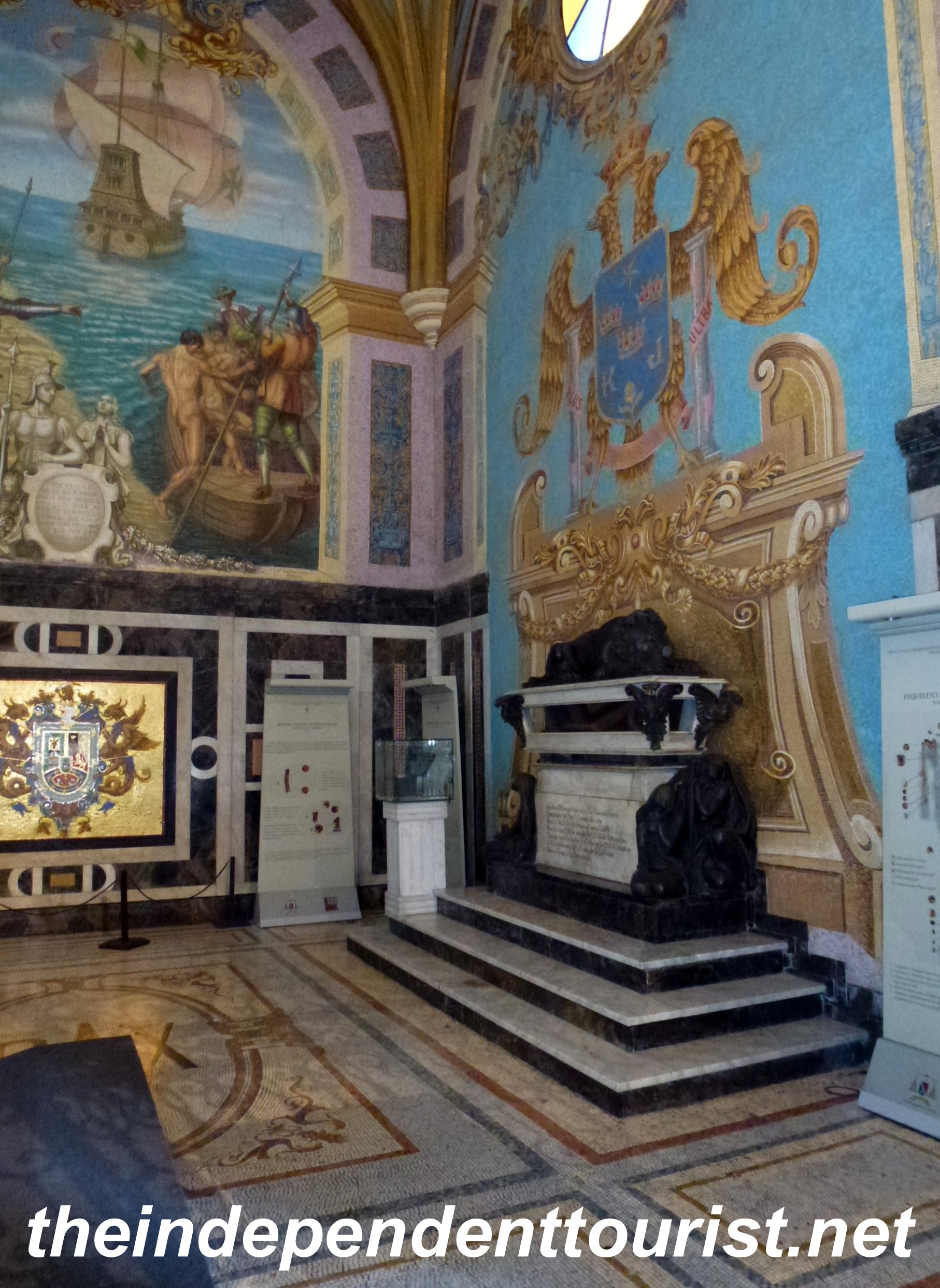
Lima Catedral (Cathedral). One of the most interesting features of this church is the tomb of Pizzaro, the Spanish explorer who founded Lima as part of the Spanish empire in 1535 and designed the layout for the cathedral. The cathedral had to be rebuilt after earthquakes in 1746 and 1940.

The Lima Cathedral on the Plaza de Armas.

The Lima Cathedral on the Plaza de Armas.

Pizzaro's tomb in the Lima Cathedral.

Pizzaro’s tomb in the Lima Cathedral.

Reference: Fodor’s Guide to Peru, 3rd Edition.

Pinara – A Lycian Gem

If you enjoy visiting ancient ruins without throngs of people everywhere, check out Pinara, located northwest of Kaş, not too far from Fethiye. This part of Turkey (known as the Lycian Way) is very scenic. (For a map of sites visited in Turkey, click here).

Kalkan Beach, one of the “postcard” images of Turkey. This stunning beach is just west of Kaş, right where the road turns north and inland towards Pinara.

Kalkan Beach, one of the postcard images of Turkey. This stunning beach is just west of Kaş, right where the road turns north and inland towards Pinara.

Pinara was one of the six major Lycian cities (beginning about 7th century BC). The better-known ruins of Xanthos, which was the capital of Lycia, are nearby as well as the ruins of Letoön.

A view of the theater at Pinara from the agora.

A view of the theater at Pinara from the agora.

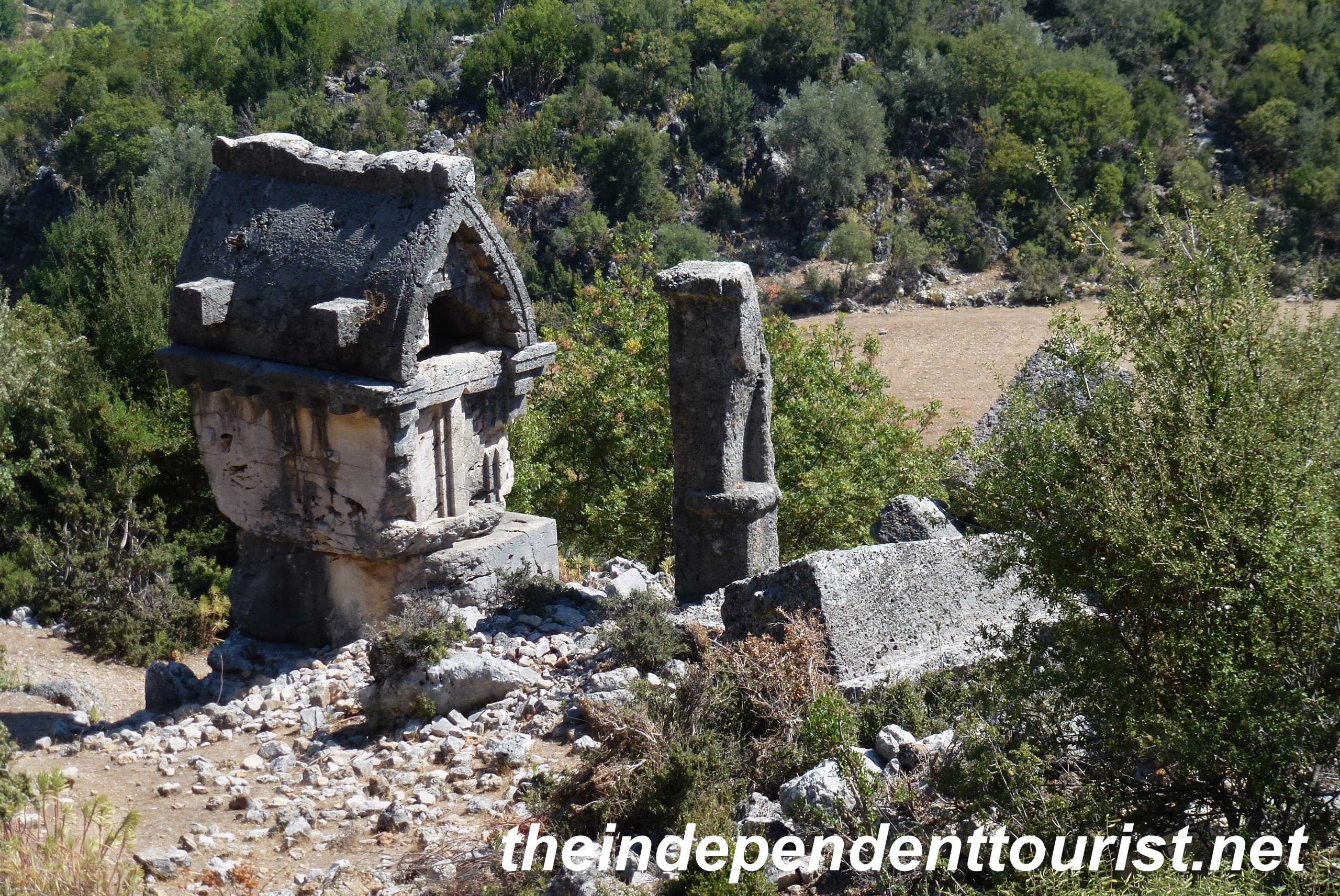
A free-standing tomb at Pinara.

A free-standing tomb at Pinara.

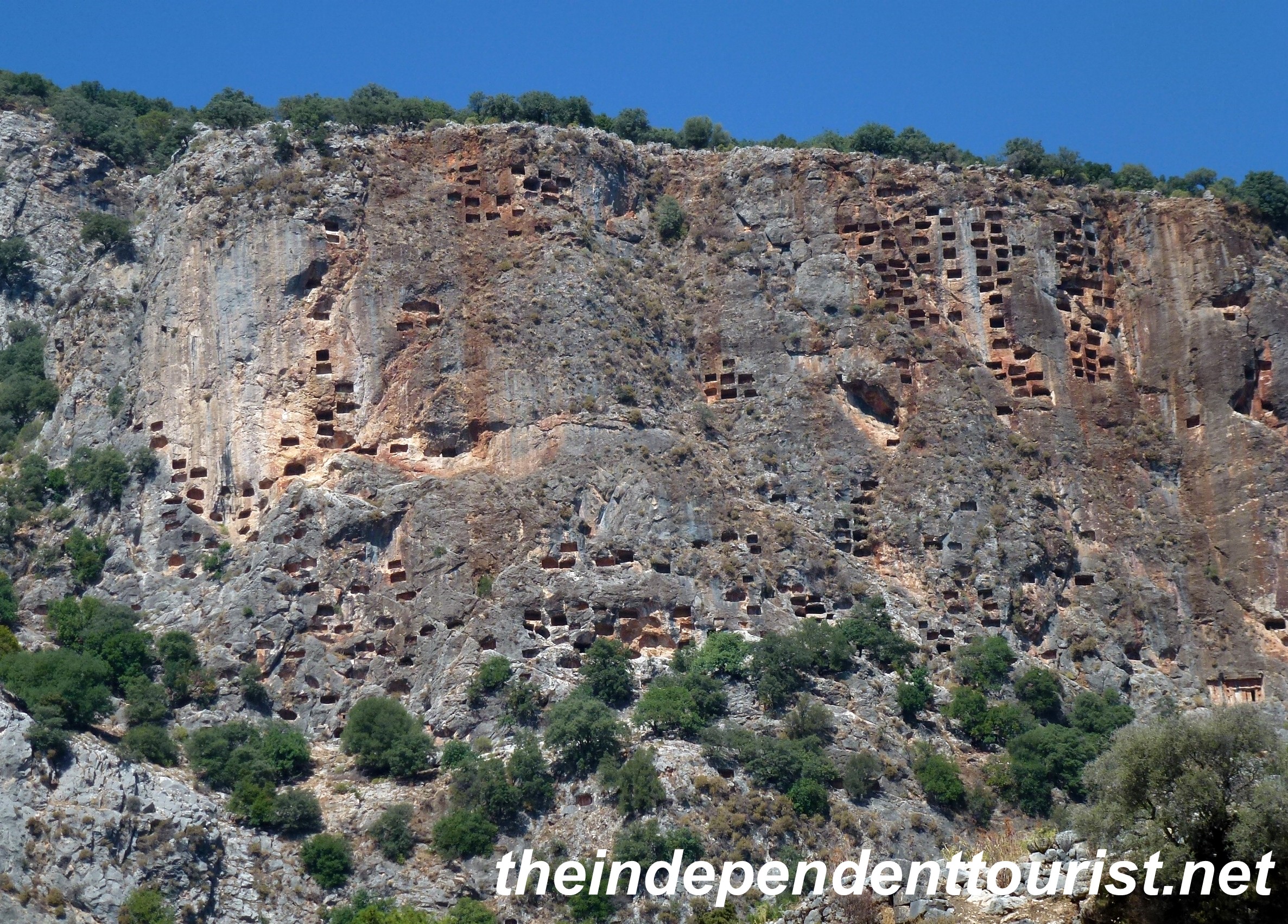
A view of Pinara from the theater.  The hilltop in the middle of the picture is round, giving Pinara it's name. The hillside is covered with tombs cut into the rock cliffs.

A view of Pinara from the theater. The hilltop in the middle of the picture is round, giving Pinara its name (Pinara means “round”). The hillside is covered with tombs cut into the rock cliffs.

Pinara_Turkey (13)

A closer view of the hillside – note the rock-cut tombs into the hillside. How did they do that?

Pinara is a large site and we moved our car a couple times to different locations to save some hiking back and forth. A short history of the site is posted at the entrance but no map was available. Signs point the way to some of the main ruins, but be sure to hike beyond the area around the first parking lot, since there are numerous hidden ruins along faint trails.

Practical Information

Pinara is about 6 km off the main road (D400). The last 2 km of road is dirt/gravel, which is passable by autos.  There were two caretakers at the site, and basic restrooms.  Bring your own water and snacks. The entry fee was 5 TL (1.8 Turkish Lira per USD). The easiest way to visit is by rental car; a brown sign on the main road marks the turnoff to the site, as with other tourist sites throughout Turkey.
One of the house tombs at PInara.

One of the house tombs at Pinara.

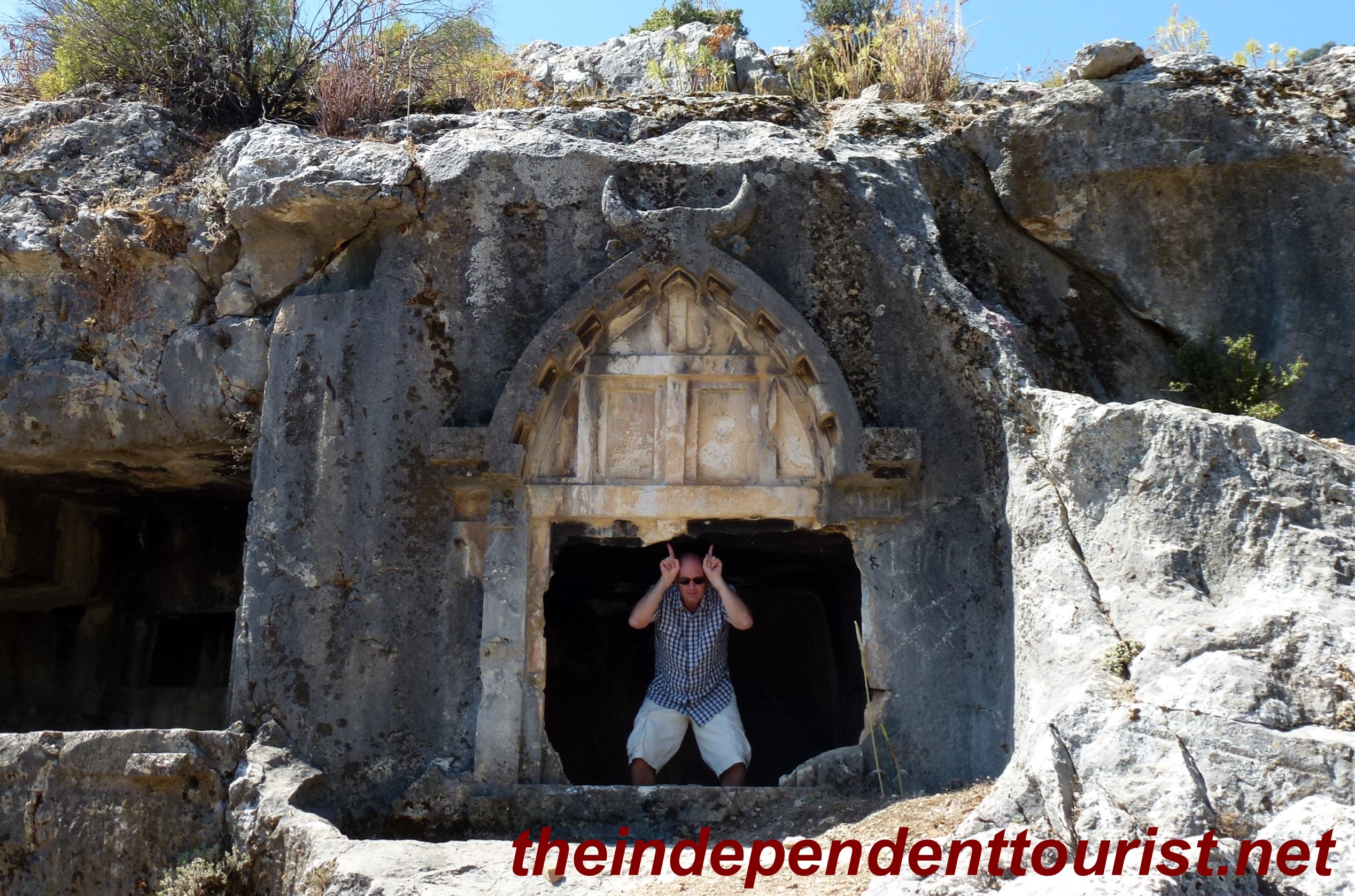
The "Bull-Headed" sarcophagus (note the top of the tomb), near the agora.

The “Bull-Headed” sarcophagus (note the top of the tomb), near the agora.

Allow at least two hours for your visit. A variety of ruins can be explored—a theater, temple foundations, tombs carved out of rock and free standing, an agora, and baths.  We also went up a steep dirt road a few kilometers behind Pinara just to explore the countryside.

I loved this place—the ruins are extensive and interesting, the countryside is scenic, and the fact that there are almost no tourists makes it a great stop.

The temple foundations at Pinara - note the fine stone-fitting work.

The temple foundations at Pinara – note the fine stone-fitting work.

From Phaselis to Kaş, Turkey – Land of the Sun (and Santa Claus)

We drove westward along the southwestern coast of Turkey from Antalya to Kaş in one day, although it’s a pretty long day (187 km of winding and beautiful coastal road) including several stops. After our first stop at the great beach and ruins of Phaselis (click here), we continued westward stopping at Cirali and Myra before getting to Kaş for the night (for a general map of our stops click here). This stretch of southwestern Turkey is known as the Lycian Way, due to the ancient Lycian civilization which inhabited this area and left many traces behind.

Cirali

This is a laid-back backpacker’s beach hangout about 7 km from the main highway with cheap ‘treehouse’ accommodations (think sleeping bags on wooden floors above ground level in the open), very casual outdoor cafes and a good (although with very little shade) beach. No wonder this stretch of Turkey is known as the Land of the Sun.

Examples of the "tree house" accomodations in Cirali.

Examples of the “tree house” accomodations in Cirali.

The beautiful beach at Cirali.

The beautiful beach at Cirali.

Not far from here are the enduring flames (from escaping natural gas), known as Yanartaş (“burning stone”), but since we visited during the day, we did not take the 2 km hike to the flames.  If you try to blow them out, they immediately light again. In ancient times, these flames helped provide a beacon to ships. This beach is also close to the ruins of Olympos, which we unfortunately did not have time to visit.

Myra (near Kale, AKA Demre)

The history of Myra and Lycia - Land of the Sun.

The history of Myra and Lycia – Land of the Sun.

Myra - note the tombs in the hillside.

Myra – note the tombs in the hillside.

View of the rock carved tombs at Myra.

View of the rock carved tombs at Myra.

The ancient city of Myra is just 2 km inland from Kale (no problem locating it with the excellent road signs). Myra dates from 5th century BC and was a significant port city. It was one of the major cities of the Lycian League. Myra is mentioned as a stopping point in St. Paul’s journey to Rome in 60 AD (see the New Testament, Acts 27:5).

Stone carving of actors' masks at the theater in Myra.

Stone carving of actors’ masks at the theater in Myra.

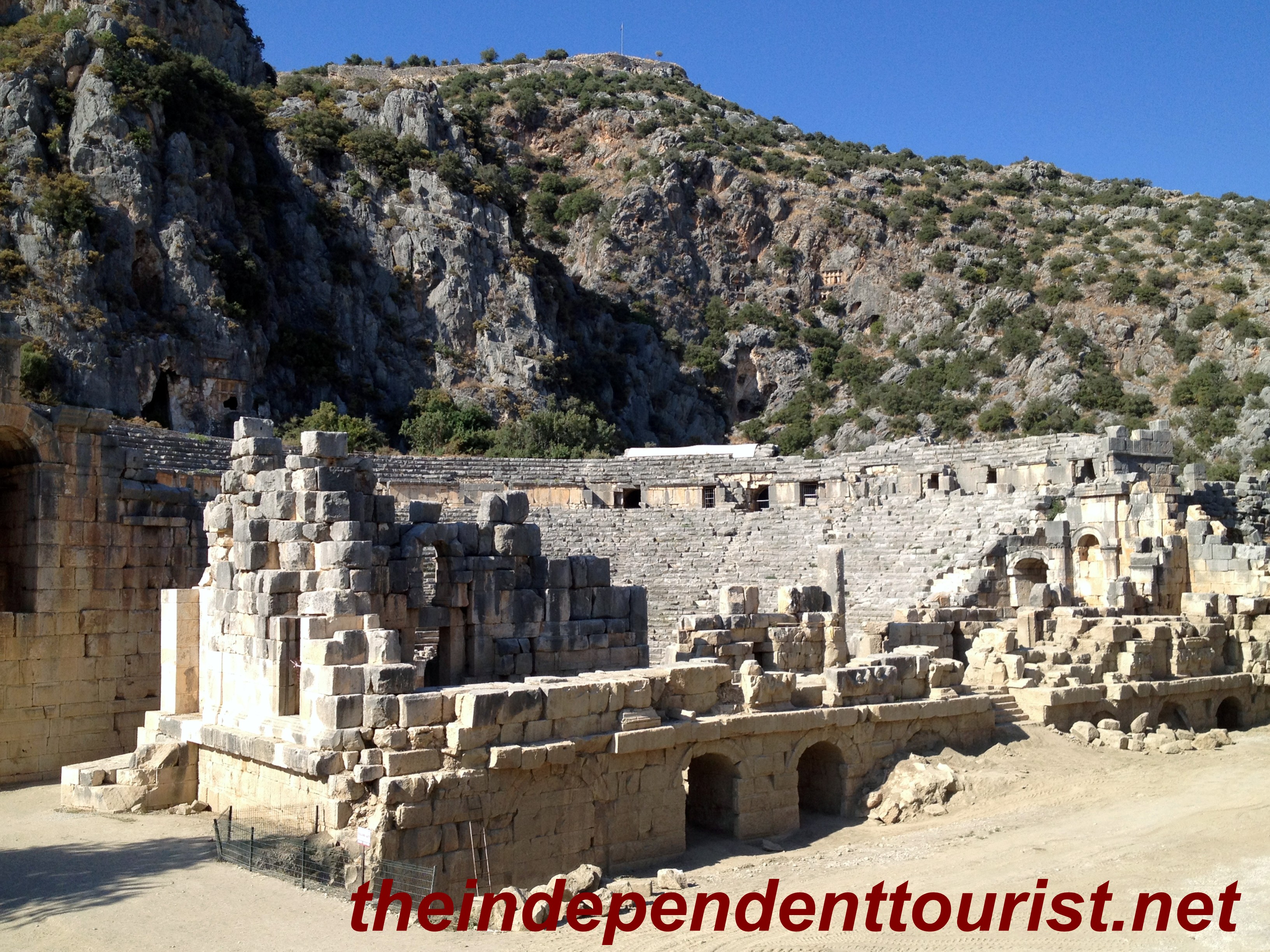
The Roman theater at Myra.

The Roman theater at Myra.

It became part of the Roman empire in 43 BC. Later, in the 4th century under the Byzantine Empire, Myra had its own bishop, St. Nicholas (died 343 AD), who eventually became today’s Santa Claus (“Jolly Old St. Nicholas…”).  St. Nicholas is the patron saint of Russia and lots of Russians love to make the pilgrimage here. The theater at Myra is huge and the nearby house tombs on the hill are a great example of Lycian architecture. The entry fee was 15 TL per person (1.8 Turkish Lira per USD).

Another view of the theater at Myra - there is a fortress at the top of the hill in the distance and tomb in the distance above the theater.

Another view of the theater at Myra – there is a fortress at the top of the hill in the distance and tomb in the distance above the theater.

Kaş

If I had had any idea how much there was to do around Kaş (pronounced “cash”), we would have spent more than one night here.

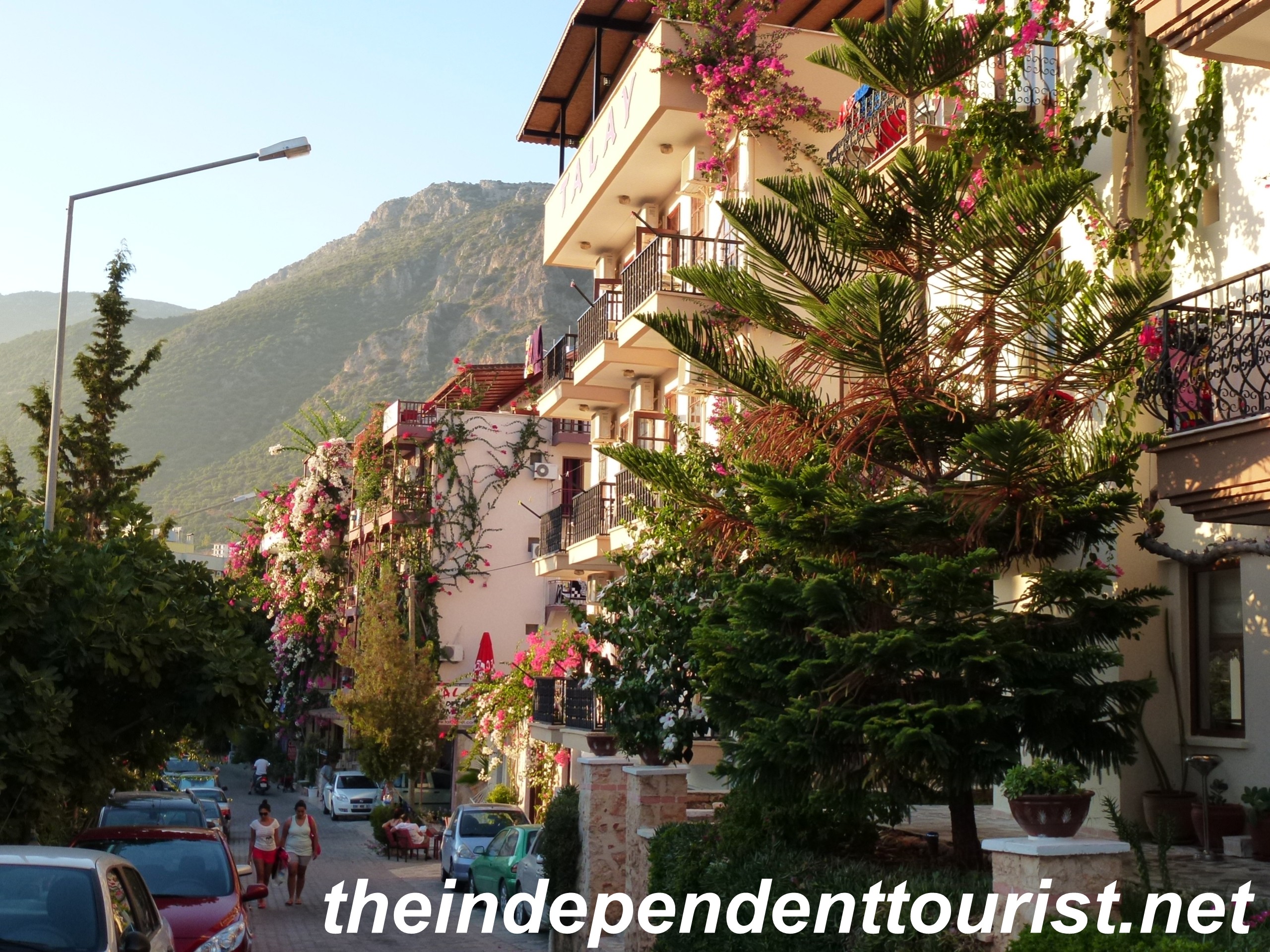
A street scene in Kas. The bougainvillea are everwhere.

A street scene in Kas. The bougainvillea are everwhere.

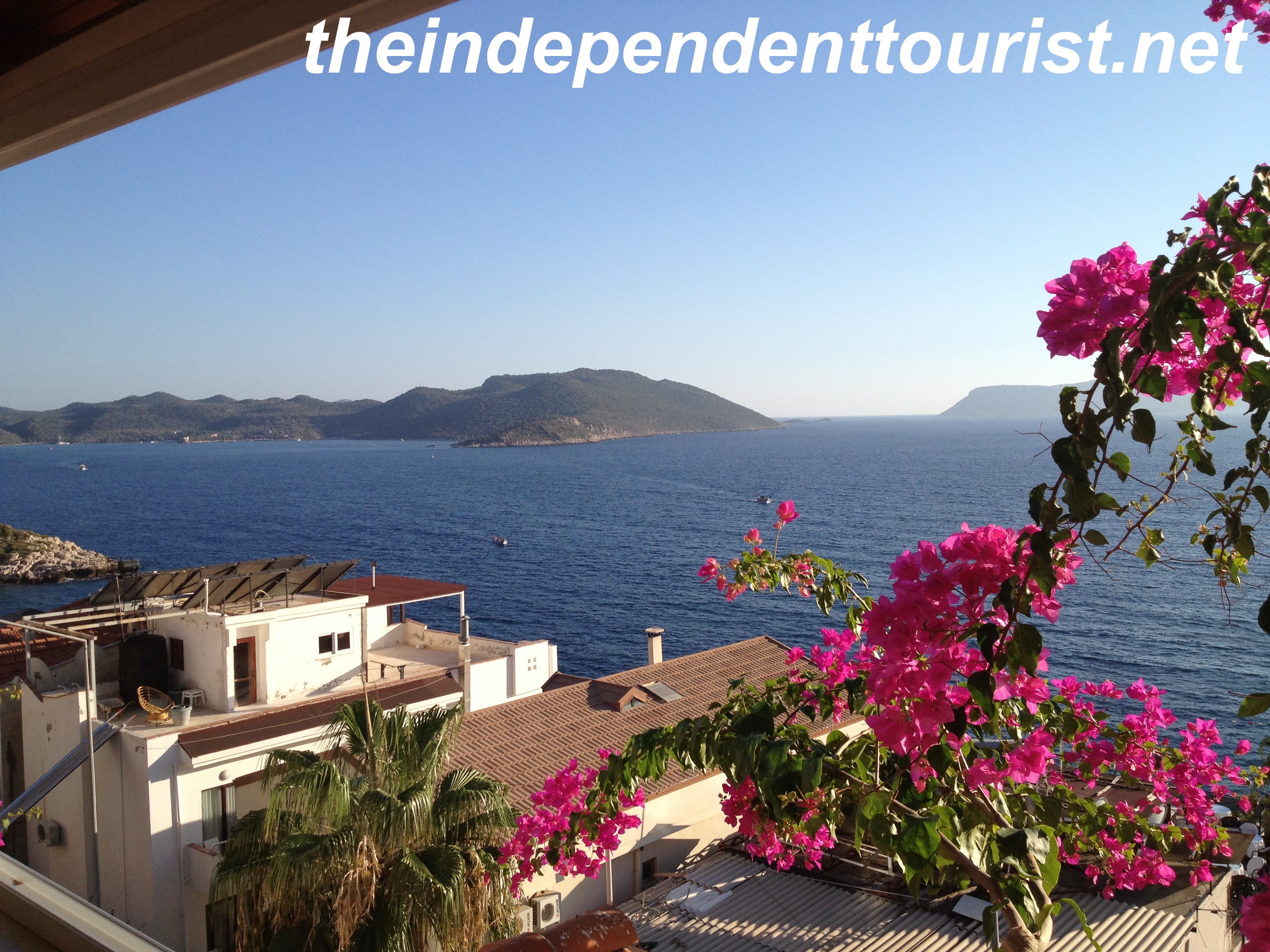
The town is in a beautiful setting, nestled on a steep hillside, with views of the Greek island of Meis (or Kastellorizo) just offshore. We had a good hotel here (Hotel Kayahan), with a fantastic view overlooking the harbor. The only downside to the hotel was that parking is extremely limted–we ended up parking about 200 yards away in a town square.

View from the terrace of the Kayahan Hotel.

View from the terrace of the Kayahan Hotel.

The terrace dining area of the Kayahan Hotel.

The terrace dining area of the Kayahan Hotel.

There are lots of day-trips by boat to be had out of Kaş, with options including secluded beaches, snorkeling, sea kayaking, sunken ruins (such as Kekova Island), a ferry ride to Meis or just lazing around Kaş itself. It would be very easy to spend an entire week in this spot with no chance of getting bored.