Horezu Monastery—A Great Example of the Brâncovenesc Style of Architecture

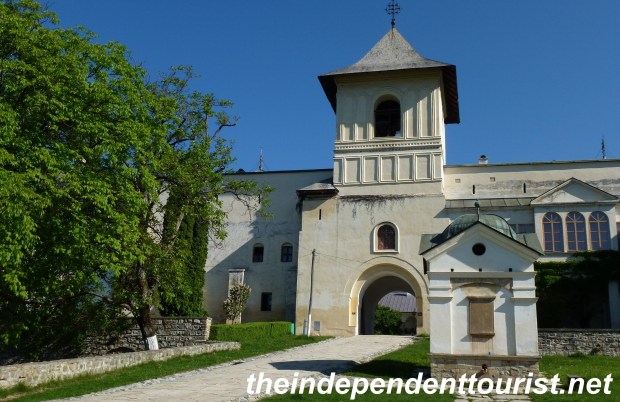
The entrance to Horezu Monastery.

From Hunedoara and Corvin Castle we drove southeast to Horezu (via Târgu Jiu and an incredibly narrow mountain river gorge). Horezu, in the region of Wallachia, Romania is home to Horezu Monastery, a UNESCO World Heritage Site. The monastery is located just a few kilometers outside the village of Horezu–known for its brown pottery.
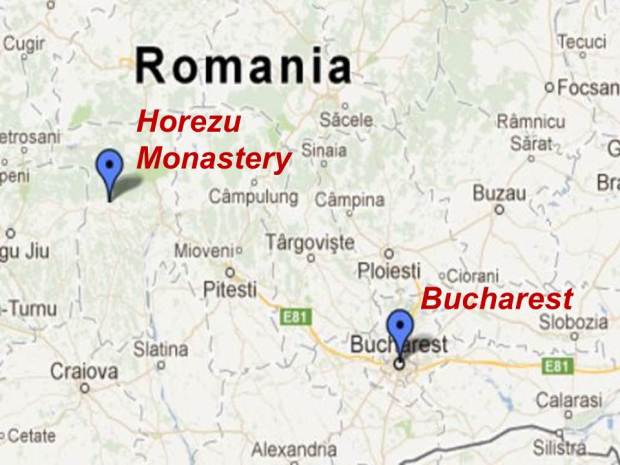
Horezu Monastery is about 136 miles northwest of Bucharest.

The monastery was founded in 1690, during the reign of Constantin Brâncoveanu (1654-1714). Brâncoveanu brought about a cultural renaissance to Wallachia. He met an unfortunate end to his life by being arrested, tortured and executed in Constantinople (Istanbul) in 1714, along with his four sons. He and his sons were declared saints and martyrs of the Romanian Orthodox Church in 1992. His work at Horezu gave him immortality by becoming the center and most famous example of an architectural style he established, now known as Brâncovenesc, which combines Western (Venetian) and Oriental (Ottoman) influences.
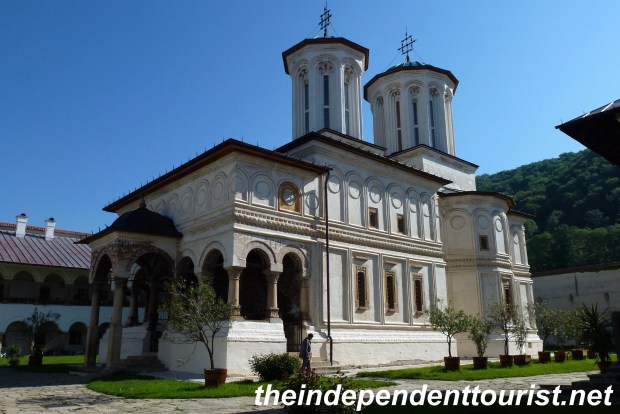
View of the Great Church, with its ten-pillared porchway.
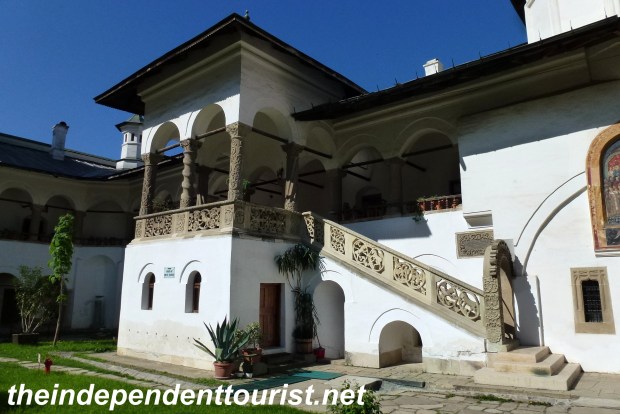
A Brancoveanu porch with a stone balustrade carved with animal motifs.

In the 17th and 18thcenturies, the Horezu monastery was a prestigious fresco-painting school. In the Great Church one can see why. This Church, dedicated to the Roman Emperor Constantine and his mother, Helena, contains outstanding frescoes which are original from 1694, although they were blackened by the smoke of fires of Turkish slaves who camped here (and thankfully now restored). I loved the frescoes in the main chapel and also in the refectory. There is no entry fee to the monastery.
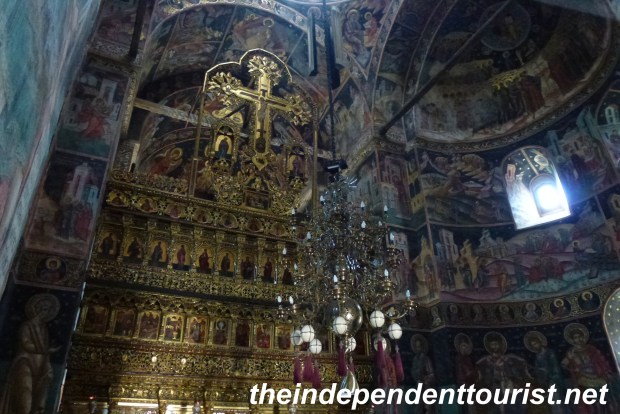
Interior of the Great Church.

The frescoes inside the Refectory.

In the summer, the monastery opens 20 rooms for guests, so if you’ve ever wanted to live the life of monk, this is your chance. Keep in mind no food is served, so bring your own or be prepared to go back into town.
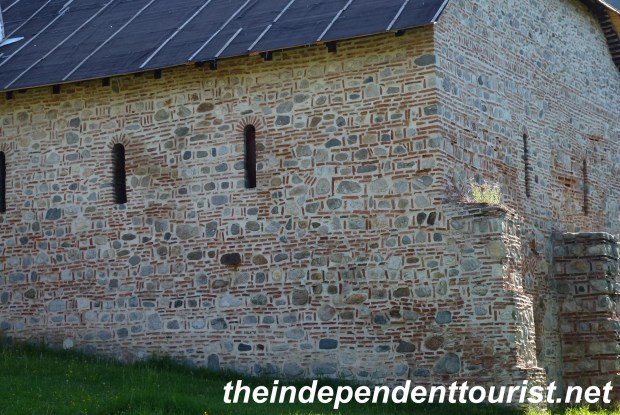
A building with interesting construction techniques just outside the monastery–note the walls.

The little town of Horezu had an interesting church with great frescoes.
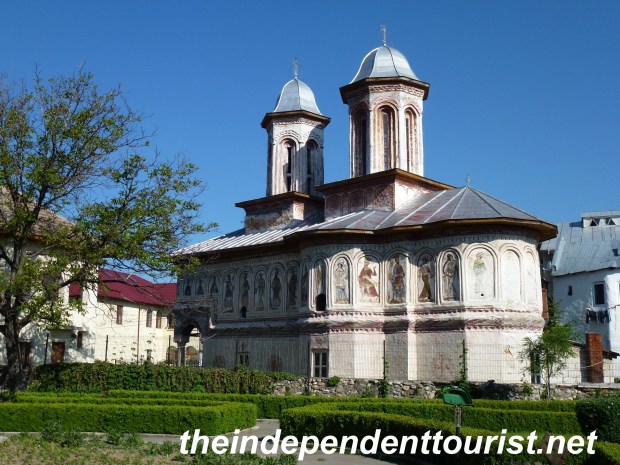
A little church in the village of Horezu–also beautifully decorated inside and out with frescoes.
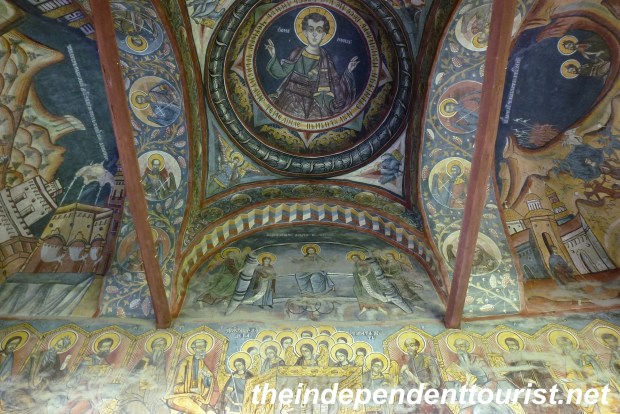
The ceiling of the porch in the little church in Horezu village.

We stayed in a lovely pension in Horezu, called Pension Criveanu.
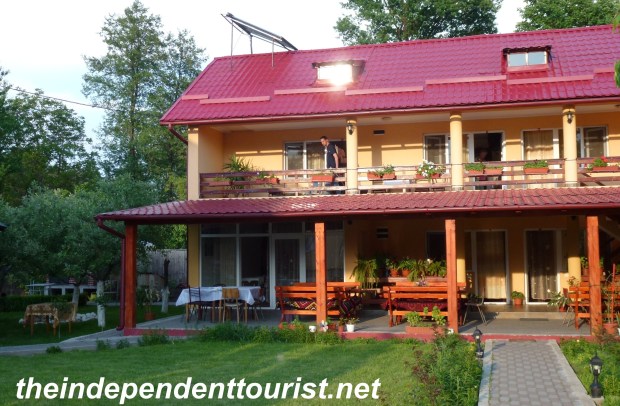
Our pension in Horezu, Romania.

The Monastery of El Escorial – A Great Day Trip from Madrid

El Escorial is huge–a view from the western side.

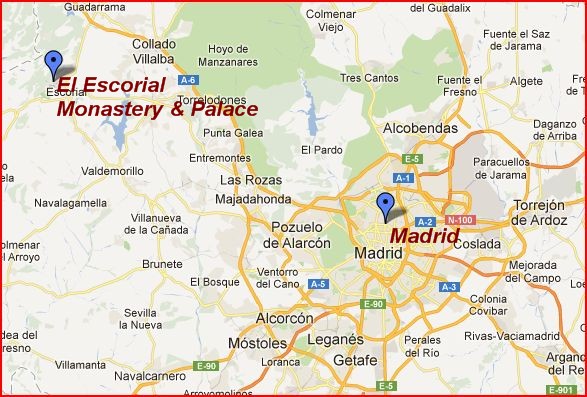
El Escorial (the official name is The Monastery of San Lorenzo de El Escorial) is in a beautiful setting, on a hill looking towards Madrid, Spain with green tree-covered mountains as a backdrop. It is massive. Getting a good picture of the exterior is a challenge given the size of the building. It is very stern looking—some describe it as looking more like a prison than a monastery and palace. I would agree.

Looking out from the royal apartments onto the well-mainicured gardens.

While on business recently in Madrid, I had an afternoon free up and decided to visit this sight which is located about 48 km northwest of Madrid. I had missed the monastery during a previous holiday in Spain, so it was really a pleasure to have the opportunity to visit during this trip.

El Escorial is just 48 km northwest of Madrid, Spain.

History

The monastery was built between 1563 and 1584 at the suggestion of King Philip II of Spain, who also closely supervised its construction.  Its uses were very clearly specified in a charter in 1565:  A convent for monks of the Order of St. Jerome, a church, a public and private palace, the royal and princes pantheons, a seminary, a school, a library, a hospital and rooms for scientific research. Many rooms are still in use today. The building is constructed from huge blocks of granite, and I cannot imagine all the blood, sweat and tears that went into cutting, hauling and placing these massive blocks, most of which are larger and taller than a person.

The northern (main) entrance to El Escorial (although used as an exit for tourists, the tourist entrance is on the eastern side).

Other Visit Information

Photographs are not allowed in most parts of the monastery, and it is heavily secured—there are security guards posted in just about every room along with cameras; however I was able to capture a few images, with permission. Tours are self-guided, either with an audio guide or just with the signage posted in Spanish and English.

The ceiling paintings in a main stairway.

Although I’m sure I saw just a small portion of the entire complex, I was able to see exhibits of the construction techniques, rooms where the royal family lived, the pantheon where the kings and queens are buried, a long hall with rooms of tombs of royal children who did not live into adulthood, and another long hall with amazing wall paintings of successful battles by the Spanish Kings, an incredible library—due to both the ceiling artwork and the priceless volumes it contains, and the basilica which is so huge it reminded me of St. Peter’s basilica in Rome, and various other rooms.

The artwork on the ceiling of the magnificent library.

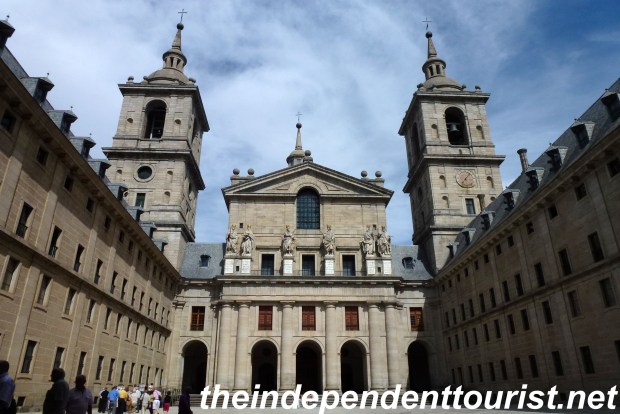
The entrance to the huge basilica from the inner courtyard at El Escorial.

El Escorial’s pantheon–resting place of many kings and queens of Spain.

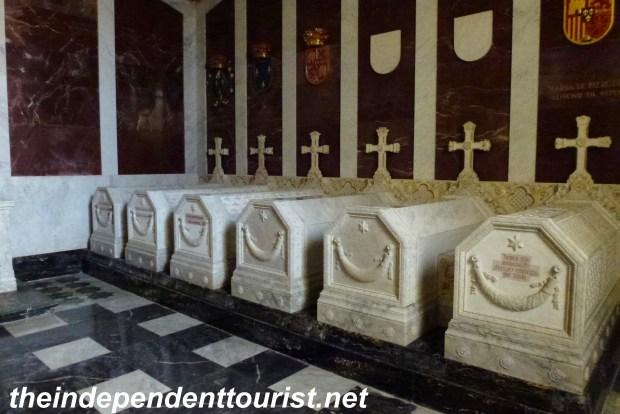
The tombs of royal children–many did not make it to adulthood.

There is a €10 entry fee and I would suggest allowing two hours for your visit. The town of San Lorenzo also is pleasant with many restaurants near the monastery.

Travel Logistics

Trains depart from Madrid hourly (I caught the Renfe train at the Nuevos Ministerios station, which is a metro and train station) and the trip takes just about one hour to reach the town of El Escorial. A round trip ticket was €7.60.

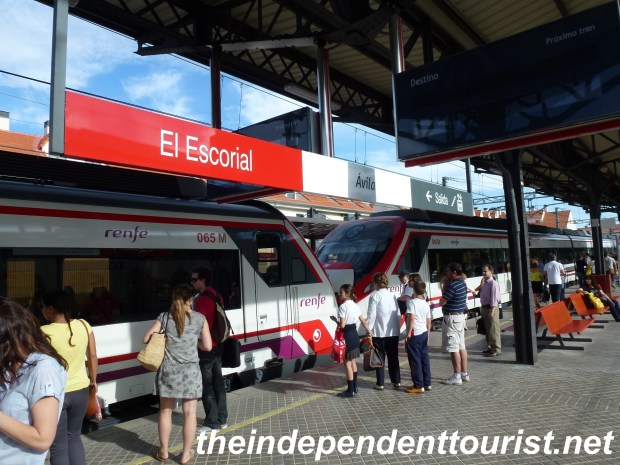
The train statiion at El Escorial. The trains are very clean and efficient.

Please note that the monastery is actually located in San Lorenzo de El Escorial and upon arrival at the train station there is a bus (timed to meet the incoming train) immediately outside the station that will take you to San Lorenzo (which is just a couple km further uphill) for €1.30 each way.  After your visit, you can catch this same bus back to the train station, which again is timed to allow you to arrive back at the train station a few minutes before the next train to Madrid—very nice system!  There is also bus service to San Lorenzo from Madrid.

The pleasant town of San Lorenzo de El Escorial.

The monastery is open until 8 pm during the summer, allowing a late visit if desired. Since this is a popular tourist attraction, I was surprised to see ample available auto parking available directly on the north side of the monastery, even in mid-June; however most people probably arrive by tour bus or train as I did.

Corvin Castle—The best castle that (nearly) no one will see

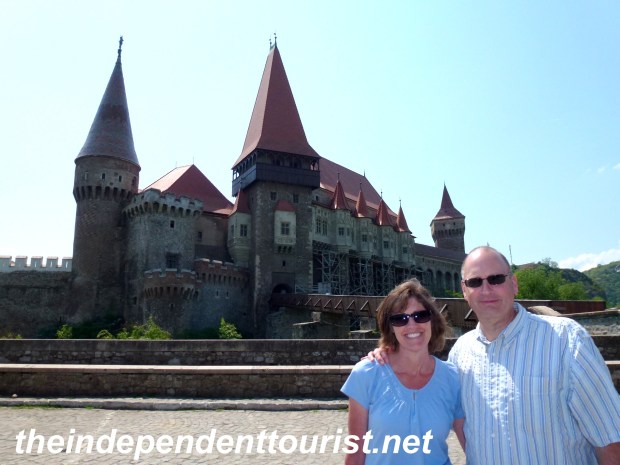
The main entrance to Corvin Castle.

One of the best castles in Romania is Corvin, a 14th century castle located in the city of Hunedoara, at the western edge of Transylvania. This castle receives few visitors since it is a bit off the beaten path in Transylvania and since Romania in general is off the beaten path. We drove to Hunedoara from Sibiu, which took about 2 hours. The castle is at the western edge of the city, on a slight hill. The city of Hunedoara has a communist-era feel owing to several old (closed) steel mills located here due to the iron ore in the nearby hills. The iron deposits were even known by the Romans. For a map of locations visited in Romania click here.

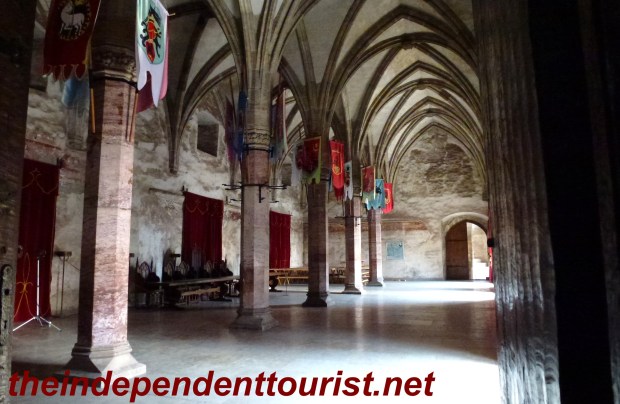
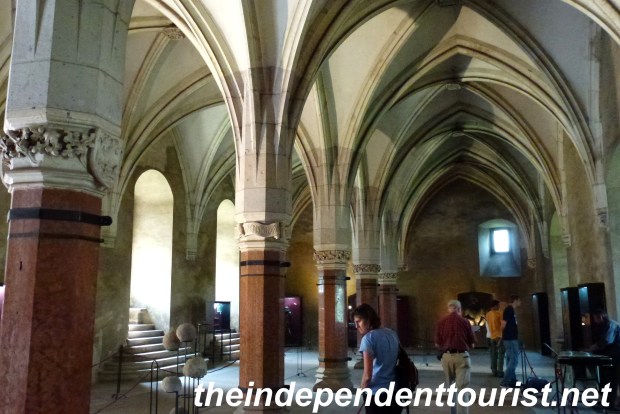
The Council Hall of Corvin Castle.

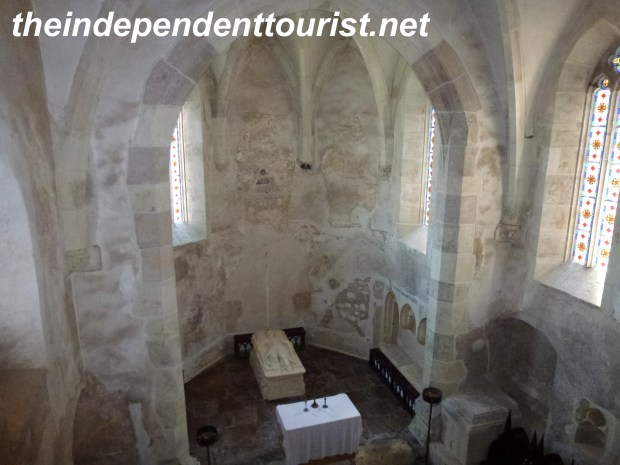
The chapel at Corvin Castle.

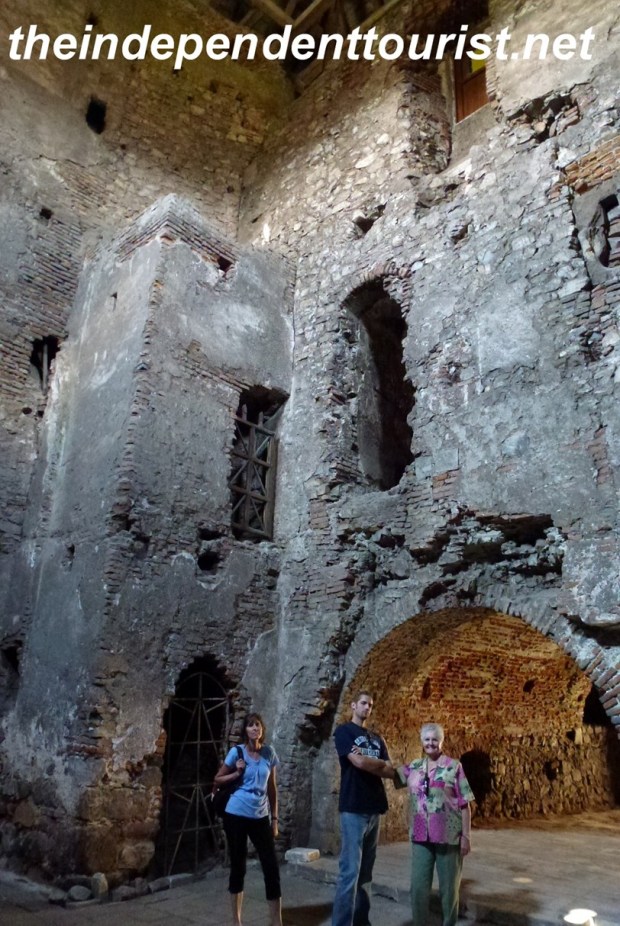
The eerie unrestored part of Corvin Castle–Dracula would be right at home!

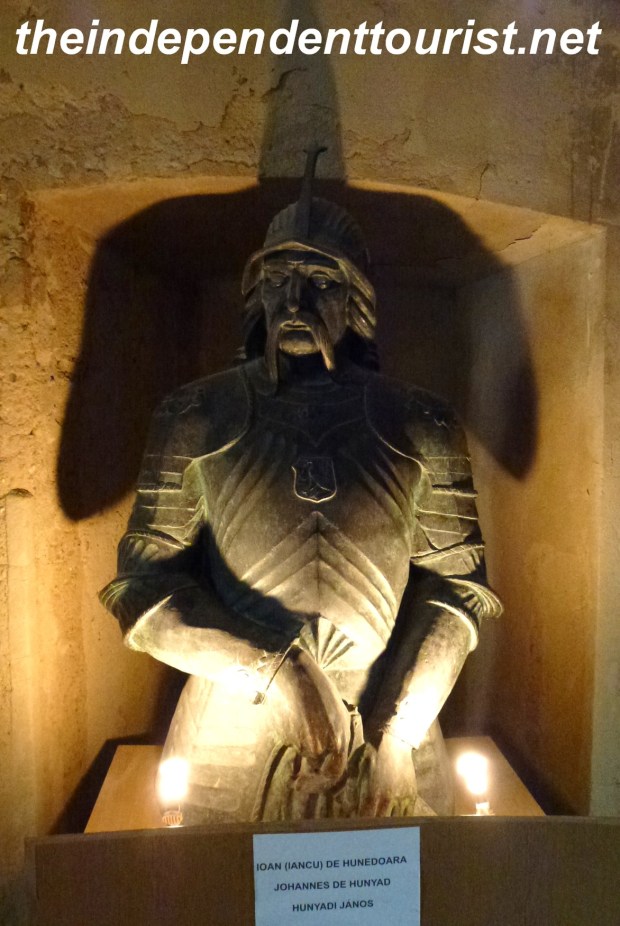
The castle and the town get their names from two kings (Ioan Huneadoara and his son, Matthias Corvinus), considered among the greatest Hungarian rulers of Transylvania.

A statue of Ioan of Hunedoara, the Hungarian King responsible for the rebuilding of Corvin Castle in 1453, the town where the castle is located bears his name.

In the 14th century, Turkish prisoners had the fun job of hewing the castle walls out of solid rock. Also, in the 15thcentury, three “lucky” Turkish prisoners had to dig a well, and were promised their freedom by King Ioan after its completion. It took them 15 years to dig about 100 feet deep, when they finally found water. Ioan was dead by the time they finished, and his wife, Elisabeth, revoked the king’s promised and had the three prisoners put to death. Upon learning their fate, one of them wrote on a stone in the well: “You may have water but you have no soul.” I wonder if those words haunted Elisabeth.

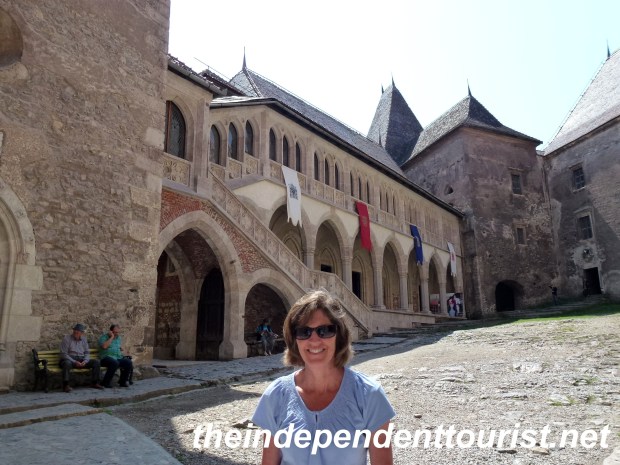
The inner courtyard of Corvin Castle.

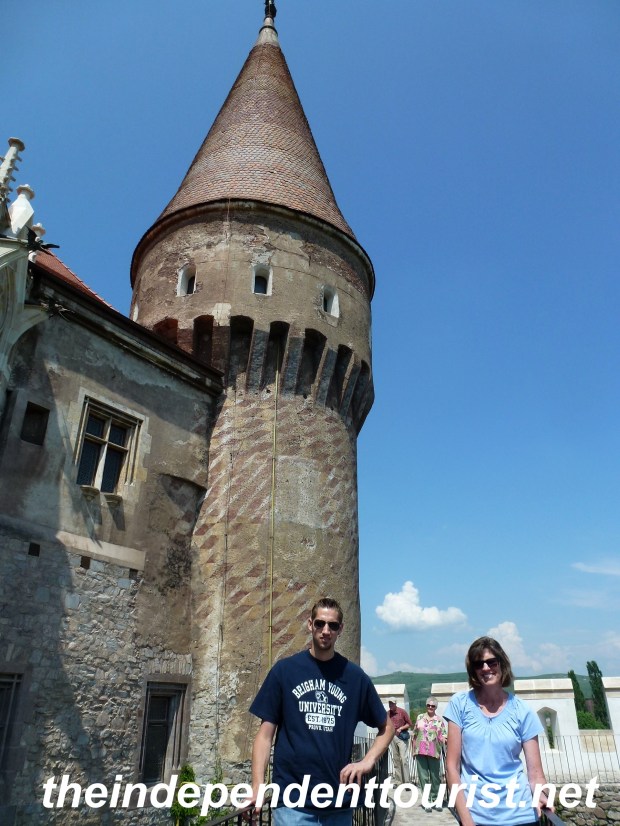
The Mace Tower, Corvin Castle. Note the traces of 15th century frescoes on the outside.

The Knights Hall at Corvin Castle.

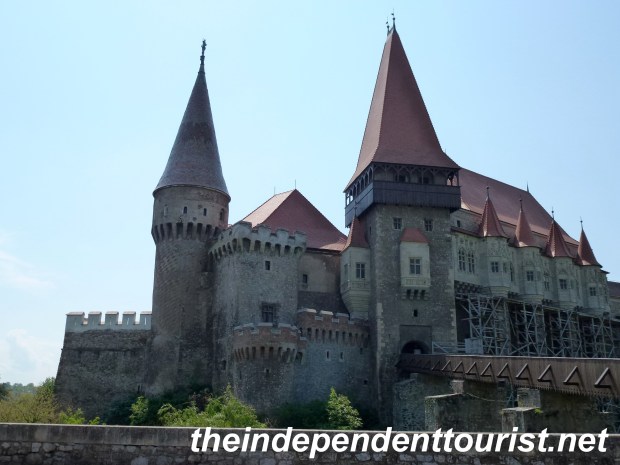
One more view of Corvin…a classic castle, with a long drawbridge over the huge moat.

Jules Verne thought enough of this castle to include it in his book, Around the Word in 80 Days, in 1873. It is one of the great medieval castles in Europe. The entrance fee was 10 lei (3.3 lei to the US dollar) and a photo pass was 5 lei.

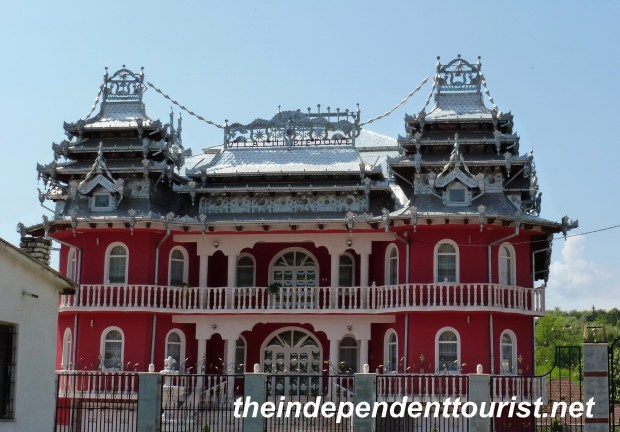
We noticed these very unique metal roofs all over Hundedoara. Hungarian influence?

References: Informational signs throughout Corvin Castle.

Humayun’s Tomb – Precursor to The Taj Mahal

Humayun’s Tomb and the lovely surrounding grounds.

In New Delhi, India, on the eastern side of the city, near the Yamuna River is Humayan’s Tomb.

New Delhi is in north central India.

It is a short walk from the Oberoi Hotel, one of the finest hotels in the city (I thoroughly enjoyed the excellent service and room–stay there if you can).

Location of Oberoi Hotel, Humayun’s Tomb, and Purana Qila.

Humayun was 2ndMughal (meaning Muslim, also spelled Moghul or Mugal) emperor. The Mughal emperors were generally able military leaders and were accomplished in many of the arts and sciences. Although Humayun was considered less of an effective military commander than his father (Babur, the first Mughal emperor), he did have a passion for astronomy and astrology and organized the empire’s administrative matters based on the planets (for example, Tuesday, governed by Mars, was given to matters of justice). His reign spanned 25 years, although 15 of the 25 years were spent in exile, including time in Persia, a culture which was to have great influence on the architecture of the Mughal Empire. Humayun returned to the throne in 1555 with the help of a Persian army, but his return was short-lived—he died less than a year later.

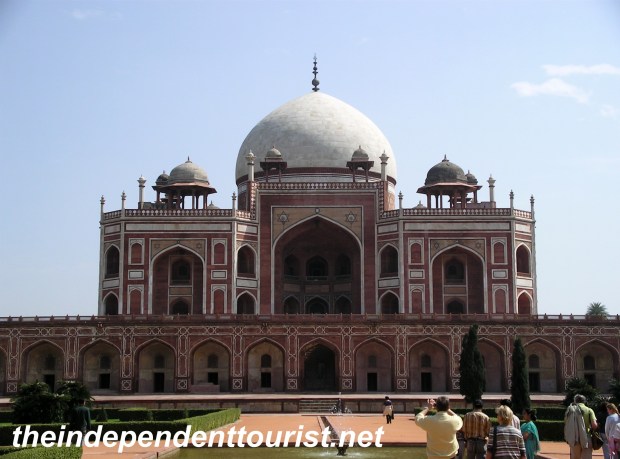
The similarity in style to the Taj Mahal is unmistakable.

The tomb was built in 1569 for Humayun by his widow, Haji Begum. It was the first mausoleum built for a Mughal emperor, and became the model for the incredible Taj Mahal, built about a century later, located 130 miles south in Agra, also on the Yamuna River (see my post on the Taj Mahal).

Note the fine stonework on Humayun’s Tomb.

The mausoleum is constructed of red quartzite, red sandstone and white marble inlay. The style of dome was influenced by Persian architecture and was an engineering feat for its time due to the height and shape. It was the first dome of its type in India (known as Hindustan) at the time. The dome is made of marble, and is a double dome, the interior dome being lower and more in line with the other interior heights. The influence of the Persian architecture is also evident in the 3 great arches on each side of the mausoleum.

On the well-manicured grounds there are several other smaller tombs and mosques dating from the same time period.

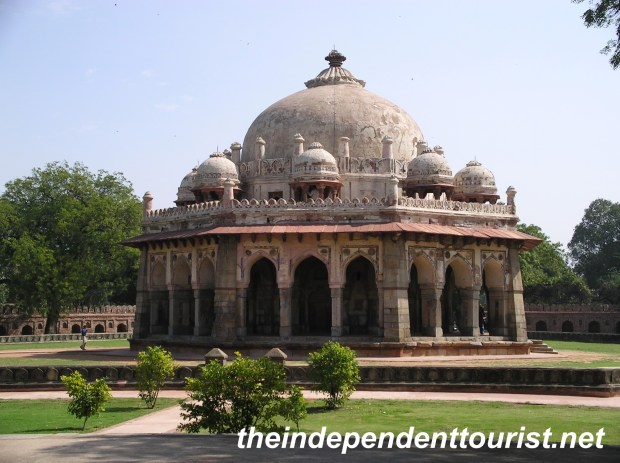
Isa Khan’s Tomb, on the grounds of Humayun’s Tomb (built in 1547).

Afsarwala Mosque & Afsarwala Tomb on the grounds of Humayun’s Tomb (built in 1560).

Purana Qila

Humayun also founded a city, now known as Purana Qila (Old Fort), about 5km north from where his tomb is located. Sher Shah, who deposed Humayun for 15 years, built a city on the foundations of Purana Qila. In addition to the walls, there is a mosque built by Sher Shah which is still standing. I did not have time to visit this site other than take a picture from the outside.

The Old Fort (built approximately in 1538).

The walls of the Old Fort.

Reference: World Heritage Series, Humayun’s Tomb & Adjacent Monuments, Good Earth Publications, New Delhi, 2002.

Sibiu – The Red Fortress City

In southwestern Transylvania, Romania lies the city of Sibiu. It got the name of the ‘Red Fortress’ due to the massive red brick walls built to protect the city after 1241. The walls encircling the town were four kilometers in length, and had 39 towers, a number of which still survive. For a map of locations visited in Romania, click here.

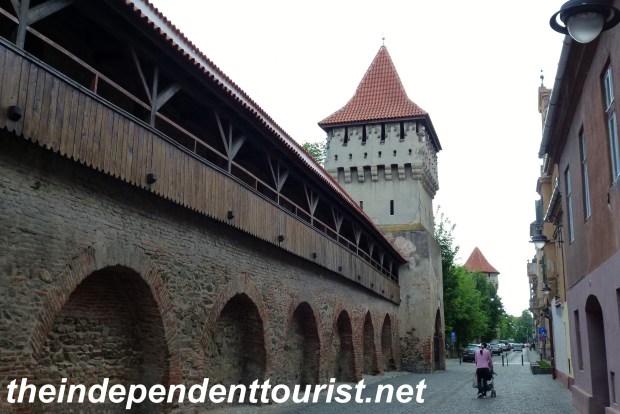
The 15th century defensive walls on the southern side of Sibiu, with the Tower of the Potters.

The EU designated Sibiu the “Capital of Culture” in 2007 and gave the city a facelift. The heart of the old city reminded me a bit of Austria, and since it was part of the Hapsburg empire for most of the 1700’s and part of the 1800’s, it’s no wonder why. The old center has an upper and lower section, and the upper section has been largely pedestrianized, making the walk through the squares a delight.

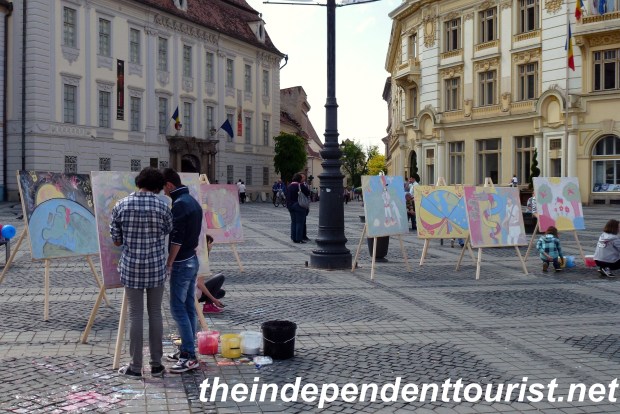
Student art project on the Piaţa Mare.

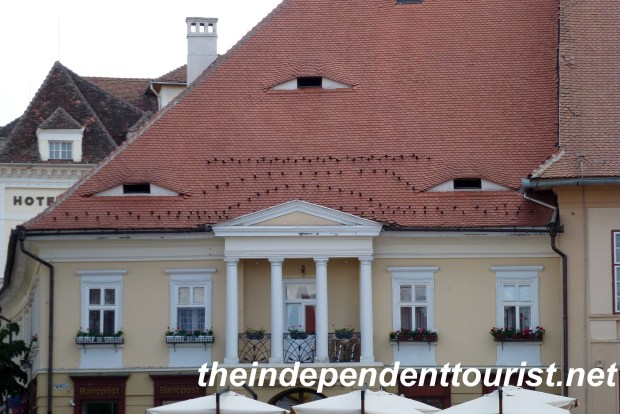
A three-eyed roof staring at us! This unique style of windows in the roof is common in Sibiu.

There are three interlocking squares in the upper old town, Piaţas Mare, Huet, and Mică, all flanked by baroque palaces and other buildings.

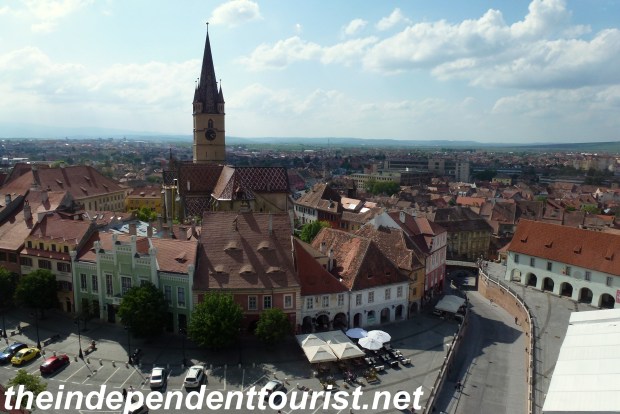
A view of the 14th century Evangelical church and Piaţa Huet from the Council Tower.

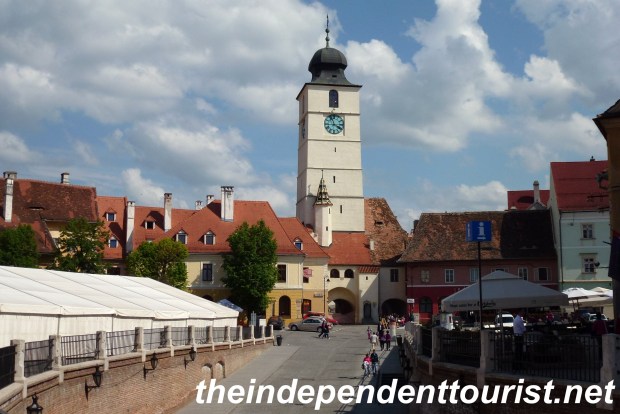
The old Council Tower (rebuilt in 1588) in the upper old town.

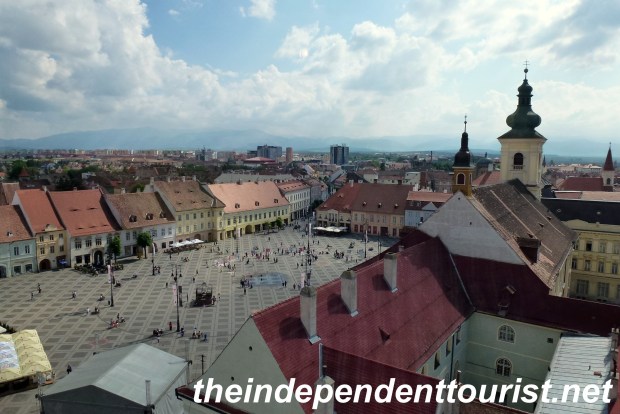
A view of Piaţa Mare from the top of the Council Tower.

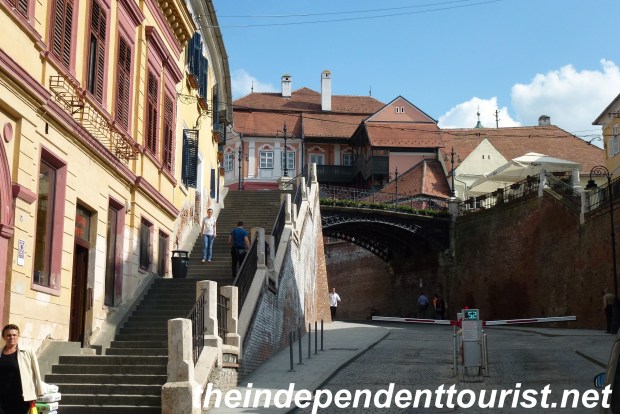
Steps from lower town to the upper town.

Although we just stayed overnight, Sibiu would be a great alternative base to Braşov for exploring Transylvania. We stayed in the tiny village of Talmacel, about 15km south of Sibiu, at the Guesthouse Rustic (not that rustic!).

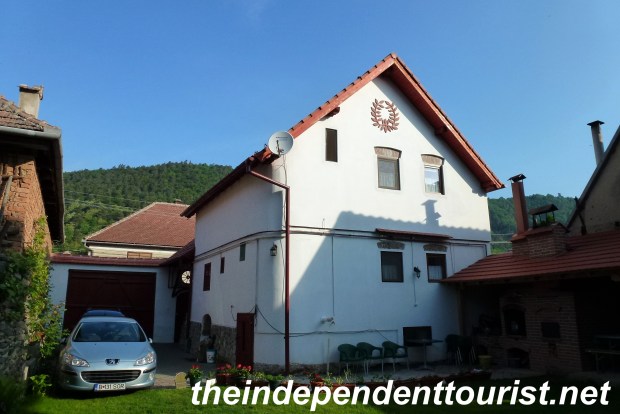
The Guesthouse Rustic in Talmacel, about 15 km south of Sibiu. Good quiet room.

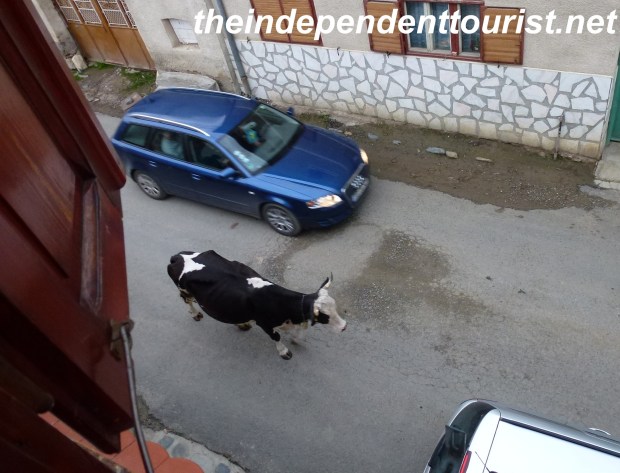
Be forwarned that this village was not on “Google Maps” as of May 2012. We loved the pension, and enjoyed watching the cows coming home through the village streets below our room.

The cows coming home on the village street below our pension room.

Sighişoara, Romania – Birthplace of “Dracula”

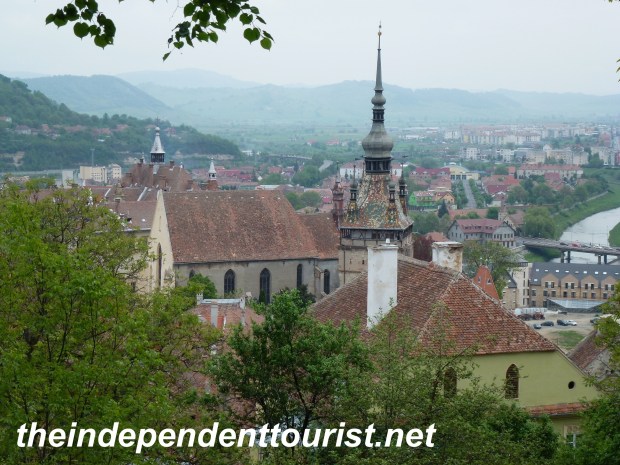
A view of Sighişoara and surrounding countryside.

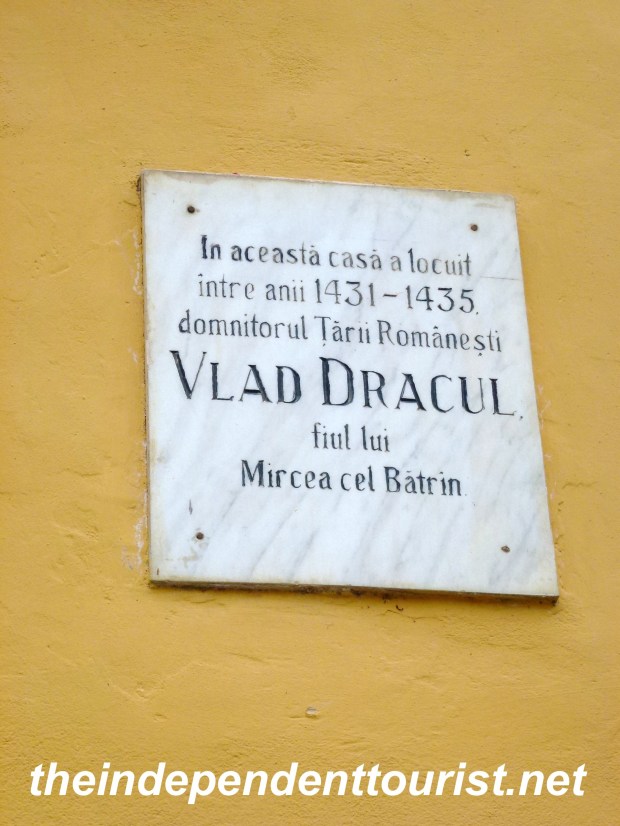
Sighişoara is the best-preserved medieval city in Transylvania. Vlad “The Impaler” Ţepeş (“Dracula”) was born here in 1431, his father being “Vlad Dracul,” a member of the “Order of the Dragon.”  For a map of locations we visited in Romania, click here.

The plaque on Vlad Dracul’s home, the birthplace of Vlad “The Impaler” Ţepeş.

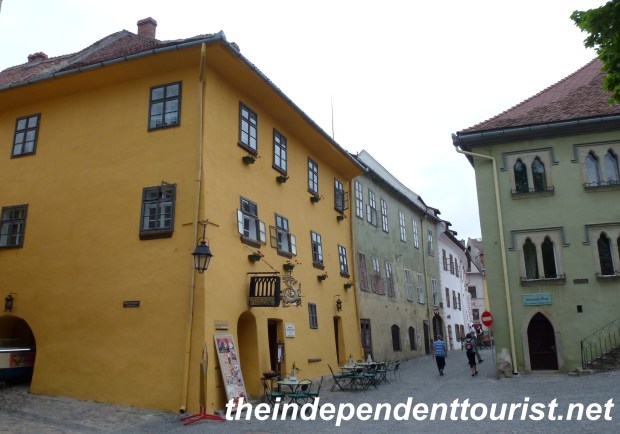
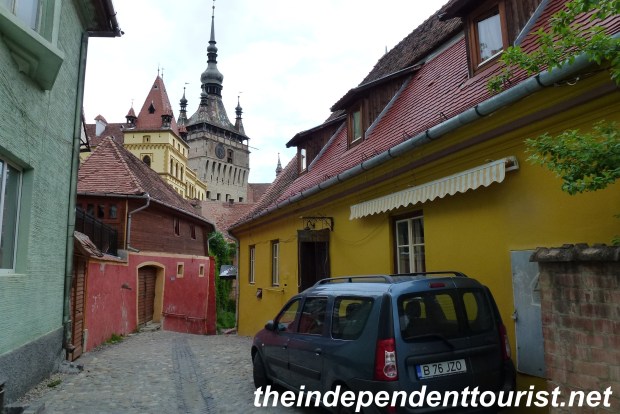
Vlad “The Impaler” Ţepeş birthplace, the yellow house on the left.

The origins of the town date back to Roman times, and German Saxons moved here during the 12th century, being promised autonomy in return for defending Transylvania from the Ottomans. About 500 Germans still live here. The towers (9 of them remain) and walls surrounding the old town are from the 14th and 15thcenturies. You can walk around the old town in less than an hour, although there are some interesting museums and churches to visit also. We enjoyed exploring the old narrow lanes and towers. This town has the perfect look for a “Dracula” movie.

The main entrance to the old citadel of Sighişoara, under the Clock Tower built in the 14th century.

In medieval times, Sighişoara was in a good location for defensive purposes, situated on a hill surrounded the Târnava Mare river, and between the cities of Braşov and Sibiu. When the town came under siege, the alarm was given by a big bell.  Everyone had a specific duty to contribute to the protection of the town, based on their training over the years. The craftsmen would fight from the fortress walls and towers, the women and children would prepare hot water and pitch which they would throw upon the heads of the attackers, the old men would give advice and the old women would take care of the wounded. Each guild had a tower that it built and defended.

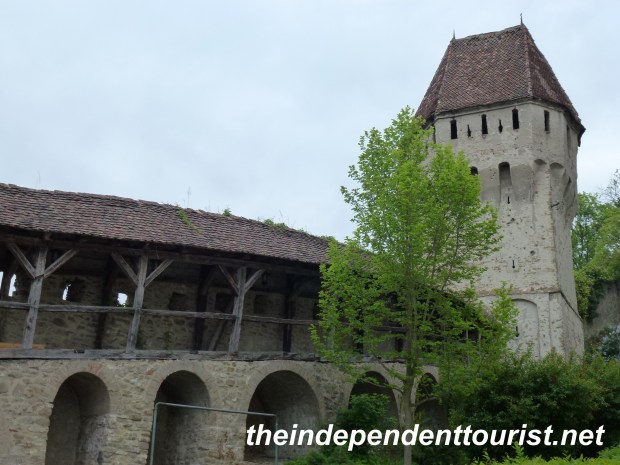
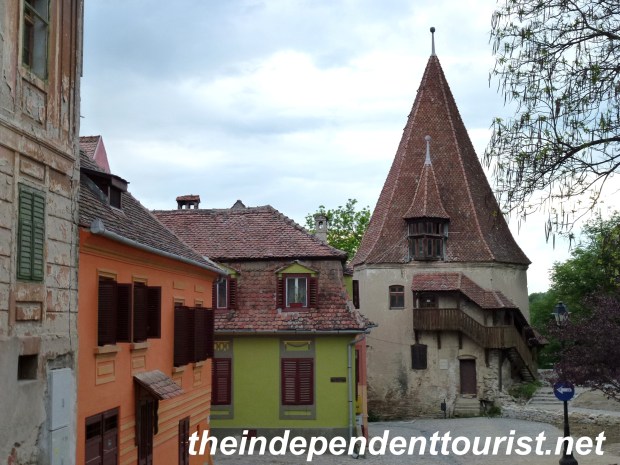
The Tinsmith’s Tower and defensive walls of Sighişoara.

The Bootmaker’s Tower.

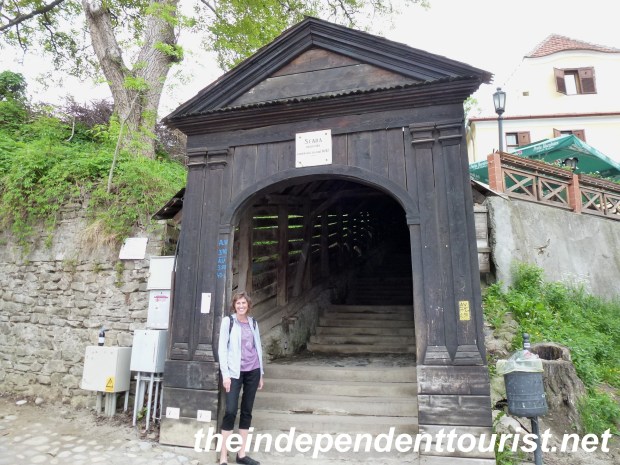
Built in 1666, The Covered Staircase has 173 steps leading up to a school and the 13th century “Church on the hill.”

Practicalities. We stayed in a small pension just outside the old citadel, called Pensiune Citadela Sighişoara, which can be found on booking.com.

The Pensiune Citadela Sighişoara is on the right, with our car parked in front.

This pension was in an excellent location and had decent rooms with exposed old wooden beams, which gave our accomodation a medieval feel. There is a tourist information office just across the street from Vlad Ţepeş’ home (now a restaurant). We ate a very good dinner at the “Stag House” or Casa cu Cerb, just a hundred feet from Vlad Ţepeş’s home, which is also a hotel. Prince Charles of the United Kingdom stayed here in 2002.

The Casa cu Cerb (hotel and restaurant) is the white building on the right.

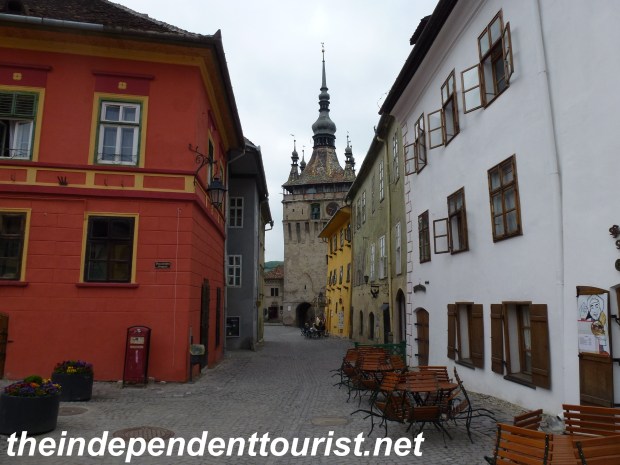
The Piaţa Cetăţii is the geographical center of the town, and is the citadel’s main thoroughfare.  The first homes were built around this square.

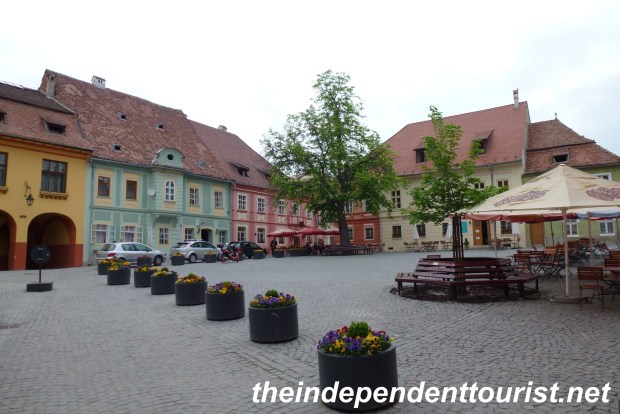
Piaţa Cetăţii, the main old town square.

A Weekend in Lisbon, Portugal

A view of Lisbon looking northeast along the River Tagus.

There are some great sights in and near Lisbon (‘Lisboa’ in Portuguese). I had a free weekend and another free afternoon during a business trip in May, and didn’t waste a moment. I was able to visit Belém, Sintra, and Tomar as well as Lisbon.

Locations visited in Portugal.

Lisbon has a very scenic setting along the Rio Tejo (Tagus River), just a few miles inland from the Atlantic Ocean. Since an earthquake in 1755 leveled the city, most of the architecture is not old, but it is still quite beautiful. The Portuguese love white buildings with red roofs and that is the image in my mind that I’m taking away from my visit. May is a great time of year to visit; the temperature was in the low 80’s F, and clear. In this post I share a few key sights in Lisbon and some tips for getting around. In other posts I will share my travel experiences to Belém, Sintra and Tomar.

A view of Lisbon and the River Tagus from the Castelo de Sao Jorge (the Praça do Comércio (historical plaza) is in the middle left of this view).

Getting Around. Lisbon has a somewhat small city feel, making it easy to get around. There is a good bus and Metro (subway) system. The Metro is well-signposted, efficient, clean, and easy to navigate. The automatic ticket kiosks have an English navigation option, and an all-day ticket for the Metro and bus system is €5.50. I used it a lot during my stay. There is also a trolley system in the heart of Lisbon covered by the same ticket. For visiting sights, a ‘Lisboa Card’ available, which provides a cost-effective way to see a number of tourist locations. I found it easy to get by on English, even in less touristy places.

A Lisbon Metro station.

San Francisco? No, Lisbon! The street cars are a great way to get around this hilly city.

Castelo de Sao Jorge (Castle of St. George). This Moorish castle dominates a hill overlooking the heart of Lisbon and Tagus River. It dates from the 11thcentury, and was a royal palace for 400 years. It is a great place to visit in the afternoon, as the sun is setting to the west overlooking the city. The castle is mainly a series of walls, and it was very enjoyable to walk the walls and take in all the different views of Lisbon from this vantage point. This spot has been inhabited for millennia. There are some ruins near the castle (part of the castle entrance fee) dating from the 7thcentury BC, now protected by modern shelters. The entry fee was €7.50.

The entrance to Castelo de Sao Jorge.

The walls of Castelo de Sao Jorge.

There are many restaurants right below the castle in this old part of Lisbon.

Sé Catedral (Lisbon Cathedral). This Romanesque 12thcentury cathedral looks out of place since it was one of the few medieval-era buildings to survive the earthquake of 1755. I was impressed with the interior. It is an enjoyable walk up hill from the cathedral to the castle area.

The Lisbon Cathedral.

The interior of the Lisbon Cathedral–rounded archways, heavy, thick walls and small windows, all typical features of Romanesque architecture.

Plazas.The Praça do Comércio is right at the waters’ edge and commemorates the seafaring history of Lisbon.

The Praca do Comercio in Lisbon. This plaza is right on the river waterfront.

Rossio Square is the center of Lisbon, and also has a train station (just to the west of the Square) from which the train to Sintra leaves (see separate post on Sintra). These plazas are connected by several avenues, one of which (Dos Correerios) is a pedestrian street where many restaurants are located.

Rossio Square – the heart of old Lisbon.

Dos Correerios pedestrian street in old Lisbon.

Elevador de Santa Justa (The Elevator). This elevator structure was built in the early 1900’s and is simply a viewing platform overlooking the central part of Lisbon and a lift for people visiting Barrio Alto where the ruins of Covent do Carmo are located. One can walk up the streets behind the tower and then take the walkway to the Tower for free (just below the observation deck). Lisbon is hilly and several lifts like this were in earlier years scattered throughout Lisbon.

Take this elevator to the top for a great view of old Lisbon.

Kasteel de Haar – One of the Best Castles of Europe

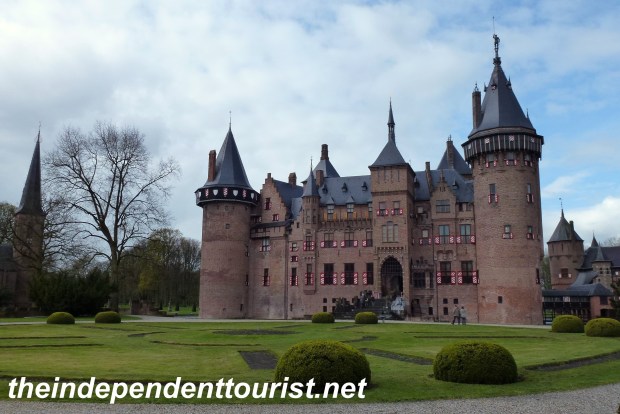
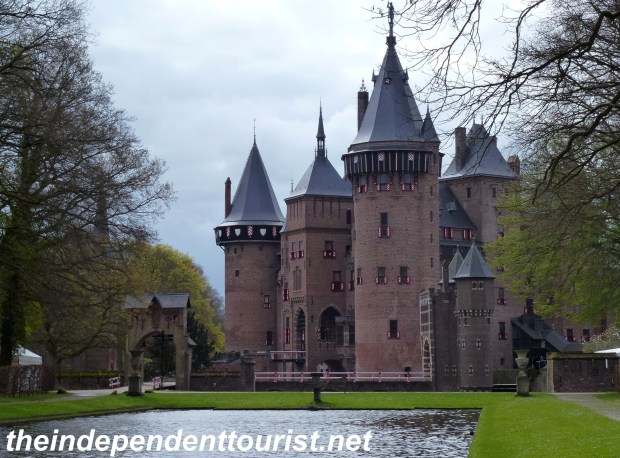
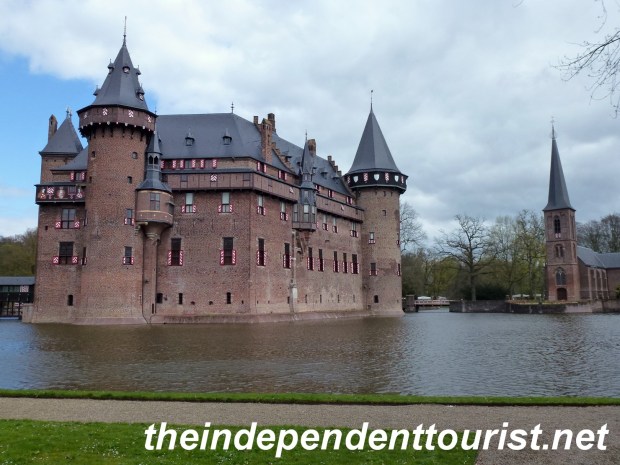
A view of Kasteel de Haar from the front.

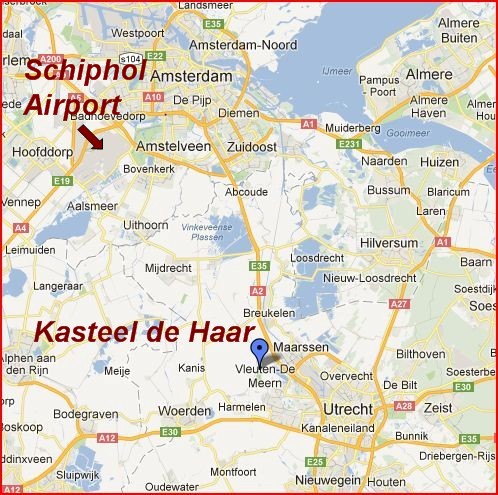
When we think of countries with great European castles, the Netherlands is usually not the first country to come to mind. However, Kasteel de Haar is impressive. It’s one of the finest castles in Europe. This lovely castle comes complete with a water-filled moat, small lakes, and landscaped gardens. It is located near Utrecht, about 30 miles from the Schiphol airport in Amsterdam.

Kasteel de Haar is just northwest of Utrecht and about 25-30 miles from Schiphol (Amsterdam) airport.

On my way from Amsterdam to Eindhoven, I had an afternoon free and decided to check out this castle.

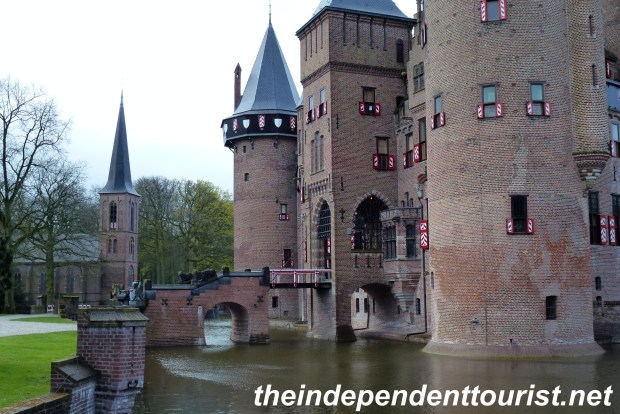
The castle drawbridge and moat.

The castle was built originally in the 1200’s and was restored in the 1890’s. When it was restored, the castle was the first building to have central heating, hot water, and electricity in the Netherlands. The castle has 200 rooms and 25 bathrooms. The old kitchen was in service until the 1970’s and has huge coal-fired stoves and ovens (the cooking surface is about 18 feet long). It must have been incredibly hot working in that kitchen in the summer (unfortunately I could not get any pictures in there).

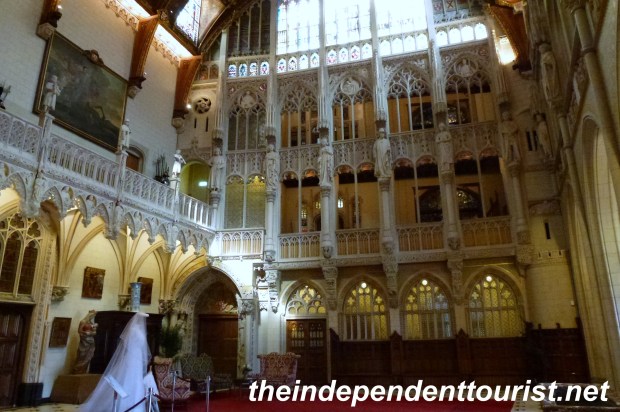
The Grand Hall–for receiving guests and entertaining,

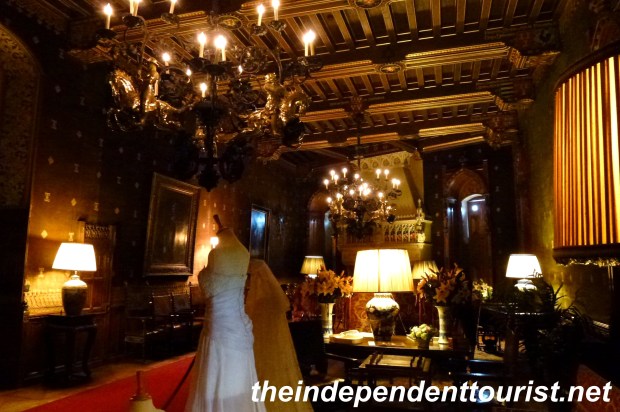
The Baroness’ bedroom. There are two doors back-to-back to this room, the baroness wanted one style (that fits the room decor), the baron wanted a Neo-Gothic style (on the outside) that fits the rest of the castle decor.

The family Van Zuylen van Nyevelt, connected through marriage to the Rothschild European dynasty, inherited the castle in the 1800’s and lives in the castle during the month of September each year. I’d be tempted to stay year-round! It contains many 17thcentury tapestries and one from 1510 that is enormous. The decorations, artwork and furnishings are beautiful.

The smoking room/den.

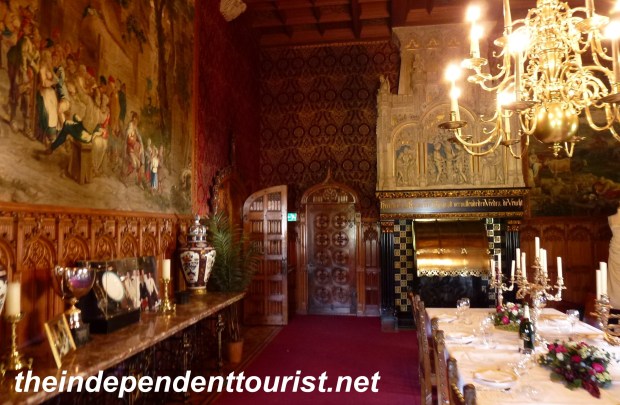
The elegant main dining room.

The grounds (135 acres) of the castle are lovely too, and at one end are a maze and reflecting pool. A whole village (Haarzuilens) was moved about 2 km away to clear and reestablish the original castle grounds. The castle has hosted many celebrities, including Roger Moore (who played James Bond in many films) and Gregory Peck (film star in the 1940’s – 1970’s).

A view of the castle from the Grand Canal or reflecting pool.

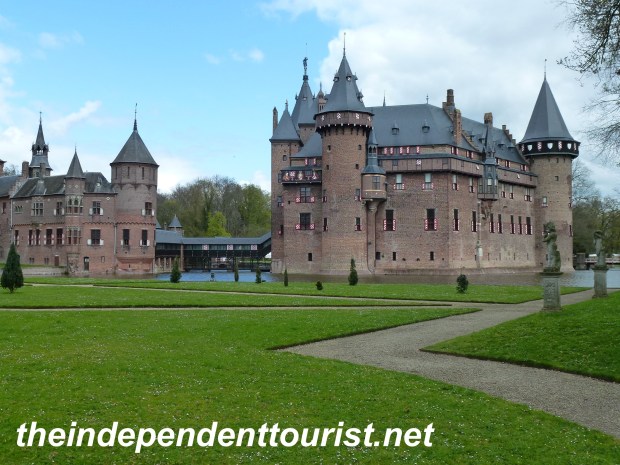
The castle, moat and chapel.

The only way to visit the castle interior is with a tour, and these run about every 30 minutes from April to December, except when the family is living there in September. The tour is in Dutch, but English audio guides are available. The entry fee is €12.50 per person and the parking fee is €4. Visit the castle website for more information, click here: Kasteel de Haar.

The view of Kasteel de Haar and chateau (on left) from the entrance.

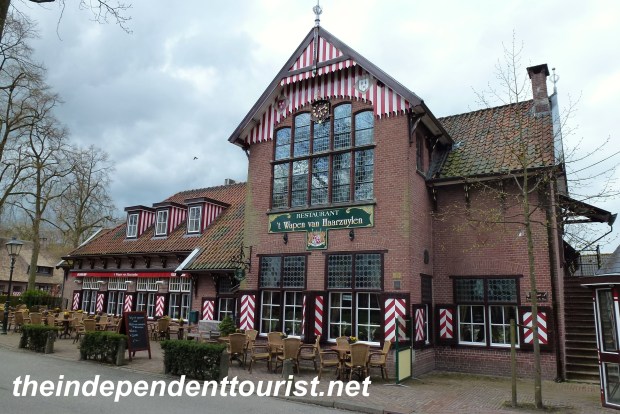
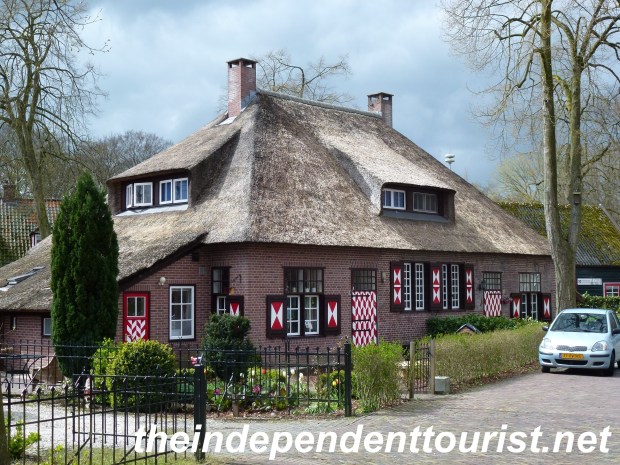
A couple pictures of the town of Haarzuilens–relocated for the restoration of the castle and grounds.

A restaurant on the main square in the village of Haarzuilens.

A thatched roof home in the village of Haarzuilens.

In need of marriage counseling? Visit Biertan!

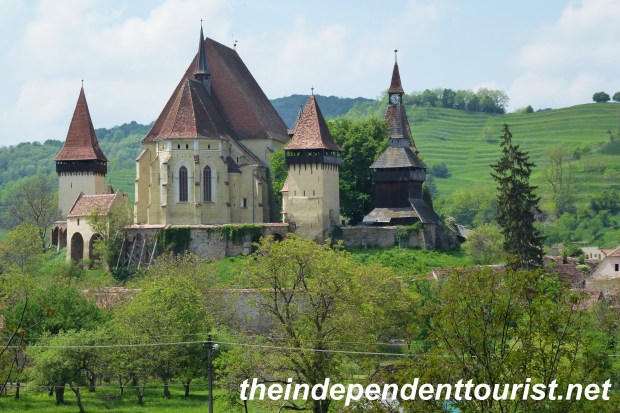
The grandest of the fortified churches in Transylvania – a UNESCO World Heritage Site.

If your marriage or partnership is suffering, visit Biertan fortified church in Transylvania. There is a room here where couples would be banished for two weeks in medieval times to work out their differences.  The room contained only one small bed and one set of cutlery. In 400 years, only one couple went through with divorce—not a bad rate of success!

The Lonely Planet Romania Travel Guide advises you to save this fortified church for last, if you are visiting several. We followed their advice, and I understand why now. Biertan is a picture-perfect fortified church in the village of Biertan, sitting on a small hill, surrounded by higher hills. Having taken a little detour from Sighişoara (Biertan is 27 km southwest of Sighisoara), we arrived from the south, and followed a dirt road into the village. For a map of our route in Romania click here.

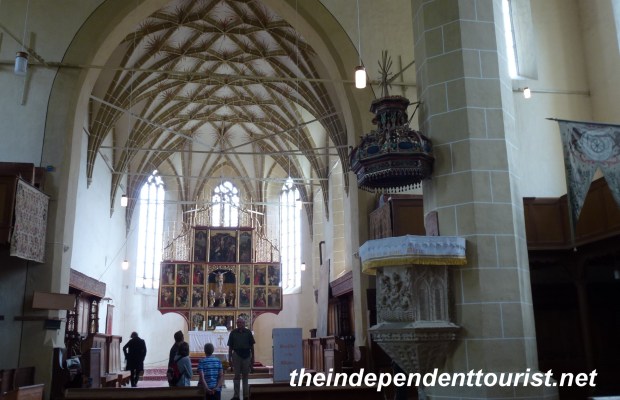
The inside of Biertan church – the altarpiece paintings are from 1483-1515.

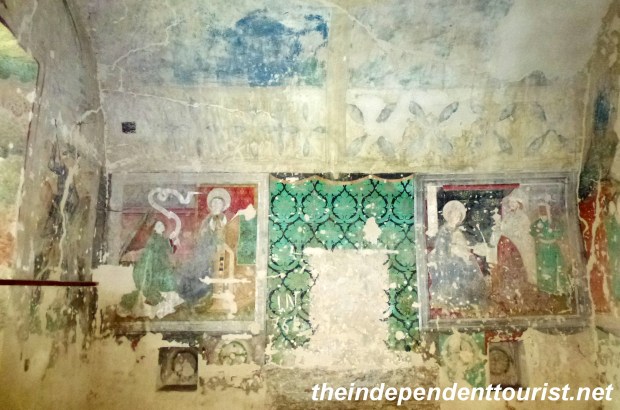
The frescoes inside one of the towers surrounding the church.

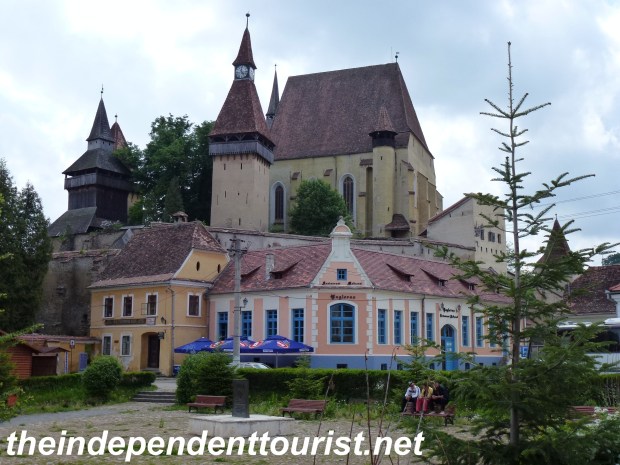
The church was built in the 15th century and is surrounded by walls and towers and has an old covered stairway climbing from the main square of the village up to the church.

Gravestones of the Lutheran bishops who served here from 1572 to 1867 are located in this tower.

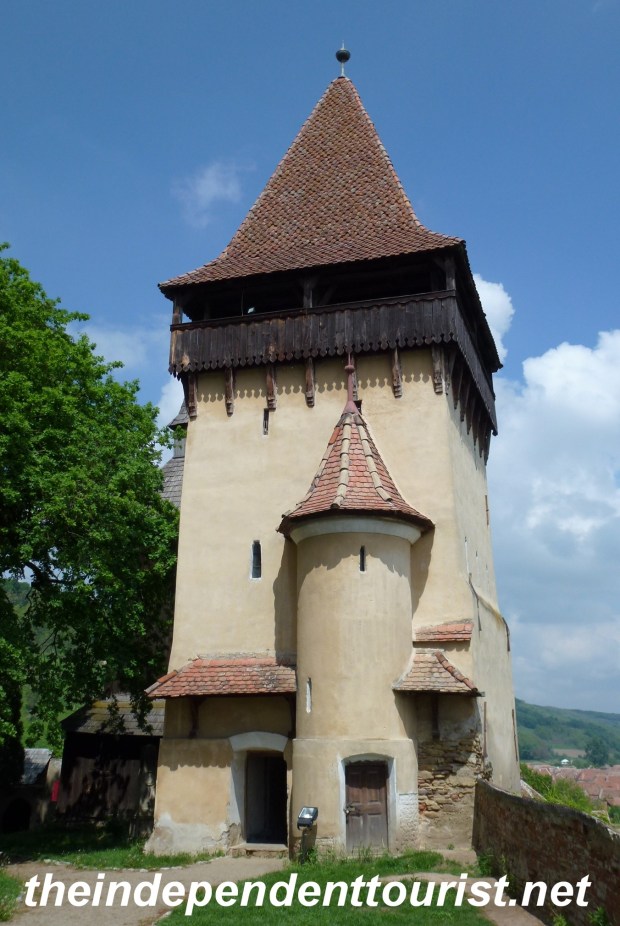
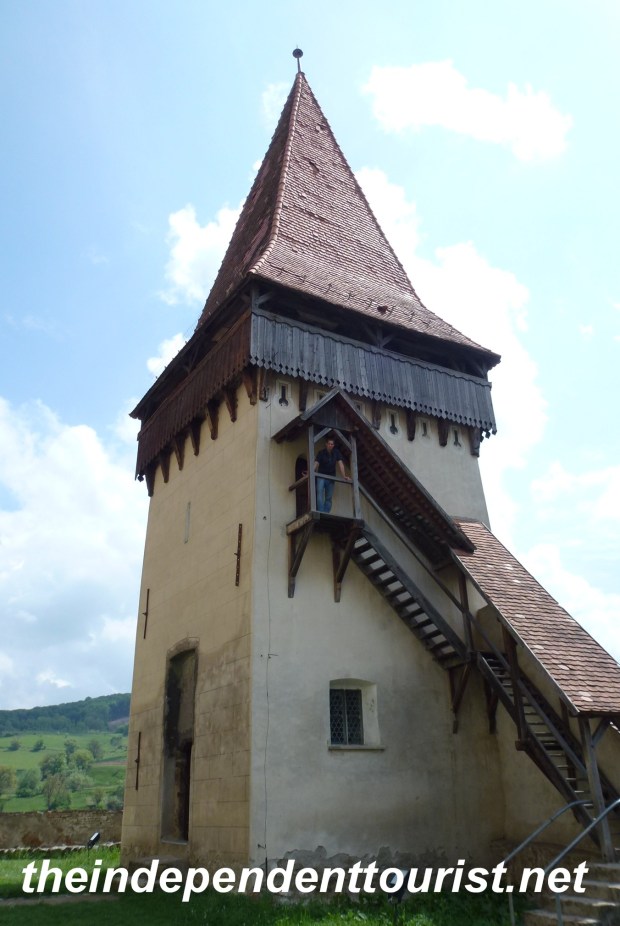
One of the towers surrounding the church.

A view of the church from Biertan village square.

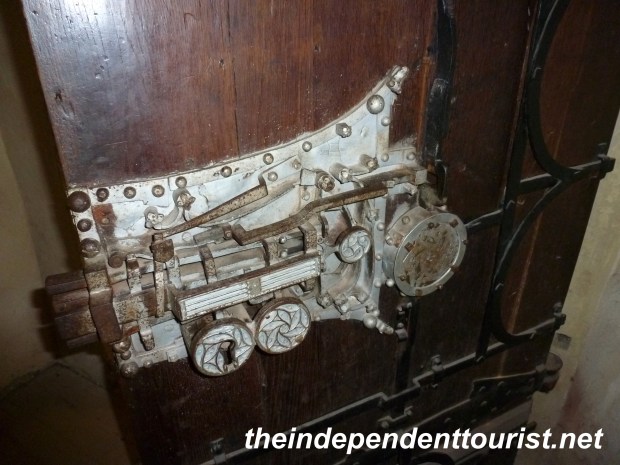
The sacristy door lock – 19 locks in one! A marvel of engineering that won first prize at the Paris World Expo in 1900. The church’s treasures were behind this door.

Leaving Biertan to the north, the road is paved to the main highway (Highway 14) connecting Sighişoara to Sibiu.

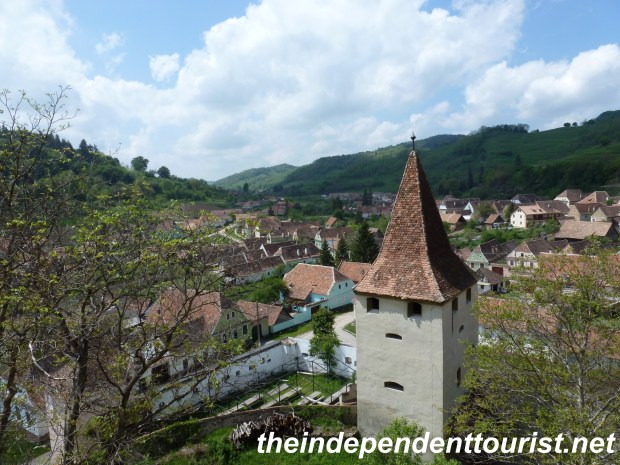
A view of Biertan village from the church, looking south.

If you only have time to visit one fortified church in Transylvania, this is the one. The entry fee is 8 lei per person (about 3.3 lei per US dollar).

See my post “The Fortified Churches of Harman and Prejmer” for a short background on fortified churches in Transylvania. Other references: Lonely Planet-Romania 2010 & Rough Guide – Romania 2010.

Viscri – A Seemingly Untouched Romanian Village and Fortified Church

This little village and fortified church were on my list of favorite spots in Romania. The village feels secluded and remote, and the church doesn’t appear to have changed in hundreds of years. This place felt like the “real Europe” and one can quickly imagine what life was like here hundreds of years ago. The village has very few cars and no paved streets (one street was cobblestone). The church is visible as you drive into town, just follow your nose to find it. For a map of main sites visited in Romania click here.
The fortified church of Viscri.

Walking up to the entrance of Viscri fortified church.

While Viscri is not far (only 7 km) off the main route (E60) between Braşov and Sighişoara, the road is a bit rough—a combination of rough, broken pavement and gravel. Since there are few cars in Viscri, the locals probably don’t care that the road is not in the best shape, and the more difficult access means less visitors messing up the place! The only practical way to visit Viscri is with a rental car. The church is 13thcentury, and hasn’t changed much in the last 400 years; the old painted wood loft railings and creaky stairways are original from the 1600’s.

The interior of the Viscri fortified church–frozen in time.

At the top of the Viscri church tower, trying not to fall through the floor boards.

My son and I climbed up the tower of the church, through narrow stone stairways and over wooden boards where we had to watch our step or take a chance on falling through!  The fortified walls, built in 1525, contain storage areas and farm tools from many years ago.  There was an entry fee of 4 lei per person.

Inside the walls of Viscri fortified church.

A view of the village of Viscri and surrounding area from the tower of the church.

The village population consists of a few Saxons and mainly Roma (Gypsy).  We saw some displays of woolen socks as well as other woolen items (hats, etc.), and read afterwards that making these items is a major cottage industry of the village, exporting many of their hand-made goods to Germany.

A typical scene in Viscri.

You pass through the village of Bunesti on the way to Viscri – a view of rural life in Romania.
New home construction in Bunesti.

Children in the village of Bunesti pose for their picture.

See my post “The Fortified Churches of Harman and Prejmer” for a short background on fortified churches in Transylvania. Other references: Lonely Planet-Romania 2010 & Rough Guide – Romania 2010.