The Fortified Churches of Hărman and Prejmer

A great day trip from Braşov is visiting the fortified churches in Harman and Prejmer, towns that still retain their Saxon roots. We visited these churches as we left Braşov before heading to Sighişoara. The easiest way to visit these towns is by rental car, but it’s also possible by train or bus. Hărman is not open Monday and Prejmer is not open Sunday, so if you want to do both, you’ll need to visit Tuesday—Saturday. For a map of sites visited in Romania click here.

Exterior view of Harman fortified church with the walls and towers.

Fortified churches are a unique feature of Transylvania, and there are 280 in Transylvania. Each one has its own different style, but common features include high surrounding walls (sometimes several concentric rings) usually with towers, a church in the center of the fortifications, often with its own tower, and rooms for provisions in case of attack and sometimes boarding rooms for the villagers inside the walls—these fortifications often look like a combination of a castle and church. A whole trip could be spent just visiting these wonderful sights, and maps are available that show driving tours of these churches, which are often in little villages. The two listed here are close to Braşov and close together. Their purpose during medieval times was to provide safety to the villagers in times of attack, often from the Ottomans as they sought to expand their empire westward.

Hărman

The church at Hărman dates back to 1240, the belfry tower was added in the 14thcentury, and the walls were constructed in the 15th century.

Even the church had exterior rooms for protection–ladders could be pulled up.

In addition to the church, the fortifications retain part of the interior living and storage rooms along the walls, giving a feel to what the internal fortifications looked like.

The storage and living quarters along the inside walls.

You can visit some of the rooms and dark walkway around the wall which haven’t changed much from their original state. In the church, women would sit in the center pews and the men on the side pews, in case of attack the women would be in the center protected by the men surrounding them.

The pews where the women would sit in the church.

The men would sit in these side pews to protect the women.

It would have been quite a life to constantly worry about your village being attacked by the Ottomans.  The walls originally had a moat around them, and part of it is still visible.

The caretakers of this church are German, descendants of the Saxons who settled this town.  The entry fee was 4 lei per person (about $3.25).

Prejmer

The village of Prejmer is more rustic than Hărman, with dirt roads in some parts of the village.

A typical street scene in Prejmer–note the horse-drawn “tractor” on the right.

The fortified church has very high walls (12-14 meters high), and given its size, it’s difficult to appreciate from the outside.

Exterior view of Prejmer fortified church.

Reinforced door at the entrance to Prejmer fortified church.

Prejmer was the most powerful peasant fortress in Transylvania. The main entrance feels like a step back in time, just like walking into a medieval village. This fortification also had a moat, which has since been filled in.

The entrance to Prejmer fortifications.

Beyond the initial entrance, there is another entrance into the interior courtyard where the church is located and surrounded by little rooms (272 of them) on four levels attached to the defensive circular walls.

The 13th century Prejmer church.

The interior shelters of Prejmer–where the villagers would live in times of pending attack.

These rooms are well-preserved, and from the courtyard the ring of rooms almost looks like a hotel, with numbers on each door. Each room was assigned to a village family. Many of the rooms are open, and they also provide access to a dark walkway running the length of the walls at the top, where guards and lookouts could be posted.
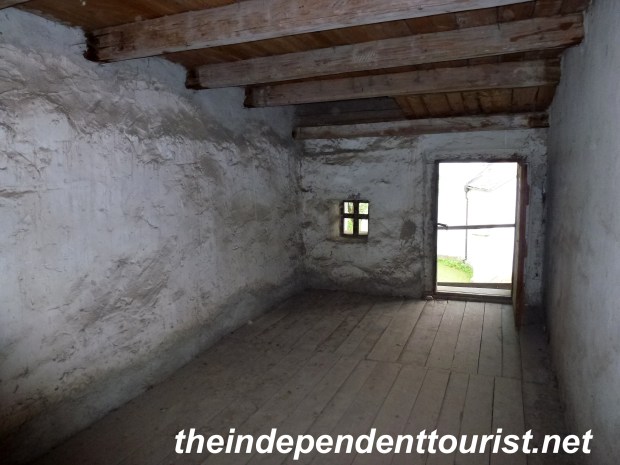
Typical living quarters inside the fortifications.

The walkway on the upper floor around the walls of Prejmer fortifications.

Some rooms were also dedicated to specific purposes–such as a school, for storage, weaving, etc. The entry fee was 8 lei per person.

A school room at Prejmer. Note the wall paintings.

As with many sites we visited in Romania, we pretty much had these places to ourselves.

References: Lonely Planet – Romania & Information at the sites.

Bran Castle and Raşnov Fortress – The Valley of the Roses

These two great medieval sights are about 16 km southwest of Braşov, and only 10 km apart, so they make a good day trip from Braşov. Raşnov gets its name from the Saxon word Rosenau, which means the Valley of the Roses. For a map of these locations, click here.

View of the town of Rasnov and surrounding “Valley of the Roses” from Rasnov Fortress.

Since we were traveling by car, our Pension recommended a great scenic drive to Raşnov, going by the ski resort area of Poiana Brasov. Driving through the Transylvanian mountains felt a bit like our home state of Colorado. This is a very pretty area of Romania.

Raşnov Fortress

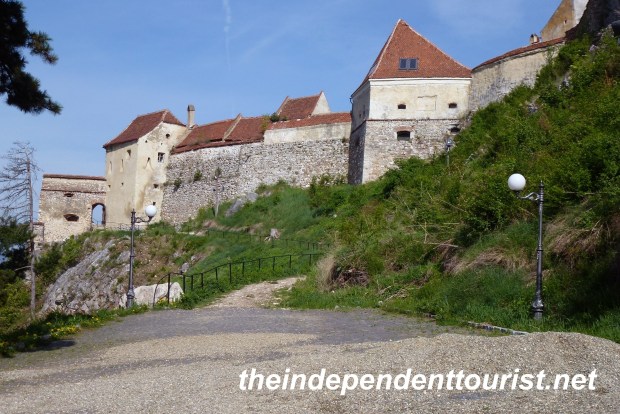
Raşnov Fortress sits at the top of a hill, overlooking the small town of Raşnov, and like Braşov, has a “Hollywood” sign in front of it on the hill.  Why the Romanians like to put these signs up is beyond me, but luckily Braşov and Raşnov are the only places that have these signs, to my knowledge.

View of Rasnov Fortress from the town of Rasnov.

Coming from the north, the fortress can be seen for miles. Since we were arriving through the heavily forested mountain passes from the south, we saw the parking lot before the fortress. We were the first visitors to arrive at the car park on a clear, sunny day in May. From the car park you can either walk up or take a little tractor-train up to the fortress for 3 lei per person (about 3.3 lei to the USD at the time of writing this post)We took the train up and walked down.

Another view of the little village inside the Fortress.

We arrived pretty early (around 9:30 am); the exhibits and shops weren’t open yet in the fortress—which gave the place a very peaceful feel. We enjoyed the views and wandering around the tiny village.

The village in Rasnov Fortress.

We had the site to ourselves. As we were leaving, a few other people were making their way up the hill. The fortress is believed to have been built in the 1200’s and functioned in a military capacity until the 1700’s. It withstood a Turkish invasion in 1335. Today it preserves the folk art of Romania through exhibits and shops; in medieval times the village within the fortress was known for glass making and weaving.There is an entry fee of 10 lei per person.

Walking up to the Fortress entrance.

In the town of Raşnov we wanted to visit the old St. Nicholas Orthodox Church (just to the west of the town center). It’s the oldest Romanian Orthodox Church in southeastern Transylvania, dating to the 1200’s. It contains paintings from the 16th century. Unfortunately, it was closed on Monday, the day of our visit.

Bran Castle

Exterior view of Bran Castle from the west.

Just 10 km west of Raşnov is the famous Bran Castle, long associated with “Dracula” or Vlad Ţepeş. The castle has very little historical connection with Vlad Ţepeş. That said, there is an extensive exhibit on Vlad Ţepeş and the Dracula legend in two of the castle’s rooms.

Hiking up the stairway to the castle entrance.

Information on Vlad Tepes (the inspiration for Dracula) at Bran Castle.

The castle may have been inspiration for the setting of Bram Stoker’s Dracula. Bran castle dates from the late 1300’s, and was built to help fortify Braşov from the Ottoman raids. In 1459 Vlad Ţepeş passed through the area and attacked Braşov, which is the only connection Bran Castle has to him. In 1920 the people of Brasov donated the castle to the royal family (Queen Mary and King Ferdinand) of Romania. This act saved the castle from falling into disrepair, and today the castle is in very good condition. The castle is still owned by the royal family’s descendants.

The Large Drawing Room inside the castle.

A secret passage stairway in the castle.

Bran is a very cool castle, and one of the finest in Europe. From the pictures we had seen, we thought the castle would be isolated in a mountain valley. We were a bit surprised to find that it is right at the edge of the small town of Bran, on a small hill. Bran Castle was the most touristy of the sites we visited in Romania—with lots of little shops at the entrance—and you can get your Dracula T-Shirt here! Even so, there were only a couple of small tour groups here in early May. We parked just outside the castle grounds for 10 lei for 4 hours, and the castle entrance fee was 25 lei per person.

A view of the Round Tower (oldest in the castle),courtyard and well below.

We also ate an early dinner in Bran, right across from the entrance to the castle, and had a very good, large meal for 3 people for $27! I would have thought prices would have been higher in this tourist spot. We found the restaurant prices throughout Romania to be quite cheap compared to Western Europe.

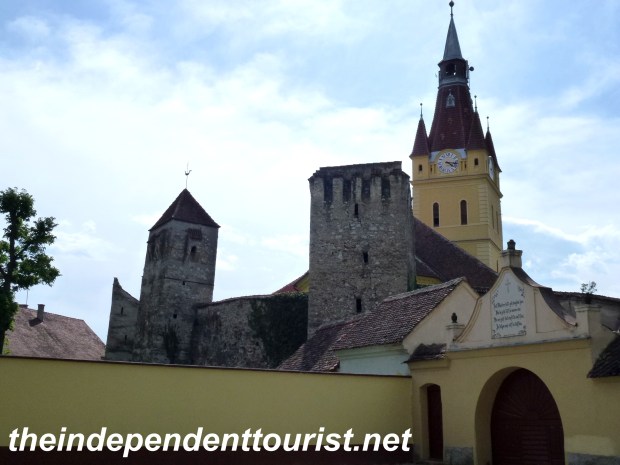
On our way back to Braşov, we stopped briefly at the town of Cristian, which is home to one of the many fortified churches in Transylvania. It wasn’t open, but it was fun to see our first of several fortified churches in this non-touristy town.

Cristian Fortified Church, on the road to Rasnov from Brasov.

Reference: Tourist Guide-Bran Castle by Compania de Administrare a Domeniului Bran, Nicoleta Petcu, 2010.

Peleş Castle – Livin’ the Dream

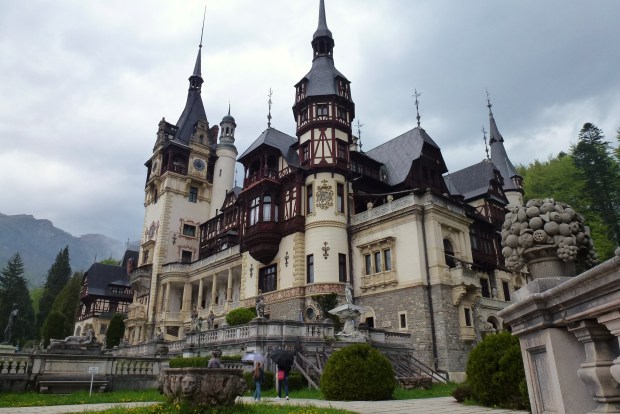
View of Peles Castle from the gardens.

One of the highlights of Romania is a visit to Peleş Castle, located in Sinaia, about 110 km north of Bucharest or 50 km south of Braşov. We visited this fairytale palace on a day trip from Braşov. Although this castle is not old (it was started in 1875 and finished in 1914), it is a testament to what a King can build when money is apparently no object. It was the first European castle to have electricity, central heating—and even central vacuuming—very advanced for its time. It cost about $80 million at the time, and would be almost impossible to replicate today. The craftsmanship is really beyond compare. The main rooms are exquisitely decorated with materials from all over Europe and each has a unique feel – owing to the origin of the decorations as well as the building materials—Italian, German, Turkish, etc. Of special note is the incredible woodwork, and decorated leatherwork on the walls. There are excellent collections of medieval arms too.  A map of sites visited in Romania can be found here.

The German decor and woodwork in the dining room.

Turkish decor and furnishings in a sitting room.

The exquisite wooden circular staircase above the main reception room.

The stunning main reception room.

We owe this marvel to King Carol I and his wife, Elisbeta. It was intended to be their summer residence, and given its location at the threshold to the Transylvanian mountains, I can imagine how the setting and altitude made it a nice escape from the heat of Bucharest on the plains of Wallachia.

Some practicalities: The castle is to the west of the main road (E60) from Ploiesti to Brasov, and I didn’t see any signs to the castle until after we took the northernmost exit off the highway into Sinaia. Parking cost 10 lei (the current exchange rate is about 3.3 lei to 1 USD). Tickets to the castle can be bought in the courtyard of the castle.  It is possible to just view the exterior and wander the grounds by paying the parking fee only, but this would be a serious mistake. Note that it is a steep walk up hill from the parking areas to the castle itself.

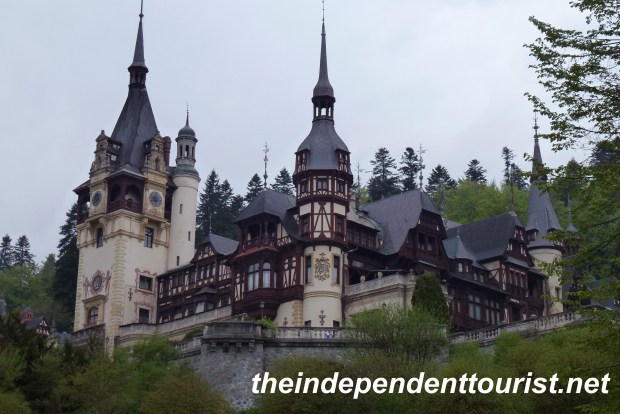
View of Peles Castle from the walk leading up to the entrance.

There are 3 prices for tickets (30, 50 and 70 Romanian lei each), and a separate pass is required to take photographs (32 lei). The most expensive ticket includes getting to see the private apartments, a theater where performances are still held, and other areas off limits to the other tours. It also includes nearby Pelişor Palace, which, since we were on the last tour of the day, closed before we could get to it. Allow at least 2-3 hours for your visit. Since Romania is quite cheap by western European standards, the entry fees felt expensive, but in reality are well worth it. Guided tour is the only way to visit the castle interior and tours are offered in English as well as other languages.

One of the private apartments (fine leatherwork on the walls).

An interesting side note—this castle was used as a prop in the 2009 movie “The Brothers Bloom” starring Adrian Brody and Mark Ruffalo as con artist brothers. In the movie, it was the home of a young eccentric rich woman (played by Rachel Weisz) in New Jersey of all places, and at one point in the movie the castle is blown up! I was happy to see that through the magic of Hollywood, the castle is still there. This movie was a critical hit, but not at the box office.  If you enjoy offbeat humor, watch this movie.

Braşov – A Great Base for Exploring Transylvania

Transylvania contains a number of fortified towns, and Braşov is a great example. The fortifications were begun in 1203 and constructed by the Saxons (Germans) as defenses against the Ottoman Empire. Local Romanians were actually forced to live outside the main town. Some of the old town’s walls, towers and gates remain. Located about 170 km north of Bucharest, Braşov is a great place to call home for a few days to explore this part of Transylvania. We spent 3 nights in Braşov and were able to explore the old town of Braşov and Peleş Castle (about 50 km south of Braşov) on our first day, Bran Castle and Raşnov Fortress on the 2nd day, and Harman and Prejmer fortified churches on our way out of town on the 3rd day. For a map of our tour of Romania, click here.

Mt. Tampa rises above Braşov.

The old town of Braşov is set against Mt. Tampa on the south. The path around the outside of the walls on this side of the city is shaded and a favorite place for locals to stroll on Sundays. There is a Hollywood-like sign on the mountain (“Braşov”). If you want to get  a great view of Braşov and the surrounding countryside, take the tram up Mt. Tampa, located outside the old walls. At the top of the mountain, follow the trail to the west (or right) towards the Braşov sign for an overlook of the old town and surrounding area. The tram costs about $6 round trip. Another option is to take the tram up and walk the trail back down.

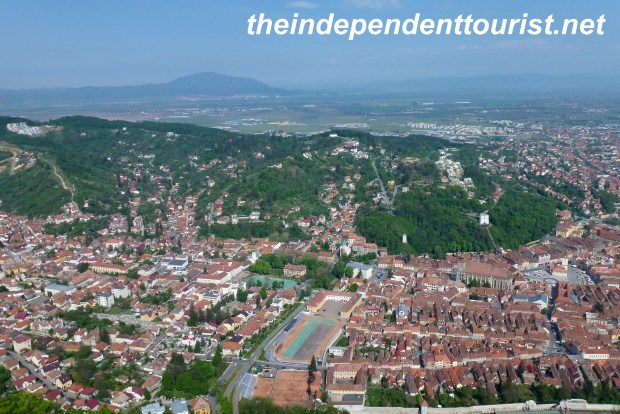
View of Braşov and surrounding area from Mount Tampa. The old city of Braşov is in the lower right (the Black Church and the main square are visible).

The old city is well-preserved with a number of interesting streets and buildings.  It is a very lively town, with many people enjoying the outdoors on the plaza and open air cafes.

The pedestrian street of Strada Republicii, looking towards the Black Church. It’s lined with cafes and a great place to spend a summer evening.

The main square is the heart of old Braşov, and has an interesting history.  Some claim the Town Council building is haunted, and given its bloody history, maybe there is a good reason!

The Piata Sfatului, with the council house (built in 1420), and Trumpeter’s Tower, where many tortures took place. This square was apparently the site of the last witch burning in Europe.

The Black Church along with the Council House are the main landmarks in old Braşov. The Black Church is the largest Gothic church between Vienna and Istanbul. Construction on the church started in 1383 and lasted almost 100 years. It received its name after a huge fire that blackened its walls and swept through the town in 1689.  It has a 4,000 pipe organ and many Turkish rugs hanging from the balconies, which were gifts from merchants–not something you see everyday in old churches.

The old city of Braşov. The Black Church is center-left, while the city walls are in the foreground, and Trumpeter’s Tower is center-right.

Sforii (Rope) Street. The narrowest street in Braşov and one of the narrowest in Europe (1.32 meters wide and 83 meters long).

Braşov fortifications.

The old city retains some of its original fortifications, with a number of towers and some remaining walls.  The outline of the old city can clearly be seen from Mt. Tampa and also there are old drawings of the city in the Black Church. There are several towers outside the city walls which provided early warning in case of attack.

The Weaver’s Bastion is the best preserved of the city’s fortifications; it sits at the southwest corner of the old city walls. Construction began in 1421. The walkway to the tram up Mt. Tampa is located near to this Bastion.

City gates. There are a few remaining gates to the old city, and one of the most scenic is Catherine’s gate.

Catherine’s Gate retains its original appearance and was a main entrance to Braşov from the Schei District. Outside the city walls was a large moat, which was drained just in the 1800’s.

Schei District.

This is where the locals lived, while the Saxons lived in the fortified city.  We took a walk through this section of town, which also has interesting churches and squares.

St. Nicholas Stone Church (a cathedral) built in 1495, is in the Schei district to the southwest of the old city. This church has great wall paintings from the 1700’s.

References: Lonely Planet Romania, 2010; Braşov by Romghid Press, 2010

A Tour of Romania – The Europe of Yesteryear

We just completed a great vacation to Romania. Most of our friends were asking “Why are you going to Romania? “or even “Where is Romania?” Admittedly, Romania is not the first place one usually thinks of for a European vacation, but that’s because many people don’t know what the country has to offer rather than it not being a good place to go. We flew into Bucharest and traveled north to Transylvania, where we made a loop for about 9 days. This part of Romania has beautiful snow-capped mountains, with green valleys and thick forests, fantastic little villages with fortified churches (which are unique to Transylvania), great castles and medieval towns. We visited in May, and ran into very few tourists in most locations.
Central Romania and the main sites we visited. Transylvania is in the heart of Romania, north and northwest of Bucharest.

The Transylvanian countryside of Romania

The fortress and town of Rupea in Transylvania.

Romania is in a time warp; modern cars are zipping by on roads, passing horse-drawn carts carrying families into the village or hay to the barn. We saw some folks sitting in their horse-drawn cart talking on a cell phone! It is an agricultural society, with huge fields being planted by hand, and horse-drawn plows tilling the fields. And then you have the ugly years of communist rule under Ceauşescu, and a number of burnt-out old factories blighting some of the towns, but luckily these do no mar most of the historic sights.

Typical road – cars, trucks and horse-drawn carts all sharing the lanes.

A typical Romanian village scene.

Women on their way to their fields – working the land is a family affair.

Here are a few things to know if you’re considering this country as a vacation destination. In future posts we’ll describe in more detail the sites we visited.

Cost. Go now. Romania is quite cheap compared to Western Europe. It is not yet on the Euro which keeps costs more reasonable. The cost of gasoline is on par with Western Europe, but accommodations are much less (most rooms were an average of about 35 Euros per room, which is about 1/3 of what you would pay in Western Europe). Food was another bargain; a good meal in a nice restaurant for 3 people was typically around US $35 total, not including alcohol. Entry fees to most sites were $2-3, with a few exceptions.

Roads.  We rented a car, which is the best way to get around, since many of the interesting sights are in little towns. Our guidebooks warned us about the roads, and yet we found most of them to be in good or better condition. Yes, there were a few roads with numerous potholes and lots of patches, but those were really pretty rare, even on the small backcountry roads. Some roads to little villages are still dirt or gravel, or a combination of gravel and some pavement. It was not uncommon for many village roads to be dirt. Everything is well sign posted. We never bought a map and just followed road signs and used Google maps on our iPhone for some directions (although we did discover Google hadn’t mapped some little villages). I found Romanian drivers to be similar to other places in Europe–driving pretty fast, but also highly alert and reasonably patient. I would say they were actually less crazy than places like Italy.

A dirt/gravel road in the village of Viscri, Transylvania, Romania.

Our rental car in Romania.

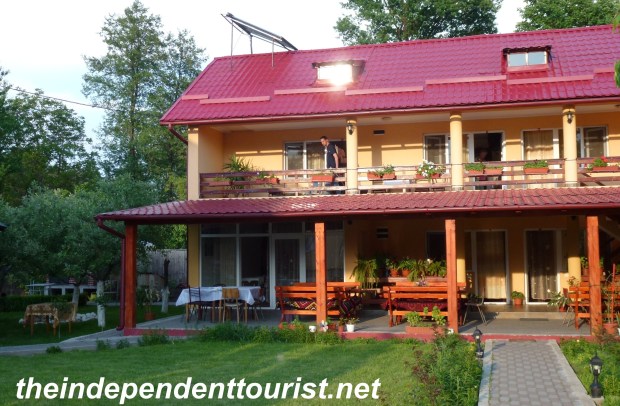
B&B’s. We found our accommodations through Booking.com. There are not many large hotels, especially in the smaller towns. Our rooms were clean, many were recently remodeled, with good showers and decent beds. Every place we stayed had free wireless internet, a very handy feature.

Our B&B in Horezu, Romania

Inside our B&B room in Brasov.

Food. Another thing we’d correct about our guidebooks (Lonely Planet and Rough Guide) is regarding the food. The books did not rave about most of the food dishes, and yet we thought the local cuisine was very good; many high quality meats served with savory sauces, good salads and soups. Good pizzas and pastas are also available. As mentioned above, you can eat a very well for about $10 per person per meal.

One of our many excellent meals in Romania. (those are bread bowls with tasty soup inside!)

Ireland Day 8 (of 8): Glendalough and Dublin

On our last day in Ireland we visited the scenic Glendalough monastery ruins and Dublin.

Glendalough

Glendalough is 58 kilometers south of Dublin. It is an early Christian monastic site found by St. Kevin in the 6th century. It sits in a beautiful valley with two lakes. The historic ruins include a round tower, stone churches and decorated crosses; most of the buildings date from the 8th to the 12th centuries. Although attacked by the Vikings and English over the centuries, this site survived until the Dissolution of the Monasteries by King Henry VIII in 1539. Since our time was limited, we visited only the lower ruins (near the Lower Lake) and did not make it to the Upper Lake and few remaining ruins there. We enjoyed the beautiful natural setting as well as the historic aspects. Glendalough is part of the Heritage Ireland system. For a map of these locations click here.

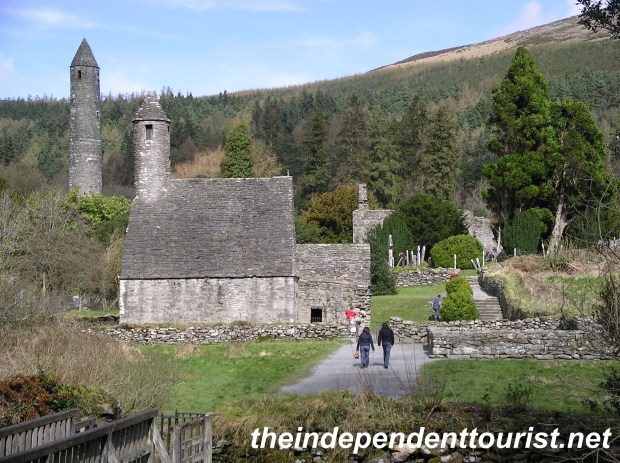
St. Kevin’s Kitchen (11th century) and round tower at Glendalough.

The Cathedral and graveyard at Glendalough.

Dublin

We then drove north to Dublin, and tried to make the most of our short time there (we had an unplanned overnight stop in Graiguenamanagh due to a rental car breakdown). Dublin is located on the east coast of Ireland (almost directly west of northern Wales), and the River Liffey goes through the heart of town west to east, not unlike the River Thames in London. I would not call Dublin a beautiful city like Paris, but it definitely has its own character, and interesting neighborhoods. Many of the historical sights are on the south side of the river.

The River LIffey in Dublin, looking east.

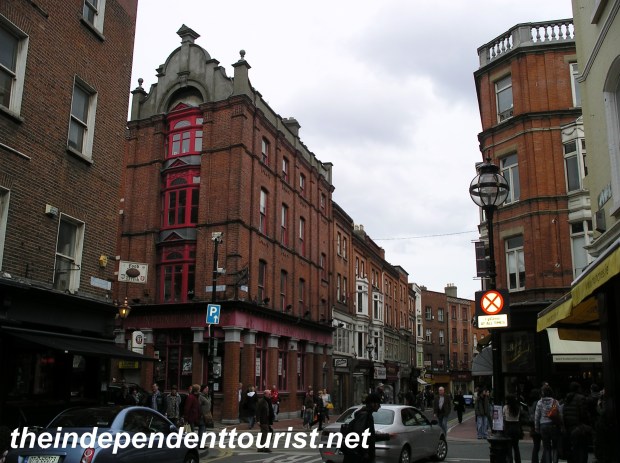
Street scene in Dublin.

Our main interest was seeing the Book of Kells, housed at Trinity College (on the south side of the River Liffey). Trinity College was founded by Queen Elizabeth I in 1592. The Book of Kells is a richly decorated artistic masterpiece. The manuscript (680 pages) dates from about 806 AD and contains the Four Gospels of the New Testament. It is considered the most important piece of art from the Dark Ages. The Book is kept in a small room in the Treasury of the Library at the University under special glass and lighting to preserve this marvelous work. Next to the Treasury is the Old Library—a 210 ft. long room built in 1732 which contains 200,000 texts on two levels. Unfortunately I could not get pictures of either of these gems.

St. Patrick’s Cathedral, Dublin. “The people’s church” dates from 1270. The Protestant Church of Ireland’s national cathedral.

This cathedral of the Church of Ireland dates from 1186, but was heavily restored in the 1870’s. Lots of interesting historical features, including a huge crypt.

We also walked around the town, visiting Temple Bar (famous pubs and restaurant area), Christ Church Cathedral and St. Patrick’s Cathedral (shown above).

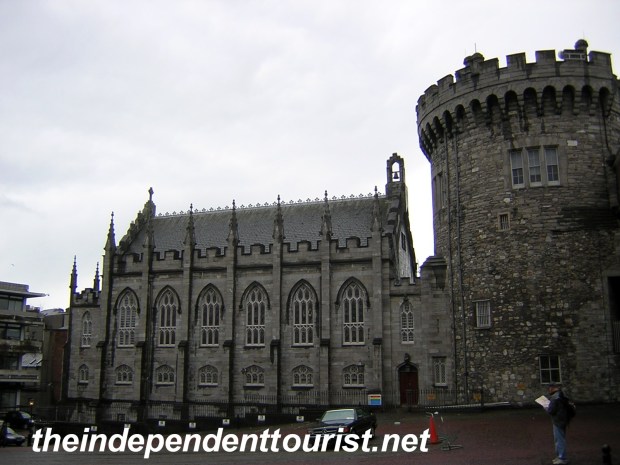
Dublin Castle, with the Record Tower (on right – built in 1226) and Chapel Royal (center – built in 1814). The Record Tower is all that remains of the original castle.

Reference:  DK Eyewitness Travel Ireland 2006

Ireland Day 7: Kilkenny Castle, Jerpoint Abbey and Graiguenamanagh

One of the best towns in Ireland for tourists is Kilkenny. It is considered the loveliest inland city, and is located in the southeast part of the country (for a map showing the location click here). It is a well-kept town with a variety of painted buildings and narrow alleyways. The town has two main historical treasures, Kilkenny Castle at one end of town and St. Canice’s Cathedral at the other.

The 18th century Tholsel (city hall) with a clock tower is the main landmark on the High Street in Kilkenny. It is still used by city councilors today.

Kilkenny Castle sits above the River Nore, and dates from the 12thcentury although it’s been heavily remodeled and restored over the centuries and now is decorated in the finest fashion of the Victorian era (1830’s). It has some great paintings, furnishings and wooden ceilings. It was owned and occupied by the Butler family until the 1930’s (a very influential family dating back to the 1300’s who also owned Cahir Castle, discussed in another post, click here). Access to Kilkenny castle is by guided tour only, which lasts about 1 hour. No video or cameras are allowed inside.

Kilkenny Castle from the north side, which faces the town.

View of Kilkenny Castle from the south side.

At the other end of High Street is St. Canice’s Cathedral. The cathedral dates from the 13thcentury and sits on a hill top above the town. I was impressed with the views of Kilkenny from its hundred-foot high round tower. The cathedral is intact and is considered one of Ireland’s key medieval treasures.

A view of St. Canice’s Cathedral, with the round tower which can be climbed.

A view of Kilkenny from the tower at St. Canice’s Cathedral. There are many old churches in this great city.

We also visited Black Abbey in Kilkenny. A Domincan abbey founded in 1225, and a working monastery today.

About 30 kilometers south of Kilkenny are the medieval ruins of Jerpoint Abbey, a large Cistercian abbey founded in the late 12th century that for some reason is not mentioned in Rick Steves’ Ireland book. The tower and cloister date from the 15thcentury. The sculptured cloister arcade is unusual and quite interesting.

A view of the tower of Jerpoint Abbey from the cloister.

The sculptured cloister at Jerpoint Abbey.

Both Kilkenny Castle and Jerpoint Abbey are part of the Heritage Ireland system, which means you buy a membership card once and don’t have to pay individual entry fees at each site which is part of the system.

The town of Graiguenamanagh was NOT on our itinerary, but a rental car breakdown (my first ever) in this town caused us to spend the night here. We actually enjoyed our overnight stop in this little town on the Barrow River. This was a chance to experience a quiet little Irish village, just a little ways east of Jerpoint Abbey.

The town of Graiguenamanagh on the Barrow River.

Ardennes (Belgium) American Cemetery – In Honor of our World War II Heroes

Not far from Liege, Belgium in the village of Neuville-en-Condrozis is the Ardennes American Cemetery, which is located on land liberated by Third Armored Division on September 7, 1944. The bodies of 5,328 Americans who died in Europe in WWII rest here, some from the Battle of Ardennes (also known as the “Battle of the Bulge”). Among the grave markers are 792 unknown soldiers, with the statement “Known Only to God” on each. The names of 462 Americans whose remains were not found are included on stone plaques around the base of the monument at the entrance to the cemetery.

The neat rows of over 5,000 grave markets in the Ardennes American Cemetery

I’ve read a little about the Battle of the Bulge, and know that it was a terribly bitter battle during the extremely cold winter of 1944. Many of the U.S. Army personnel in this battle were new recruits, who had to learn quickly how to fight and survive. This was Hitler’s last major offensive before his war machine began to collapse. Had Hitler succeeded, this world would be a very different place, I’m sure.

The monument at the Cemetery. It overlooks the actual graves, and around the base are the names of over 400 soldiers whose bodies were never recovered (you can also go inside the monument--see below).

Inside the Ardennes Cemetery monument. There are maps showing the Allied invasions, major battles, along with a short history. There is a small chapel in the monument also.

I had the privilege of visiting this cemetery recently during a business trip. It was sobering to view the thousands of grave markers of those who gave their lives in this great conflict. My own father served in the Navy in the Pacific Theater during WWII.  Tom Brokaw dubbed this generation “The Greatest Generation” and I agree with his observation. I honor those who have served and currently serve our country in the Armed Forces.

The cemetery was constructed by American Battle Monuments Commission, and is supervised by an U.S. superintendent. The cemetery is open at 9 am every day of the year.

Ireland Day 6: Waterford, Rock of Cashel and Cahir Castle

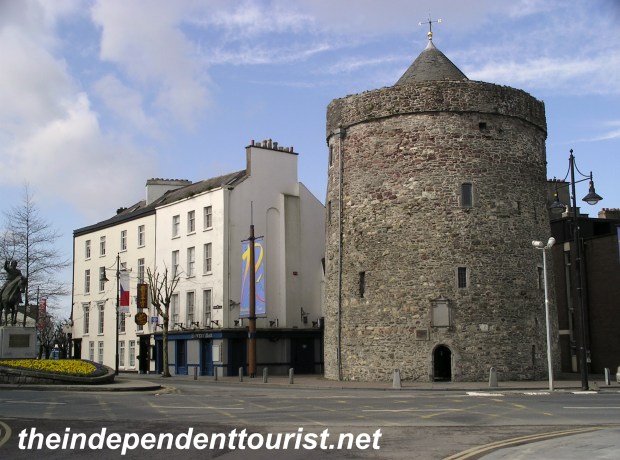
From Kinsale we drove to Waterford. Waterford is the oldest town in Ireland, located on the River Suir, near the southern coast. Our main reason for visiting Waterford was to go to the world famous crystal factory located on the edge of the town. The factory provides a one-hour tour of the crystal-making process and has a large store. Of course we had to buy something; Robyn bought a crystal nativity set. We also visited Reginald’s Tower, the oldest surviving civic urban building in Ireland.  Reginald’s Tower was part of the old town’s defenses, built in the late 1100’s. It was used as a mint, prison and military store, and now houses an exhibition on the history of the area. For map of sites visited in Ireland, click here.

Reginald's Tower in Waterford. Dates from the 1100's.

From Waterford, we drove northwest 80 kilometers to the medieval site of the Rock of Cashel, standing over the town of Cashel. It was extremely windy and rainy that day (in mid-March), with the rain coming at us horizontally on the Rock, but we enjoyed our visit nonetheless.  The Rock contains a collection of buildings from the 12th, 13th and 15th centuries.  It was the seat of the Kings of Munster who ruled much of southern Ireland from the 5th century to the 12thcentury. St. Patrick baptized King Aengus here in 450 AD.

Cormac's Chapel from the south side. The first Romanesque church in Ireland, consecrated in 1134. There are a few faint frescoes inside.

The site was turned over to the Catholic Church in the 1100’s as a strategic move to favor the Church and keep the site out of the hands of rival clans. The buildings and ruins include a Romanesque chapel (Cormac’s Chapel), a Gothic cathedral, archbishop’s house (or castle), round tower (the oldest stone structure on the site, 92 ft high), graveyard and other stone monuments. The dormitory building (Hall of the Vicar’s Choral) contains a restored medieval wood roof, visitor’s center and museum.  If you like medieval history and buildings, this is one of the greatest sites in Europe.

The imposing Rock of Cashel as viewed from the north.

A view of the graveyard and round tower on Rock of Cashel.

A view of the round tower and north transept of the cathedral on Rock of Cashel.

From Cashel, we drove to Cahir, to visit Cahir Castle, located 17 kilometers south of Cashel. Cahir is one of Ireland’s largest and best preserved castles, and yet seems to be somewhat unknown to tourists. It is located on a rock island in the River Suir, in the heart of the town of Cahir.  It was built in the 13th century, and expanded in the 15th and 16thcenturies. It was granted to the Butler family by the English crown in 1375, and stayed in the ownership of the family until 1964. There are lots of rooms to explore in this castle.

Cahir Castle on the River Suir.

View of Cahir Castle.

Reginald’s Tower, the Rock of Cashel and Cahir Castle are all part of the Heritage Ireland system.

References: Rick Steve’s Ireland 2007 and DK Eyewitness Travel, Ireland 2006.

Ireland Day 5: Blarney Castle, Kinsale and Charles Fort

Blarney Castle is near Cork, in southwest Ireland.

From Kemare and the Ring of Kerry, we headed southeast to Blarney Castle (for a map of Ireland see my post “Eight Day Tour of Ireland”). This castle is famous for the “Blarney Stone” which is supposed to endow the “gift of gab” on anyone who kisses it. The stone is at the top of the keep (up 127 steps), and one has to lean backwards over the edge of the wall (see picture below) to kiss it. We didn’t bother to kiss the stone, but everyone else seemed to be doing it! The castle was built in 1446. Underneath the castle there are some tunnels that were interesting to explore, perhaps old secret passages. This castle is not part of the Heritage Ireland system, and so a separate fee is required. There are lovely gardens and well-manicured grounds around the castle. The little village of Blarney is also well-kept.

The lovely grounds of Blarney Castle.

The Blarney Stone is located above the top window, in the parapet wall.

From Blarney, we headed to the south coast of Ireland (via Cork) to the town of Kinsale, known as one of the prettiest towns in Ireland. Kinsale was an important shipping port and naval base, from Middle Ages and through the 1800’s. It was known for making top quality wooden (oak) casks (there used to be plentiful forests of oak in this area), and the wine trade was a major driver of the economy. Desmond Castle is a fortified Norman customs house, and was used to house prisoners in various wars and also American Revolutionary War “rebels” captured at sea—they were chained to the outside of the building as a warning to local Irish who also might want to rebel against British rule. There are some interesting exhibits in the Castle about the wine trade and the history of the area. It is part of the Heritage Ireland system.

A view of Kinsale harbor.

Desmond Castle in Kinsale.It once housed 600 prisoners during the Napoleonic wars (where did they all fit?).

Just two miles from Kinsale is Charles Fort, a massive star-shaped fortress built in the 1670’s which was modified over the next couple of centuries. The fort was meant to protect Kinsale from naval attack, but was vulnerable to land attack, which happened in 1690. The British occupied this fort until Irish independence was achieved in 1922. This fort was really a mini-city, and feels like a “ghost town” with many buildings still standing. The fort is also part of the Heritage Ireland system.

A view of the coast from the massive walls of Charles Fort.

A view of the barracks and other buildings at Charles Fort.

Another view of Charles Fort and Kinsale harbor.

Close to Kinsale is the town of Cobh, which we did not have time to visit. The Titanic made a last stop at Cobh before heading across the Atlantic on its fateful voyage to America.

References: Rick Steves’ Ireland 2007 and DK Eyewitness Travel, Ireland, 2006.